


How many four-character idioms that include numbers—like “killing two birds with one stone” (isshoku nichō) or “writhe in agony” (shichiten battō)—do you know? Four-character idioms are studied extensively even in elementary school and often appear on Japanese language tests and Kanji proficiency exams.
But are you understanding their meanings correctly? In this article, we introduce number-containing four-character idioms that are perfect for deepening knowledge and that we’d like elementary school children to learn.
Even if they seem difficult, many of them are expressions you can use in familiar situations, so you’ll surely be able to enjoy learning them!
- Interesting four-character idioms for elementary schoolers! Words you'll want to use once you understand their meanings
- Learn the meanings too! Cool four-character idioms that elementary school students will want to remember
- Four-character idioms with numbers: clear explanations of meanings and usage
- [For Elementary Students] A Collection of Beautiful Four-Character Idioms to Know
- A four-character idiom quiz that elementary schoolers will love! Questions become fun once you understand the meanings
- Easy-to-remember, positive four-character idioms for elementary school kids! Words that brighten the heart
- [Elementary School Students] Perfect for Kakizome! A Collection of Four-Character Idiom Ideas
- Popular even among elementary school students! Stylish and easy-to-remember four-character idioms
- [For Elementary School Students] Four-character idioms you can use in sports! Words that are helpful for cheering and goal setting
- Recommended for elementary school class goals! A collection of impactful ideas using four-character idioms
- Perfect for elementary school slogans! A collection of four-character idiom ideas you'll want to use
- For Elementary School Students: Four-Character Idioms You Can Use for New Year’s Resolutions — How to Set Cool Goals!
- Easy for elementary school students to remember! A four-character idiom that expresses the feeling of trying your best
Boost your vocabulary with four-character idioms that include numbers! A collection of four-character idioms for elementary school students to learn (1–10)
to writhe in agony
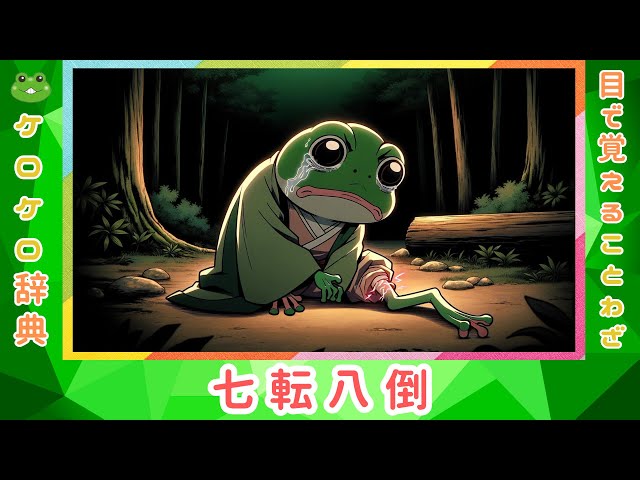
It’s pronounced “shichiten-battō.” Because it uses the characters for “seven” and “eight,” it’s easy to confuse it with “shichiten-hakki” (seven falls, eight rises), but the meanings are completely different.
“Shichiten-battō” means “to writhe in agony due to excruciating pain; extreme turmoil or confusion.” Many of us have probably faced walls and been driven into difficult situations at school, work, or in our personal lives.
Just imagining pain so severe that you roll on the ground is enough to make your whole body shudder.
cutting straight through with a single stroke
@kotobaano cutting straight through with a single strokeTranslationProverbtoday
♫ Original Song – Semihotaru – Kotoba-no | Word Explanation
Many of you may have heard this four-character idiom that includes the kanji for “one.” It means “to make quick decisions and take bold action.” There are situations—such as at work—where you need to render a clear, swift judgment rather than proceeding ambiguously.
When a problem arises that demands speedy decision-making, it might be best to move forward with ittō-ryōdan—decisively cutting through.
It could also serve as a goal for those who tend to be indecisive.
one day feels like a thousand autumns
https://www.tiktok.com/@mitsu_is/video/7532441826570079504The phrase ichijitsu-senshū expresses a feeling of such intense longing that a single day feels as long as a thousand years.
It’s read “ichijitsu-senshū.” Its origin is the Chinese Book of Songs (Shijing), in the poem Wang Feng: Cai Ge, which uses the expression “one day, three autumns.” Because it comes from poetry about romantic yearning, it’s often used to describe feelings for someone you love.
Have you ever felt ichijitsu-senshū yourself? It’s one of those four-character idioms that’s easy to use in daily life, so even outside of romance, try using it whenever you’re eagerly awaiting something.

Once-in-a-lifetime encounter
@kotobaano Once-in-a-lifetime encounter#shortsTranslationProverbTranslation
♬ Original Song – Kotobāno – Kotobāno | Word Explanation
The expression “ichigo ichie” refers to opportunities and encounters that come only once in a lifetime.
It’s often misread as “ikki ikkai,” but the correct reading is “ichigo ichie.” Life happens only once, and the same circumstances don’t necessarily come around again.
That’s why we treat every opportunity and meeting as a one-time moment and cherish it.
It’s a four-character idiom that’s easy to use in everyday conversation, so you may have heard it before.
If you didn’t know it, take this chance to remember it.
killing two birds with one stone
@yojijyukugo.seizan translationworking adultTranslationstudy
♬ Original Song – Sacred Mountain – Four-character idiom / Sacred Mountain
We express getting two benefits from a single action as “killing two birds with one stone.” As the characters suggest, “one stone” refers to a single stone, and “two birds” to two birds.
It’s said to be the Japanese rendering of a foreign proverb: you throw a stone aiming at one bird, and both birds fall.
This four-character idiom is widely used in Japan.
It’s often used to describe good fortune or when you come up with an idea or solution that gives you extra advantages.
There are also coined variations like “killing three birds with one stone” or “four birds with one stone” for cases where you gain even more benefits.
Three in the morning, four in the evening
@kotobaano Three in the morning, four in the evening#shortsTranslationProverbTranslation
♪ Original Song – Kotobaano / Kotobaano – Kotobaano | Word Explanation
We call it “chōsan boshi” (literally, “three in the morning, four in the evening”) when people fail to notice that the outcome is the same and get fixated on immediate gain, allowing themselves to be deceived.
This four-character idiom comes from a story in China’s Song dynasty about a man known as the Monkey Keeper (Jūgō) and his monkeys.
The keeper loved his monkeys and kept them as pets, but when he became poor he decided to cut back on their food.
First he said, “I’ll give you three acorns in the morning and four in the evening.” The monkeys got angry, saying it wasn’t enough.
So he said, “Then I’ll give you four in the morning and three in the evening.” In the end they were only getting seven acorns either way, but the monkeys focused only on the immediate benefit of getting four in the morning and were delighted.
nine times out of ten
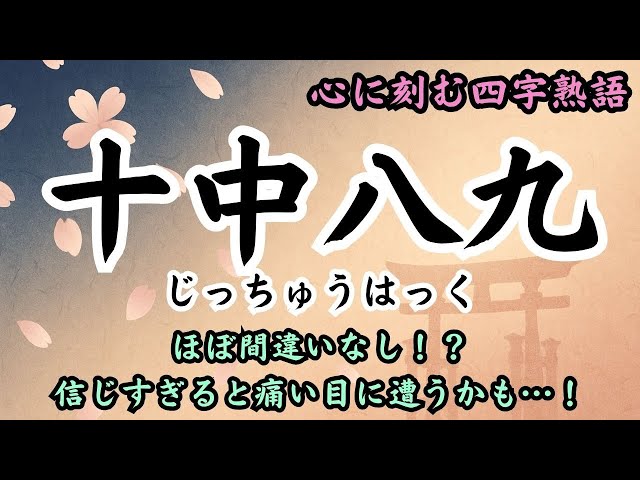
The expression “十中八九” literally means “eight or nine out of ten,” and it’s used with the sense of “almost certain” or “it will probably turn out that way.” For example: “Ten to one, this plan will succeed,” or “I think there’s a very high chance he’ll pass the exam.” It’s a handy phrase when you want to praise someone’s effort or tell them they’re very close to their goal, even if you can’t say it’s absolutely certain.
That said, since it only means an eighty to ninety percent likelihood, it’s best not to get complacent just because you hear it!