

Boost your vocabulary with four-character idioms that include numbers! A collection of four-character idioms for elementary school students to learn.

How many four-character idioms that include numbers—like “killing two birds with one stone” (isshoku nichō) or “writhe in agony” (shichiten battō)—do you know? Four-character idioms are studied extensively even in elementary school and often appear on Japanese language tests and Kanji proficiency exams.
But are you understanding their meanings correctly? In this article, we introduce number-containing four-character idioms that are perfect for deepening knowledge and that we’d like elementary school children to learn.
Even if they seem difficult, many of them are expressions you can use in familiar situations, so you’ll surely be able to enjoy learning them!
- Interesting four-character idioms for elementary schoolers! Words you'll want to use once you understand their meanings
- Learn the meanings too! Cool four-character idioms that elementary school students will want to remember
- Four-character idioms with numbers: clear explanations of meanings and usage
- [For Elementary Students] A Collection of Beautiful Four-Character Idioms to Know
- A four-character idiom quiz that elementary schoolers will love! Questions become fun once you understand the meanings
- Easy-to-remember, positive four-character idioms for elementary school kids! Words that brighten the heart
- [Elementary School Students] Perfect for Kakizome! A Collection of Four-Character Idiom Ideas
- Popular even among elementary school students! Stylish and easy-to-remember four-character idioms
- [For Elementary School Students] Four-character idioms you can use in sports! Words that are helpful for cheering and goal setting
- Recommended for elementary school class goals! A collection of impactful ideas using four-character idioms
- Perfect for elementary school slogans! A collection of four-character idiom ideas you'll want to use
- For Elementary School Students: Four-Character Idioms You Can Use for New Year’s Resolutions — How to Set Cool Goals!
- Easy for elementary school students to remember! A four-character idiom that expresses the feeling of trying your best
Boost your vocabulary with four-character idioms that include numbers! A collection of four-character idioms for elementary school students to learn (11–20)
around the clock
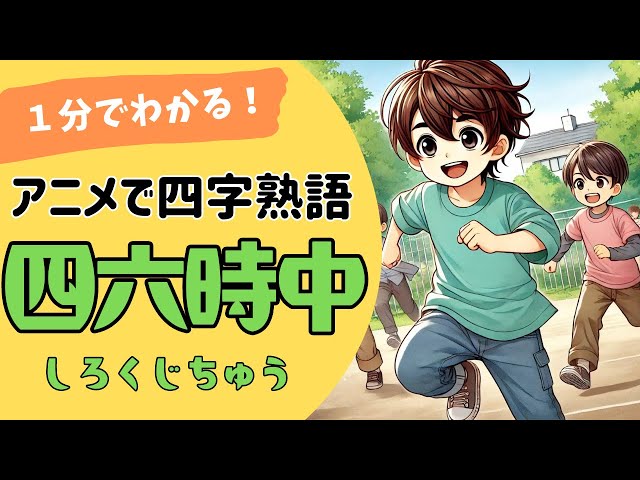
Even in everyday life, it’s used quite often! This four-character idiom, which contains the kanji numerals for “four” and “six,” is used as an expression that encompasses all the hours in a day.
Since 4×6=24, it indicates the 24 hours in a day.
It can be used to describe scenes of working continuously without rest or constantly being deep in thought.
There are likely many situations in daily life where you can make use of it.
It might also be a good way to feel closer to four-character idioms.
One day, one lifetime

Ichinichi isshō (One day, one lifetime) means treating each day with such care and intention that it becomes as meaningful as a whole life.
It encourages valuing your daily school life, playtime, studying, and lessons.
By keeping this in mind when you wake up in the morning or take on something new, you cultivate the drive to work positively toward your goals.
Including it in your New Year’s resolutions helps you adopt a mindset that makes each day fulfilling rather than wasted—an actionable and cool four-character idiom.

One good deed a day
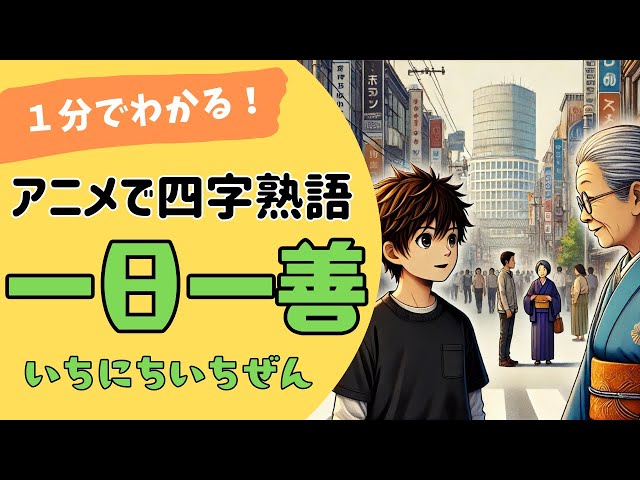
This four-character idiom means making it a habit to do just one good deed a day.
Even though it’s only one per day, it might be surprisingly difficult.
But it can be something small: helping your family, being kind to a friend, helping your grandpa or grandma.
Such small “good deeds” can make the people around you happy and, in the end, bring happiness to yourself as well.
In the new year, how about starting by writing this idiom in your first calligraphy of the year and trying to do one “good deed” every day?

unity; standing together as one
Recommended for times when everyone wants to join forces and work hard toward the same goal.
For example, during a sports day relay, passing the baton while cheering each other on as a team is also a form of united teamwork.
The same goes for cleaning the classroom together as a class to make it neat.
It’s also important to have this spirit of unity when creating a play for a school festival or coordinating an ensemble for a recital.
This four-character idiom expresses a very uplifting and important mindset: by combining everyone’s strengths, you can succeed at things that one person alone could not accomplish.

A single smile is worth a thousand gold pieces.
Isshou Senkin is a beautiful four-character idiom meaning “a single smile or laugh is worth a thousand pieces of gold.” It teaches us that a heartfelt smile makes people happier than expensive things or money.
A smile that cheers up a friend, or a small laugh that soothes a family, has the power to brighten the atmosphere around us.
Valuing smiles in everyday life also helps us build good relationships with many people.
It’s easy to remember and conveys the importance of feelings.
It’s one of the four-character idioms I especially recommend for families with elementary school children.

A hundred flowers in full bloom
@hiroaki946 Hyakka Ryouran Shorts Short videos Mini videos Set phrases Four-character idioms Proverbs Japanese The meaning of words Wordplay Learning Education Trivia Japanese culture Pastime Studying Knowledge Trivia Everyday life The power of words VOICEVOX: Shikoku Metan Riotously blooming four-character idiom “Hyakka Ryouran” Do you know what it means? First, an example sentence: With the arrival of spring, the city park was filled with flowers of every color, as if in a state of “hyakka ryouran.” People who saw this beautiful scene were moved by the beauty and vitality of nature and stopped to gaze for a while. In particular, children ran around, their smiles brimming as if they were playing in this paradise of colors. Meaning: “Hyakka Ryouran” literally refers to the scene of countless flowers blooming all at once in riotous profusion, and by extension, it describes a situation where many outstanding people or talents emerge simultaneously. For example, when talents in various fields compete and produce remarkable achievements one after another, it is praised as “hyakka ryouran.” That is all.
Original song – hiroaki946 – hiroaki946
Hyakka ryōran is an expression that describes a profusion of colorful flowers blooming all at once.
It’s used not only for actual flowers, but also to depict many talented or distinctive people flourishing one after another.
When you picture a scene filled with blossoms, it feels dazzling and exciting, doesn’t it? From this phrase, we can say that it’s wonderful when everyone shines by bringing out their own strengths.
People’s talents differ, but when those differences come together, they create great power and a joyful atmosphere.
It can also be a chance to notice the good qualities of your classmates.
Boost Your Vocabulary with Four-Character Idioms That Include Numbers! A Collection of Four-Character Idioms for Elementary School Students to Learn (21–30)
The return of the sun; the turning of the tide toward good fortune (often used to mean a revival or a new beginning after adversity).
@hjc.aki Ichi-yō rai-fuku: Winter will surely end and spring will come; tough times will surely end and happiness will arrive.The return of the sun (symbolizing the turning of misfortune to good fortune)translationCalligrapherCalligraphyTranslation
♬ Soranji – Mrs. GREEN APPLE
Like the end of a cold winter and the gentle return of spring, the four-character idiom “Ichiyō Raifuku” means that good fortune comes after a spell of misfortune.
On days when you fail at studying or sports, or when something sad happens, you may worry that things will stay this way forever.
Even so, time moves forward little by little, and a new light begins to shine into your heart.
Even if school life doesn’t go smoothly, by continuing to move forward—even if only in small steps—the situation will surely change.
It is a four-character idiom that gives you the courage to keep hope in your heart.
