

Boost your vocabulary with four-character idioms that include numbers! A collection of four-character idioms for elementary school students to learn.

How many four-character idioms that include numbers—like “killing two birds with one stone” (isshoku nichō) or “writhe in agony” (shichiten battō)—do you know? Four-character idioms are studied extensively even in elementary school and often appear on Japanese language tests and Kanji proficiency exams.
But are you understanding their meanings correctly? In this article, we introduce number-containing four-character idioms that are perfect for deepening knowledge and that we’d like elementary school children to learn.
Even if they seem difficult, many of them are expressions you can use in familiar situations, so you’ll surely be able to enjoy learning them!
- Interesting four-character idioms for elementary schoolers! Words you'll want to use once you understand their meanings
- Learn the meanings too! Cool four-character idioms that elementary school students will want to remember
- Four-character idioms with numbers: clear explanations of meanings and usage
- [For Elementary Students] A Collection of Beautiful Four-Character Idioms to Know
- A four-character idiom quiz that elementary schoolers will love! Questions become fun once you understand the meanings
- Easy-to-remember, positive four-character idioms for elementary school kids! Words that brighten the heart
- [Elementary School Students] Perfect for Kakizome! A Collection of Four-Character Idiom Ideas
- Popular even among elementary school students! Stylish and easy-to-remember four-character idioms
- [For Elementary School Students] Four-character idioms you can use in sports! Words that are helpful for cheering and goal setting
- Recommended for elementary school class goals! A collection of impactful ideas using four-character idioms
- Perfect for elementary school slogans! A collection of four-character idiom ideas you'll want to use
- For Elementary School Students: Four-Character Idioms You Can Use for New Year’s Resolutions — How to Set Cool Goals!
- Easy for elementary school students to remember! A four-character idiom that expresses the feeling of trying your best
Boost your vocabulary with four-character idioms that include numbers! A collection of four-character idioms for elementary school students to learn (1–10)
Fall down seven times, get up eight.
@az0202za #Fall down seven times, get up eight #Yojijukugo (four-character idiom) #Indomitable spirit to keep challenging #Nanakorobi yaoki (fall seven, rise eight)
♬ Original Song – 0202civo – az0202za
A four-character idiom that makes you feel like you can overcome any hardship! It contains the kanji numerals for “seven” and “eight.” It seems to mean “even when you run into failures or difficult situations again and again, you get back up each time and keep trying without giving up.” I think you’ve heard the expression with the same meaning, “nanakorobi yaoki” (literally, “fall down seven times, get up eight”).
It’s a saying that tells us that while failure can be scary when you try something for the first time, having the determination to persevere without giving up is essential for achieving your goals.
three cold days and four warm days
@kotobaano three cold days and four warm days#shortsTranslationProverbTranslation
♬ Original Song – Kotobāno – Kotobāno | Word Explanation
Sankan-shion is a four-character idiom that describes a climatic pattern in which about three cold days are followed by about four warm days.
It is a distinctive phenomenon seen in places like China, influenced by the Siberian High, and refers to climate fluctuations on a seven-day cycle.
Because this pattern was also occasionally observed in Japan during winter, the idiom was traditionally used to describe winter weather.
However, since Japan’s climate is also affected by the Pacific High, in recent years the term has come to be used to refer to the cyclical temperature changes seen in early spring.

To each their own.
@kotobaano To each their own.#shortsTranslationProverbTranslation
♬ Original Song – Kotobāno – Kotobāno | Word Explanation
A mindset needed for a positive, diversity-embracing society! It uses the kanji numeral for “ten.” It’s said to mean that people differ in how they think, feel, and what they like.
Each person has a different personality, appearance, preferences, and ideas, right? That’s normal—and it’s precisely because we’re all different that our individuality shines.
When you meet someone with a different opinion, rather than feeling anger or distrust, it’s best if we can accept that everyone thinks differently and work to reconcile our views.
Boost your vocabulary with four-character idioms that include numbers! A collection of four-character idioms for elementary school students to learn (11–20)
next to nothing; dirt cheap
@yojijyukugo.seizan translationworking adultTranslationstudy
Original Song – Four-character Idioms/Holy Mountain – Four-character Idioms/Holy Mountain
This is a four-character idiom that means the price is extremely cheap even when the quantity is large, or simply an outrageously low price.
The words include the Chinese numerals “two” and “three.” “Sanmon” refers to the smallest unit of currency in the Edo period and is also used to mean something of no value.
Its origin is said to come from the price of straw sandals woven from straw, which cost three mon for two pairs.
Since it doesn’t carry a positive nuance, be careful not to use it in the wrong situation or with the wrong person.
either-or choice
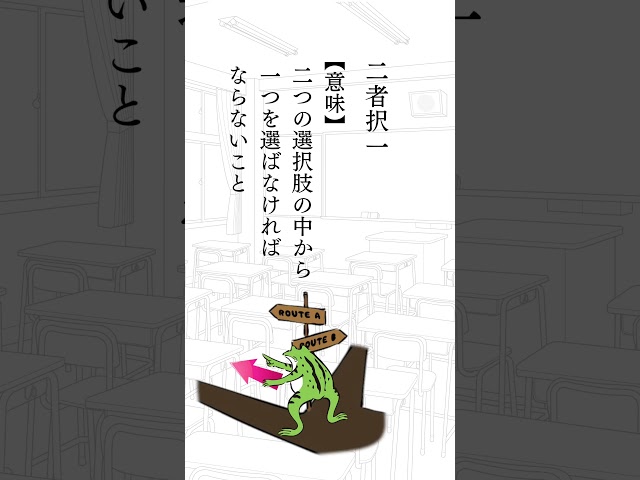
This is a four-character idiom that means choosing one of two options.
There are various theories about its origin, but it is said to be a very old term that also appears in myths from places like Japan and China.
In everyday life, there are surely situations where we have to choose between two alternatives.
If you try describing such moments using this idiom as you go about your life, your learning may deepen.
I don’t think either choice is wrong, so it’s best to pick the one that resonates with you.
people-pleaser
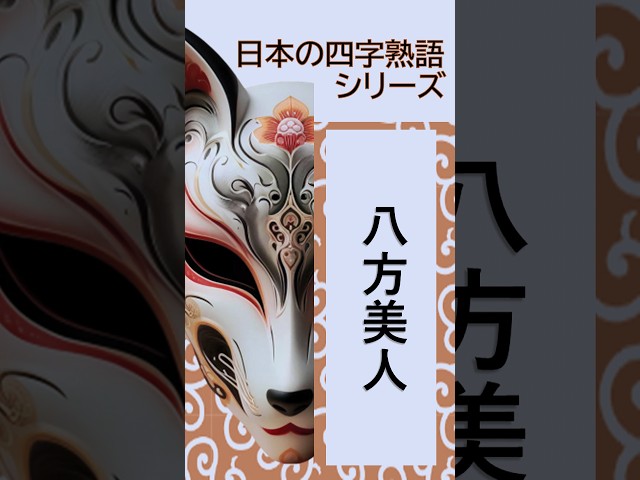
This is a four-character idiom that refers to someone who acts friendly toward everyone so as not to be disliked by anyone.
“Happō” means “in all directions,” and since it also includes the word “bijin” (beauty), you might think it has a positive meaning.
In reality, however, it’s often used with a slightly critical nuance to mean “a person who puts on a good face for anyone.” Trying to be liked by everyone can lead to saying inconsistent things and damaging relationships, so it’s something to watch out for.
various; diverse; a wide variety (literally: “a thousand differences, ten thousand distinctions”)
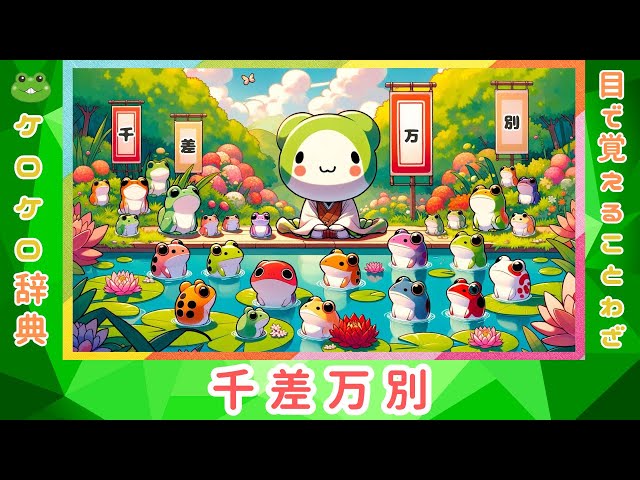
Many people read it as “sensabanbetsu,” but it seems some read it as “sensamanbetsu.” This four-character idiom means that there are a great many kinds of differences, or describes such a state, and its nuance is similar to “ten people, ten colors” (everyone is different).
However, just as the character for “person” is included in “juunin toiro” (ten people, ten colors), that phrase is used when referring to people.
“Sensabanbetsu,” on the other hand, can also be used to talk about differences in things and events.
Even when meanings are similar, the situations in which you use them differ—one of the interesting aspects of four-character idioms.