

Calculation problems that train the brain for seniors

There are many types of brain training, such as spot-the-difference and puzzles, but in this article we’ll introduce “calculation problems” for seniors.
We’ve gathered enjoyable brain-training exercises like change calculations, fill-in-the-blank equations, and simple addition.
Brain training is also known to help prevent dementia, so if you’re interested, give it a try.
It might take time to answer at first, but as you keep at it, you’ll get used to it—so take it easy and progress little by little.
- [For Seniors] Recommended Brain Training! A Fun Collection of Math Quizzes
- [For Dementia Prevention!] Brain-Training Math Quiz for Seniors
- [For Seniors] Brain Training with a Whiteboard! Fill-in-the-Blank Exercises & Quizzes
- Spot the Difference for Seniors: A Fun Brain-Training Game
- [For Seniors] Find daily brain training. Today’s recommended brain workout.
- A math quiz for adults. Can you solve it?
- Recommended for seniors’ brain training! Kanji quiz workbook of fish names
- Hand games that liven things up for seniors—also great brain training
- [For Seniors] Fun Brain Training! A Collection of Tricky Quizzes You’ll Definitely Get Stumped By
- [For Seniors] Recommended for Brain Training! Ultra-Difficult Quizzes and Riddles
- [Riddle Quiz for Seniors] Brain Training Perfect for Mental Exercise
- Fun Brain Training! Memory Games for Seniors
- [For Seniors] January Trivia Quiz & Fun Facts. Brain training with quizzes about New Year and winter.
[For Seniors] Brain-Training Math Problems (1–10)
Addition problems

How about incorporating addition exercises into your brain training? Start with very simple addition using small numbers, and gradually increase the size of the numbers to raise the difficulty step by step.
It can also be enjoyable and motivating to keep doing only very easy problems, since you can solve them smoothly.
If the difficulty increases and you find it a bit hard, try solving them slowly without worrying about the time.
There are plenty of calculation exercises for brain training on video sites as well, so give them a try.

Katakana Calculation

If you present arithmetic problems in katakana, even simple questions become a bit harder—and more fun! All you do is write the problems in katakana, but “3+5=” becomes “サンタスゴハ?” and “6×2=” becomes “ロクカケルニハ?”, which somehow makes them amusing, right? Of course, it’s harder than presenting them with regular numerals, and it might take longer to get the answer, but thinking it through is brain training—let’s enjoy ourselves while figuring out the answers!
Hiragana Calculation

How about trying a brain-training exercise that makes simple addition problems a bit harder by turning them into hiragana? Hiragana calculation means, for example, if the problem is “2+5+1,” you present it in hiragana as “にたすごたすいちは?” Turning even easy problems into this form makes the difficulty jump.
For brain training, it’s best to solve them mentally, but if that’s too hard at first, write the numbers down on paper until you get used to it and work out the sum that way.
[For Seniors] Calculation Problems for Brain Training (11–20)
5-digit addition

Even if you like calculation puzzles, this one might be a bit tough.
Adding five-digit numbers—just looking at it might make number-averse people feel dizzy (lol).
It would be great if you could solve it smoothly with mental math… but that’s pretty hard, right? It’s totally fine to pause the video and think it through carefully, or write it out on paper.
Thinking stimulates the brain, so taking your time and thinking things through is important.
Once you figure out the answer, it’s the kind of problem that leaves you feeling refreshed!
Division problem

Many people probably feel uneasy about division.
Why not try overcoming that by tackling a video quiz packed with one division problem after another? Compared to addition and such, set aside plenty of time and give it a real try.
Even when you’re thinking things through slowly, your brain is working, so it’s not wasted time—it’s brain training.
Once you can solve division problems quickly, you’ll likely start enjoying them.
Solving any problem is refreshing and gives you that satisfying feeling, doesn’t it?
Subtraction problem
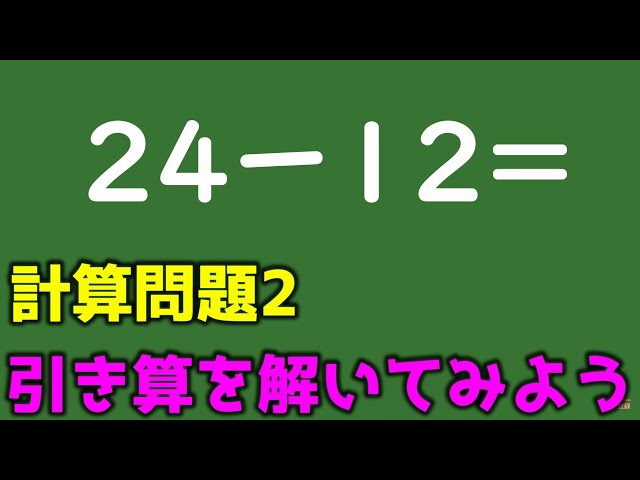
Let’s try a set of calculation problems focused only on subtraction.
I think there are many situations in everyday life where we use subtraction.
When you count items to hand to someone, or when you calculate change while shopping, you often end up doing subtraction without even realizing it.
If you watch the video and answer a series of subtraction problems mentally, it could be quite effective as brain training.
It’s fine to pause the video and solve them carefully, and if you get stuck, you can skip and move on to the next problem.
Dice calculation problem

This is a calculation puzzle using dice faces.
A die has numbers from 1 to 6, so addition should be easy, right? However, in this puzzle, you add the numbers on the opposite faces of the visible dice.
On a standard die, each pair of opposite faces sums to 7.
The opposite of 1 is 6, and the opposite of 2 is 5.
So if the problem shows 1 + 6 on the dice, you add their opposite faces and the answer is 11.
There’s a bit of a trick to it, so it’s not straightforward and can be challenging at first, but once you get used to it, it may become surprisingly easy to solve!