



There are many types of brain training, such as spot-the-difference and puzzles, but in this article we’ll introduce “calculation problems” for seniors.
We’ve gathered enjoyable brain-training exercises like change calculations, fill-in-the-blank equations, and simple addition.
Brain training is also known to help prevent dementia, so if you’re interested, give it a try.
It might take time to answer at first, but as you keep at it, you’ll get used to it—so take it easy and progress little by little.
- [For Seniors] Recommended Brain Training! A Fun Collection of Math Quizzes
- [For Dementia Prevention!] Brain-Training Math Quiz for Seniors
- [For Seniors] Brain Training with a Whiteboard! Fill-in-the-Blank Exercises & Quizzes
- Spot the Difference for Seniors: A Fun Brain-Training Game
- [For Seniors] Find daily brain training. Today’s recommended brain workout.
- A math quiz for adults. Can you solve it?
- Recommended for seniors’ brain training! Kanji quiz workbook of fish names
- Hand games that liven things up for seniors—also great brain training
- [For Seniors] Fun Brain Training! A Collection of Tricky Quizzes You’ll Definitely Get Stumped By
- [For Seniors] Recommended for Brain Training! Ultra-Difficult Quizzes and Riddles
- [Riddle Quiz for Seniors] Brain Training Perfect for Mental Exercise
- Fun Brain Training! Memory Games for Seniors
- [For Seniors] January Trivia Quiz & Fun Facts. Brain training with quizzes about New Year and winter.
[For Seniors] Brain-Training Math Problems (1–10)
Let’s complete the equation! Fill-in-the-blank math problems
Rather than looking at an equation and deriving the answer, this is a type of problem where part of the equation is left blank, and you fill in the missing piece by looking at the remaining numbers and the answer.
It’s a perfect kind of calculation exercise for brain training, isn’t it? Let’s start with single-digit addition and subtraction that you can solve in a few seconds.
There are plenty of fill-in-the-blank problems on video sites as well; they come at you quickly like a stream, but even if you don’t know the answer, just thinking about them serves as brain training, and you gradually pick up the knack.
Try it in whatever way feels easiest for you.

Change calculation

Calculating change is also very effective for activating the brain.
By consciously doing the change calculations that we usually perform without thinking, you might discover a new source of enjoyment close at hand.
For example, you could imagine buying something with 500 yen and then calculating the change you’ll receive.
This requires more mental ability than simple arithmetic, and because you’re picturing a real-life situation, it’s more interesting than just solving equations.
If a problem is difficult, take your time and work through it slowly.
Mixed addition and subtraction calculations

Even if you’re good at arithmetic problems, how about problems where addition and subtraction are mixed together? If you’re not confident with calculations, you might hesitate a little—but take it slowly and you’ll be fine.
Let’s give it a try! We’ll start with single-digit addition and subtraction, and once you get used to it, we’ll move on to two-digit numbers and raise the difficulty.
When it becomes two digits, it suddenly feels harder, doesn’t it? But if you build a solid foundation with single digits, you’ll gradually get the hang of it—almost like getting into a rhythm!
single-digit addition

You might think single-digit arithmetic problems are easy… but this one has lots of single-digit numbers that you have to add up and produce an answer within a time limit.
You go through the randomly arranged numbers and add them one after another, but it’s surprisingly tricky, and some people may find they can’t finish in time.
Even if you can’t do it at first, you’ll gradually get the hang of it and be able to find the answer.
If it’s still difficult, try increasing the thinking time and take on the challenge at a slower pace.
20 Mixed Problems

It sounds fun to mix a variety of problems—from simple addition to slightly more difficult multiplication and division! Try combining operations within a single problem, and mix in easy one-digit addition and subtraction with two-digit calculations that are hard to do mentally.
Adding variety in difficulty—like suddenly throwing in an easy problem after a tough one—keeps things exciting and boosts the game-like feel, so it’s highly recommended.
Even if you don’t know the answer, don’t worry—just keep moving on to the next question and give it a try!
Mental math: “How much change is there in total?”
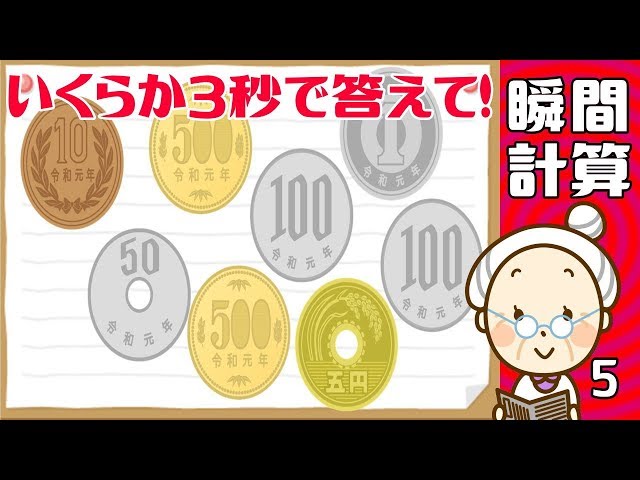
Let’s try a “How much change is there in total?” exercise where you count the coins shown on the screen, add them up, and give the total amount.
Handling small change is familiar in daily life—buying things and receiving change—but quickly glancing at coins in an image or video and telling the total isn’t something we often do, is it? Can you look at a row of coins and come up with the answer in a few seconds? You can do it while watching the video, or try it with actual coins.
If you’re solving the problems using the video, don’t worry too much about the countdown timer—work at your own pace.
Fill-in-the-blank numbers: “Please make the total ◯◯.”

Let me introduce a fill-in-the-numbers puzzle that’s fun, like logic rules.
There’s a 3-by-3 square grid, and the rule is to fill the blanks so that the sums of each row and column match the target numbers.
Start by practicing with smaller numbers.
Once you get used to it, try increasing the target numbers or using two-digit numbers in the cells.
It’s a bit complex, but there’s actually a trick: fill in one cell first, then figure out the rest.
Give it a try!
