

[For Seniors] Enjoyable Brain Training! Finger Exercises That Help Prevent Dementia


Moving the fingers helps activate the brain, so it’s recommended as a recreational activity for older adults.
Finger exercises can be done while seated, making them safe and easy to start.
There are many ideas—such as doing different movements with each hand or coordinating with songs—so they can be enjoyed according to each person’s physical and mental condition.
Also, by adding ideas like speaking aloud while moving the fingers, you can make the exercises even more enjoyable.
Since these exercises can be done anywhere, they’re also great for filling small pockets of free time.
- [For Seniors] Hand and finger play roundup: Finger exercises that lead to brain training
- Hand games that liven things up for seniors—also great brain training
- [For Seniors] Extremely Effective Brain Training! A Fun Collection of Hand Games
- [For Seniors] Brain Training Recommended for Dementia Prevention
- [Brain Training for Seniors] Recommended Hand-Play Recreation for Dementia Prevention
- [For Seniors] Fun Brain Training! Lively Mind Exercises
- [For Seniors] Popular Hand-Play Songs: Fun Brain-Training Ideas
- [For Seniors] Recommended Rhythm Play and Exercises
- [For Seniors] DIY Hand Rehabilitation Tools to Strengthen Fingertips: A Collection of Handmade Ideas
- [For Seniors] Liven Things Up With Different Left-Right Movements! Game and Exercise Ideas
- [Today's Recommendation] Gentle Health Exercises for Seniors
- For Seniors: Fun and Lively Exercise Recreation
- [For Seniors] Core Training: Recommended Simple Rehabilitation
[For Seniors] Fun Brain Training! Finger Exercises to Help Prevent Dementia (1–10)
Maple Leaf Finger Exercises

Let’s try a finger exercise to the tune of the children’s song “Momiji”! The method is simple: bend only the first joints of your fingers and repeatedly make a light fist and open your hand.
However, if you keep your arms extended and continue this movement until the end of the song, it turns into quite a good workout.
Follow the relaxed tempo of “Momiji,” slowly repeating the motion of clenching and opening.
Gradually your fingers themselves will get tired, and your outstretched arms will, too.
But you also have to sing properly.
It’s an exercise that uses not just your fingers, but also your arms and your voice.

The Itomaki (Spool Winding) Song Using Rubber Bands

This exercise aims to make finger movements smoother by stretching a rubber band with both hands and moving it from finger to finger.
Maintaining strength is important to keep the band well stretched, so sustaining effort while moving adds complexity that also helps stimulate the brain.
If you coordinate the movement of shifting the rubber band with a song—such as the children’s song “Ito Maki”—and proceed rhythmically, it will further improve smoothness.
We also recommend starting with patterns that move the band to the same finger on both hands, then gradually shifting the positions to make the patterns more complex over time.

Inchworm Brain Training Exercise

Let’s stimulate your brain with a finger play that mimics an inchworm’s movement.
Inchworms move by stretching and contracting their bodies, right? We’ll recreate that motion with your fingers as a hand game.
Touch the tips of your index finger and thumb together on both hands.
From there, bend one thumb and touch it to the index finger of the other hand.
Then alternate by bending an index finger to touch the thumb on the other hand, and keep repeating this pattern.
The motion looks like an inchworm, doesn’t it? At first, it can be hard to make each finger meet the opposite one smoothly, but working to make the connections is said to help activate your brain.

[For Seniors] Enjoyable Brain Training! Finger Exercises That Help Prevent Dementia (11–20)
Finger exercises you can enjoy with one hand
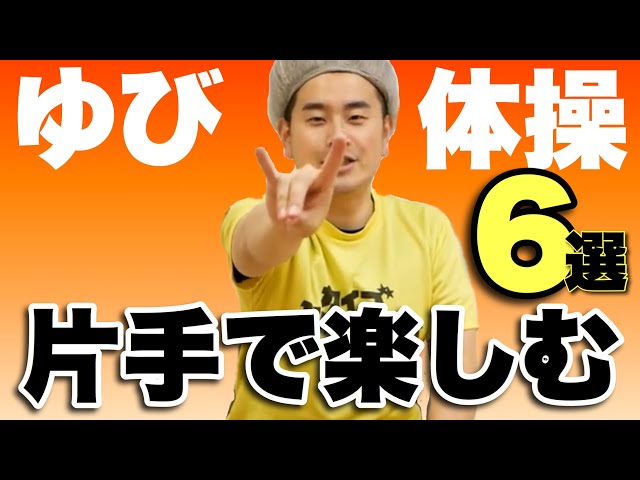
This is a one-handed finger exercise that even those who find it difficult to move both hands can enjoy without strain! After warming up with the basic rock–paper–scissors motions, try adding a “fox” shape by touching the thumb to the middle and ring fingers in between.
You can also increase the difficulty gradually by repeating rock–paper–scissors while moving the hand forward and back, or by adding a knee tap when switching.
In recreational activities, the most important thing is to have fun! Encourage participants by saying, “Please do it within your comfort level,” and proceed while carefully observing their condition.

Hometown: A song-and-exercise routine that livens things up with three movements

Move your hands to the melody of the children’s song “Furusato,” and stimulate your brain not only through the hand movements but also by visualizing your hometown.
The flow is two claps followed by forming a number with your hands, thinking ahead to the next number while keeping the rhythm of the song in mind.
After making a 5 with both hands, the count returns to 1, so this is where you should focus carefully and aim for smoother movements.
Once you get used to it, we also recommend increasing the speed to further improve concentration.
Exercise collection specialized in improving hand and finger movements

This is an exercise where you perform various finger movements in sequence, checking how your fingers move while aiming for smoother motion.
The routine progresses from overall movements to examining each finger’s motion one by one, gradually becoming more complex, which can also be expected to stimulate the brain.
If you find a movement that doesn’t go as you intend, focus on that one to work toward improving your finger control.
It’s also recommended to do the exercises to the rhythm of a children’s song or similar music, as it helps you keep time while you practice.
Finger rotation exercise

Let me introduce a finger-rotation exercise where you touch the same fingers of both hands together and rotate them.
This exercise was devised by an internist, and it’s said to help improve cognitive function, speed-reading ability, and calculation skills.
Amazingly, more than a third of the cerebrum is devoted to moving and controlling the hands and fingers.
So simply moving your fingers stimulates and activates the brain.
Since you’ll be moving your fingers, it might help to gently massage the bases of your fingers before you start.
The motion is simple—just twirling your fingers—so it seems easy to fit into small pockets of time.