

[For Seniors] DIY Rehabilitation Aids: A Collection of Easy-to-Make Ideas

The main goal of rehabilitation for older adults is to restore motor functions that have declined due to illness or injury, so they can live independently in their daily lives.
Some people train using store-bought items that have rehabilitative effects.
However, commercial products can be expensive and not easy to purchase.
That’s why this time we’re introducing ideas for handmade rehabilitation tools that you can make with relatively easy-to-find materials, such as those from 100-yen shops.
We’ve collected ideas that are effective for brain training and allow for easy rehabilitation.
It can also be great to start from the process of making them together with older adults.
Please use these ideas as a reference and give them a try.
- [For Seniors] DIY Hand Rehabilitation Tools to Strengthen Fingertips: A Collection of Handmade Ideas
- [For Seniors] Finger Rehabilitation Tools: Easy DIY Ideas
- [For Seniors] Ideal for Finger Rehabilitation: A Collection of Simple Ideas Made with Yarn
- [For Seniors] Great for Brain Training! Enjoy Handmade Puzzles
- [For Seniors] Recommended Handmade Activities! Simple Ideas
- [For Seniors] Simple and Fun: Craft Ideas You Can Make with Everyday Items
- For seniors: Recommended for day services. Hands-on activities that help prevent dementia.
- [For Seniors] Practical Crafts to Make in Day-Service Recreation: Idea Roundup
- [For Seniors] Let’s Have Fun While Training the Brain! Handmade Card Game Ideas
- [For Seniors] Enjoy Your Alone Time: Perfect Ideas for Passing the Time
- [For Seniors] Handmade gifts they’ll love: a roundup of simple ideas
- [For Seniors] Recommended Muscle Training Gear. Simple and Easy
- [For Seniors] Small craft ideas: for yourself and as gifts!
[For Seniors] DIY Rehabilitation Aids: A Collection of Easy-to-Make Ideas (1–10)
Finger training with clothespins

This activity uses clothespins to build fingertip strength and pinching motions.
You stick a large illustration onto cardboard and then attach clothespins to the illustration as if they were hair.
It’s fun because children can move their fingers while thinking about what kind of hairstyle to create.
When connecting clothespins to each other rather than just attaching them to the illustration, they need to carefully consider where to clip them, which also engages the brain.
While clothespins are commonly operated with the thumb and index finger, intentionally trying different fingers can help train finger strength more evenly.

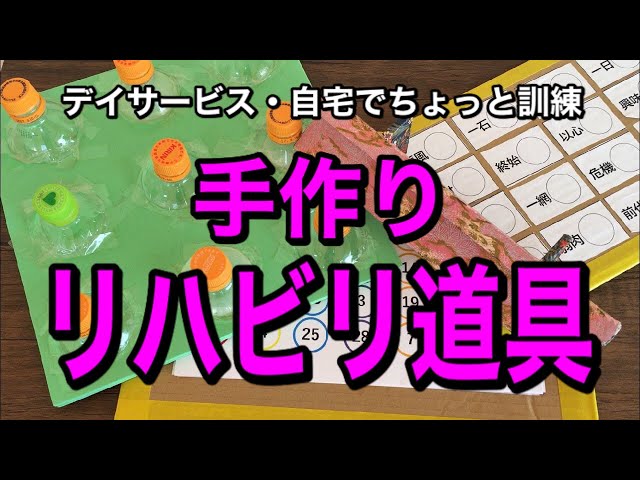
PET-bottle bingo for dementia rehabilitation

This is a game where you insert plastic bottle caps into a dedicated stand, aiming to create a row of caps of the same color.
The stand consists of a board with rods attached, and the caps are pre-punched with holes so they can be slid onto the rods.
Players take turns inserting caps of two colors, alternating by color.
While focusing on building your own row and preventing your opponent from completing theirs, the game feels like a three-dimensional version of Five in a Row.
Although it develops thinking and decision-making skills through strategy against your opponent, you can also strengthen finger dexterity by designing the cap holes and practicing sliding the caps onto the rods.
rehabilitation chopsticks

Let me introduce rehab chopsticks that are perfect for practicing the act of using chopsticks itself! Prepare one pair of disposable chopsticks, two rubber bands, and a clothespin.
Split the disposable chopsticks and attach the clothespin to the end you hold.
Position the opening side of the clothespin at the end of the chopsticks, clamp it with the chopsticks, and secure each side with a rubber band.
And that’s it—your rehab chopsticks are complete! When you grip the chopsticks with your fingers, the clothespin mechanism moves, making the chopsticks open and close so you can pick up food.
If you find chopsticks hard to use because you can’t move your fingers well, try rehabilitating with these chopsticks!

[For Seniors] DIY Rehabilitation Aids: A Collection of Easy-to-Make Ideas (11–20)
color clip fastener
@user8492253312849 Independent Project Production Log 75. Color Clip FastenerTranslationHandmade teaching materialsSpecial Needs Education#AutismNeurodevelopmental disorder#After-school Day ServicesTokachi
♬ A walk with the puppies Relaxing pops – spiraea
“Color Clip Match” is an activity where you prepare colorful sheets of paper and clip on paper clips of the same color, making use of the paper’s original colors.
There’s no need to color the paper, so preparation is simple.
Pinching the clips with your fingertips and attaching them to the matching color spot is perfect for training fine motor movements and grip strength.
Distinguishing colors and placing the clip in the correct spot also stimulates the brain.
The materials are easy to find at 100-yen shops and similar stores, making it simple to get started.
It’s a fun, game-like rehab method that’s highly recommended for older adults.

hair tie holder
@user8492253312849 Independent Project Production Log 87. Hair Tie Holder 2TranslationSpecial Needs EducationHandmade teaching materials#AutismNeurodevelopmental disorder#After-school Day ServicesTokachi# developmental support (ryōiku)
superstar – Sharou
“Hair Elastic Hook” is a rehabilitation tool for older adults made with a wooden board, colored pushpins, and hair elastics.
Push pairs of red, blue, yellow, and other colored tacks into the board, then loop matching-colored hair elastics over the corresponding tacks.
Pinching and stretching the elastics with the fingertips requires fine motor control and engages the hands’ functional movement.
Matching the colors correctly also stimulates the brain, supporting cognitive training.
Its colorful and playful look helps maintain focus.
All materials are easy to source and it can be made like a simple craft, so it’s easy to introduce.
It’s a convenient and practical rehab activity that we recommend.
Finger exercises with cotton swabs
@habii.jp Simple Craft Series: Finger exercises with cotton swabs. “HABii,” the official child development support and after-school day service that supports the growth of children with developmental concerns. <Posted around evenings three weekdays a week> For the official account of Wellbe Employment Support, go here → @Wellbe Employment Support [Official]#NeurodevelopmentalDisordersParenting# developmental support (ryōiku)Habi
♬ Dino Song – Mr. Popolo
The “cotton swab finger exercise,” which can be made with everyday materials, is a perfect DIY rehabilitation idea for seniors.
Paint cotton swabs in colors like red and blue, put matching colored stickers on toilet paper rolls, and make small holes there.
The way to play is very simple: find the matching color and insert the cotton swab into the corresponding hole.
Distinguishing colors and making fine finger movements provides hand dexterity training and stimulates the brain.
Because it feels like a game, it’s easy to keep doing regularly, which is a nice bonus.
All the materials are household items, so you can make it right away whenever you feel like it.
A device for training fingers by inserting rods
This item can be used to train grasping with the fingertips.
Prepare materials like finely cut pieces of drinking straws or thin, rolled sticks made from origami paper.
Also prepare a container, and make holes in it that are just large enough for the sticks to pass through.
The person training should insert the sticks only through these holes.
It may look simple, but aiming for small holes and inserting the sticks can be quite challenging.
Let’s practice the actions of pinching and releasing with the fingertips until they can be done reliably!