

[For Seniors] DIY Rehabilitation Aids: A Collection of Easy-to-Make Ideas


The main goal of rehabilitation for older adults is to restore motor functions that have declined due to illness or injury, so they can live independently in their daily lives.
Some people train using store-bought items that have rehabilitative effects.
However, commercial products can be expensive and not easy to purchase.
That’s why this time we’re introducing ideas for handmade rehabilitation tools that you can make with relatively easy-to-find materials, such as those from 100-yen shops.
We’ve collected ideas that are effective for brain training and allow for easy rehabilitation.
It can also be great to start from the process of making them together with older adults.
Please use these ideas as a reference and give them a try.
- [For Seniors] DIY Hand Rehabilitation Tools to Strengthen Fingertips: A Collection of Handmade Ideas
- [For Seniors] Finger Rehabilitation Tools: Easy DIY Ideas
- [For Seniors] Ideal for Finger Rehabilitation: A Collection of Simple Ideas Made with Yarn
- [For Seniors] Great for Brain Training! Enjoy Handmade Puzzles
- [For Seniors] Recommended Handmade Activities! Simple Ideas
- [For Seniors] Simple and Fun: Craft Ideas You Can Make with Everyday Items
- For seniors: Recommended for day services. Hands-on activities that help prevent dementia.
- [For Seniors] Practical Crafts to Make in Day-Service Recreation: Idea Roundup
- [For Seniors] Let’s Have Fun While Training the Brain! Handmade Card Game Ideas
- [For Seniors] Enjoy Your Alone Time: Perfect Ideas for Passing the Time
- [For Seniors] Handmade gifts they’ll love: a roundup of simple ideas
- [For Seniors] Recommended Muscle Training Gear. Simple and Easy
- [For Seniors] Small craft ideas: for yourself and as gifts!
[For Seniors] DIY Rehabilitation Aids: A Collection of Easy-to-Make Ideas (21–30)
Brain-training goods made from clear files

This is a game where you combine transparent plastic cards printed with shapes and lines to recreate a sample figure presented in the challenge.
Some figures may look impossible to make with the cards you have, encouraging players to think carefully about how to layer them.
There are techniques such as deliberately overlapping lines to reduce the number of visible lines, so offering effective hints is important when players get stuck.
The process of reasoning about shapes makes it perfect for brain training, and adjusting the positions of the cards to match the sample as closely as possible also helps players focus on fine motor control.

Also great for brain training! Clothing dressing/undressing training

This is a rehabilitation tool that focuses on the everyday action of fastening and unfastening clothing buttons, as well as the small finger movements involved in handling buttons.
It’s easy to make with just a few square felt pieces with a slit cut in the middle and a string with buttons attached at both ends.
You repeatedly insert the buttons through the felt and then remove them.
By adjusting the size of the buttons and the slit in the felt, fastening and unfastening can become more challenging, so it’s recommended to gradually increase the difficulty.
Let’s strengthen fingertip dexterity while also linking it to training for dressing and undressing in daily life.
Preventing dementia with rock-paper-scissors uchiwa (fan)

This is a large uchiwa fan illustrated with the hand shapes used in rock-paper-scissors—rock, scissors, and paper.
The person standing at the front uses the fan to show a hand, and everyone else thinks of the corresponding hand to play.
After seeing the hand that’s shown, participants decide and then show their own hands.
Have them consider not only winning responses but also losing ones.
On the back of the fan, numbers are written; by inserting a step where they determine which hand each number represents, the activity further trains their reasoning skills.
Button fastener training aid
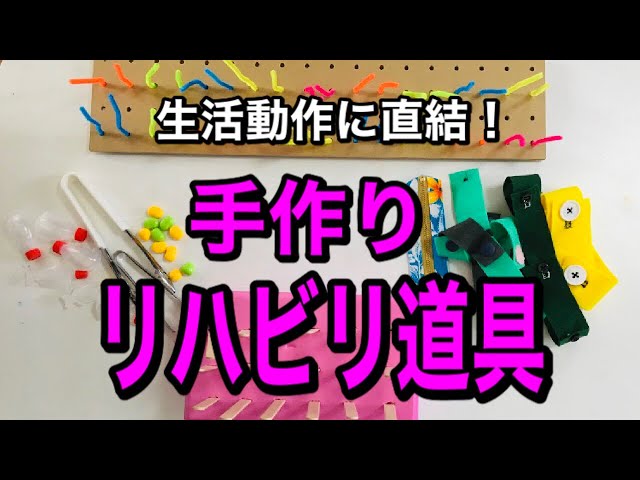
When it becomes difficult to move your fingers, putting on and taking off clothes can be challenging.
One of the hardest tasks is fastening and unfastening buttons.
This item helps you practice exactly that.
Attach a button to one end of a fabric scrap and make a buttonhole on the other end—then you’re ready to go! The person training uses this tool to practice fastening and unfastening the button.
To allow continuous practice, it’s a good idea to prepare several identical pieces.
To keep things interesting and prevent boredom, we also recommend varying the patterns of the fabric scraps and buttons.

Bottle opening and closing training tool
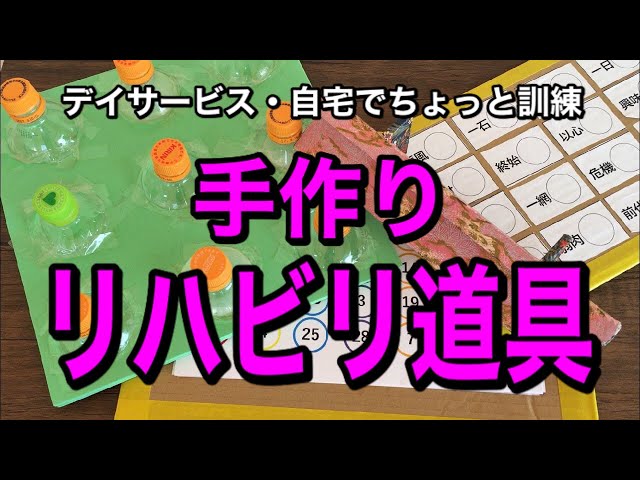
There are times when you can’t get a good grip and it’s hard to open a plastic bottle cap, right? Let’s train with this tool so you can open caps on your own! Prepare several plastic bottles by cutting off the bottom two-thirds and leaving only the area near the mouth.
Firmly attach these to a single sheet of drawing paper or thick cardstock to fix them in place, and you’re done! The person training should practice twisting with the whole hand to open and close the caps, and then increase the difficulty by opening and closing the caps using just the fingertips.
This tool lets you move the hands, fingers, and wrists thoroughly, so definitely give it a try!
Finger and brain training goods
Here is a rehab tool that trains both hand and finger movements and also works as brain training.
First, prepare a sheet of paper with numbers written inside circles placed at random, and plastic bottle caps labeled with the same numbers.
It’s recommended to make the circles about the same size as the bottle caps.
The trainee will pick up a bottle cap with a number on it and place it on the spot with the matching number on the paper.
You can arrange the numbers neatly on the paper, or increase the difficulty by scattering them randomly.
Use this to practice grasping objects with the fingers and to exercise the brain by finding matching numbers!
Finger training with a pegboard

A key point with rehabilitation and training is to keep them going.
There are many kinds of rehab tools, but if they’re expensive or hard to carry around, it becomes difficult to stick with them.
So, here’s a fingertip training tool you can make using items from a 100-yen shop.
Prepare a plastic perforated board with evenly spaced holes and a shoelace.
A regular string works fine, too.
Thread the shoelace through the holes in the perforated board.
This trains finger movements and is effective for actions like lacing shoes, sewing and other crafts, and even using chopsticks.
Try it with your non-dominant hand as well.
