

[For Seniors] Let's try customizing the usual Pa-Ta-Ka-Ra exercises!

It seems that many senior care facilities incorporate the “Pa-Ta-Ka-Ra exercises” before meals and at other times.
These are important oral exercises for older adults, using the mouth and tongue while vocalizing “pa, ta, ka, ra.”
The “Pa-Ta-Ka-Ra exercises” help prevent aspiration and support enjoyable conversation through training the muscles around the mouth.
However, doing the same routine over and over can start to feel monotonous.
So let’s try a modified version of the “Pa-Ta-Ka-Ra exercises”!
This time, we’ve gathered ideas with creative twists, such as adding hand claps or turning it into a parody song.
We hope older adults can enjoy their oral exercise time as well.
- [For Seniors] Spice Up Your Usual Oral Exercises! Patakara Exercises and Tongue Twisters
- [For Seniors] Oral Exercises to Keep Eating Deliciously and Enjoyably
- [For Seniors] Boost Oral Function with Tongue Twisters! Recommended Picks to Try
- Energetic and Lively! Sing-and-Exercise Program for Seniors
- [For Seniors] Stay Healthy Through Your Mouth with the A-I-U-BE Exercises!
- [For Older Adults] Games to Enhance Oral Function: Enjoyable and Easy to Do
- [For Seniors] Guaranteed to Liven Things Up! A Collection of Brain Training Activities That Will Spark Laughter
- For Seniors: Fun and Lively Exercise Recreation
- Tongue twisters that will make you laugh out loud! Super funny
- Hand games that liven things up for seniors—also great brain training
- [For Seniors] Let's Enjoy Exercising with a Towel!
- [Brain Training for Seniors] Recommended Hand-Play Recreation for Dementia Prevention
- [For Seniors] Hand and finger play roundup: Finger exercises that lead to brain training
[For Seniors] Let's try customizing your usual Patakara exercises! (21–30)
Tadpoles are frog children doing gymnastics.

Why not try adapting the Pa-Ta-Ka-Ra mouth exercises to the children’s song “Tadpoles Are Baby Frogs”? Change the lyrics to include words related to plants or animals that begin with “pa,” “ta,” “ka,” and “ra.” You could even make it a quiz and ask the older adults to suggest words that start with each sound.
Then fit sentences using those words into the song and sing together.
Many older adults have sung “Tadpoles Are Baby Frogs” at least once, so it should feel approachable.
By singing and having fun, you can strengthen the muscles of the mouth, tongue, and face.
Give it a try to help reduce food spillage during meals and prevent aspiration.

Singing Pa-Ta-Ka-Ra Exercises

If you just keep repeating “pa-ta-ka-ra” in a simple way, you’ll eventually get bored and lose awareness of your mouth movements.
When that happens, a great option is to adapt it by pronouncing “pa-ta-ka-ra” in time with a song.
By articulating each syllable to the rhythm, you’ll naturally pay attention to the cadence of language, which helps not only with mouth exercises but also with smoother conversation.
You can choose any song, but children’s songs are often easiest because of their clear rhythm and suitable number of beats and words.

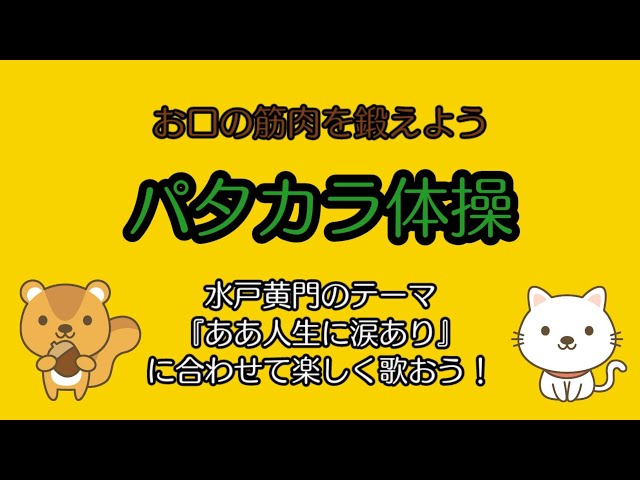
Exercise to the Mito Komon song
It seems that many older adults watch television.
Some of them probably look forward to dramas, don’t they? Period dramas are especially popular, and among them, “Mito Kōmon” is well-known.
It became a series and ran for 42 years, and its theme song is as famous as the show itself.
Let’s try incorporating the “Mito Kōmon” theme song—familiar to many seniors—into the Patakara mouth exercises! If the oral exercises use a song they know, older adults are likely to find it easier and more enjoyable to give them a try.
It can also help promote communication, such as by sparking lively conversations about the show.
Exercises in time with the song ‘Frog Chorus’

Many senior care facilities have residents do oral exercises before meals, don’t they? When we eat, we use not only the mouth but also the muscles of the neck and shoulders.
With this oral exercise routine, you can move everything in time with the children’s song “The Frog Chorus” and train comprehensively.
Within a single song, you can incorporate plenty of exercises—such as moving the body and changing the lyrics to the syllables pa-ta-ka-ra while singing.
Thanks to the humorous, lighthearted feel of “The Frog Chorus,” older adults may find it easier to participate in the exercises with a relaxed, pleasant mood.
Try adding this “Frog Chorus” routine—an inventive twist on your usual oral exercises—and give it a go.
Gymnastics to the tune of the tulip song

Let’s do oral care with the “Pa-Ta-Ka-Ra exercises,” which are actively practiced at day services and nursing facilities.
By moving the mouth while pronouncing “pa,” “ta,” “ka,” and “ra,” you train the movements of the mouth and tongue, aiming to improve the functions of eating and swallowing and to prevent aspiration.
This time, we changed the lyrics of the well-known children’s song “Tulip” to “pa, ta, ka, ra” and tried singing it.
Children’s songs have easy melodies and rhythms, so even older adults can get started right away.
Patakara exercises and clapping

By adding hand claps to the mouth-movement exercises, participants can also become more mindful of arm and hand movements.
If you insert claps between each pronunciation, it creates a brief pause before speaking, which can lead to clearer articulation and larger mouth movements.
Including elements that require thinking—such as gradually increasing the number of claps—can also provide brain-training benefits, so this is recommended as well.
Because you pronounce while keeping the rhythm in mind, it may also promote smoother movements of the mouth and tongue.
Pa-Ta-Ka-Ra finger exercises

When eating, not only mouth movements but also finger movements—like holding chopsticks or bringing food to your mouth—are important.
This is an adaptation that adds finger movements to the Patakara exercise to coordinate the mouth and fingers.
The content is simple: as you pronounce each syllable, fold a finger to count at the same time.
Once you get used to the motions, try changing the finger movements and gradually making them more complex to expect brain-training benefits.
While it’s important to focus on finger movements, it’s also crucial to be mindful that your mouth movements don’t become small.