

[For Seniors] Let's try customizing the usual Pa-Ta-Ka-Ra exercises!

It seems that many senior care facilities incorporate the “Pa-Ta-Ka-Ra exercises” before meals and at other times.
These are important oral exercises for older adults, using the mouth and tongue while vocalizing “pa, ta, ka, ra.”
The “Pa-Ta-Ka-Ra exercises” help prevent aspiration and support enjoyable conversation through training the muscles around the mouth.
However, doing the same routine over and over can start to feel monotonous.
So let’s try a modified version of the “Pa-Ta-Ka-Ra exercises”!
This time, we’ve gathered ideas with creative twists, such as adding hand claps or turning it into a parody song.
We hope older adults can enjoy their oral exercise time as well.
- [For Seniors] Spice Up Your Usual Oral Exercises! Patakara Exercises and Tongue Twisters
- [For Seniors] Oral Exercises to Keep Eating Deliciously and Enjoyably
- [For Seniors] Boost Oral Function with Tongue Twisters! Recommended Picks to Try
- Energetic and Lively! Sing-and-Exercise Program for Seniors
- [For Seniors] Stay Healthy Through Your Mouth with the A-I-U-BE Exercises!
- [For Older Adults] Games to Enhance Oral Function: Enjoyable and Easy to Do
- [For Seniors] Guaranteed to Liven Things Up! A Collection of Brain Training Activities That Will Spark Laughter
- For Seniors: Fun and Lively Exercise Recreation
- Tongue twisters that will make you laugh out loud! Super funny
- Hand games that liven things up for seniors—also great brain training
- [For Seniors] Let's Enjoy Exercising with a Towel!
- [Brain Training for Seniors] Recommended Hand-Play Recreation for Dementia Prevention
- [For Seniors] Hand and finger play roundup: Finger exercises that lead to brain training
[For Seniors] Let’s try arranging the usual Pa-ta-ka-ra exercises! (31–40)
Cognicise exercises and patakara exercises

It’s a program that trains the whole body while thinking, combining complex foot stomps and handclaps with the articulation of “pa-ta-ka-ra.” It starts with a simple flow of pronouncing “pa-ta-ka-ra” in time with the steps, then gradually becomes more complex by adding handclaps.
The key to adjusting difficulty is which letter of “pa-ta-ka-ra” you match the clap to.
Have participants try each letter in sequence so they can feel the increasing challenge.
It’s also important to ensure they don’t focus so much on the clap timing that they lose attention to the “pa-ta-ka-ra” articulation.

Get hyped with a shuffle! Patakara Cards
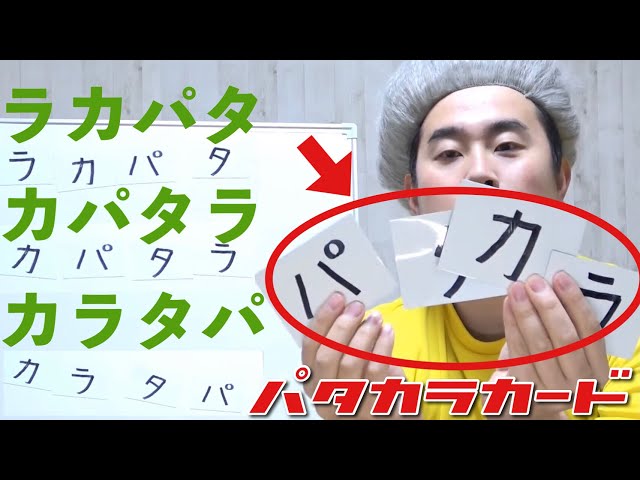
The “Patakara exercises,” which smooth the movements of the mouth and tongue, are all about focusing on the shape of the mouth and articulating clearly.
But after repeating the exercises many times, you may get used to them and lose awareness of your mouth movements.
In that case, why not try rearranging the sequence of “pa-ta-ka-ra”? Turn each syllable into a card and perform the exercises using a randomly shuffled order.
This approach not only makes your usual pronunciation feel fresh, but also engages your brain as you reconsider the sequence.
Let’s make words with pa-ta-ka-ra

This is an arrangement that makes the exercise more enjoyable by associating words connected to “patakara,” a term that focuses on mouth movements.
By thinking of words that start with each letter, you not only work on mouth movement but also gain brain-training benefits.
First, loosen up your mouth with the usual “patakara,” then start by coming up with words—for example, for “pa,” you might say “pineapple.” Once you have four words, pronounce the four in sequence clearly and quickly to connect it to mouth training.
The key point is to keep your focus on “patakara” and to pronounce the initial sound of each word firmly.
Let’s exercise with the patakara syllable sequence

This activity involves creating sentences that make you move your mouth clearly, and reading them aloud while moving your body.
Don’t just use “pa-ta-ka-ra” as the initials of the sentences—be sure to incorporate each syllable properly within the sentences as well, so participants focus more on pronunciation.
It’s also important to decide what kind of movements match each sentence: by clearly switching between lateral (side-to-side) and vertical movements, participants can move their whole bodies while feeling the flow of the text.
Because the movements are simple and mainly use the upper body, it encourages participants to value the words and articulate them clearly.
Patakara Dance You Can Do While Seated

This song celebrates the expected benefits of the “Patakara Exercises,” sung to a festive ondo rhythm.
With hand movements that get the whole body engaged, aim for smooth mouth movements by clearly pronouncing the “pa-ta-ka-ra” lyrics.
The moves are very simple and focus on the upper body, so they can be done while seated in a chair.
Because the drumbeat makes the rhythm easy to feel, try to catch the beat while also focusing on clear pronunciation.
[For Seniors] Let's Try an Arranged Version of the Usual Pa-Ta-Ka-Ra Exercises! (41–50)
Get hyped! High-speed patakara

This is an exercise that encourages you to pay close attention to the speed of articulation and aim for smooth mouth movements.
Focusing on each of the syllables in the familiar “pa-ta-ka-ra,” it’s a simple activity where you repeatedly say the specified syllable in succession.
It’s easiest to follow the person standing in front, using their pronunciation as a reference and aiming for the same mouth movements and the same speed.
The comical effort of trying hard to pronounce the same word is also an important point—let’s make it fun while training the mouth’s movements.
Oral exercises that also serve as brain training

This exercise adds a physical movement element to the usual mouth exercises, creating a brain-training effect by thinking about combinations.
The basic movement is large marching steps, and each time the step count reaches a multiple of three, you pronounce the syllables “pa-ta-ka-ra” in order.
While firmly counting your steps and considering which numbers are multiples of three, let’s move the body and activate the brain at the same time.
When attention shifts to the body’s movements and counting, the “pa-ta-ka-ra” pronunciation can become quieter, so it’s also important to encourage clear, distinct articulation.