

[For Seniors] Recommended Rhythm Play and Exercises


In this article, we introduce recommended rhythm games and exercises for older adults!
When people hear “exercise,” they might imagine something intense and feel it’s not for them.
Rhythm exercises involve moving your body to music, so you can use your whole body to keep the beat, or simply clap along while seated—both are great options!
Start by getting into the rhythm.
It’s important to do exercises without overexerting yourself, so prioritize what feels “fun” and try them casually at your own pace.
- [For Seniors] Simple Rhythm Exercises: Recommended Songs and Routines
- [For Seniors] Fun Exercises You Can Do While Seated
- For Seniors: Fun and Lively Exercise Recreation
- [For Seniors] Enjoyable Brain Training! Finger Exercises That Help Prevent Dementia
- [For Seniors] Hand and finger play roundup: Finger exercises that lead to brain training
- Hand games that liven things up for seniors—also great brain training
- Energetic and Lively! Sing-and-Exercise Program for Seniors
- [For Seniors] Easy and fun seated activities you can do in your room
- [Today's Recommendation] Gentle Health Exercises for Seniors
- [For Seniors] Simple Recreational Activities You Can Enjoy While Seated
- For seniors: Enjoyable stick exercises. Easy workouts.
- [For Seniors] Let's Enjoy Exercising with a Towel!
- [For Seniors] Let's try customizing the usual Pa-Ta-Ka-Ra exercises!
[For Seniors] Recommended Rhythm Games and Exercises (71–80)
Slow aerobics to When the Saints Go Marching In

Aerobics—moving your body to music—can feel difficult for people who have trouble with movement.
This exercise adapts aerobics by slowing the tempo and using gentler motions, making it accessible for anyone.
Find a calmer rhythm than the original song and move your body as if buoyantly engaging your whole body.
Rather than trying to keep up with the music, it’s more important to use your entire body, so it may be best to proceed at a rhythm that suits the participants.

Sing and dance! Ball exercises
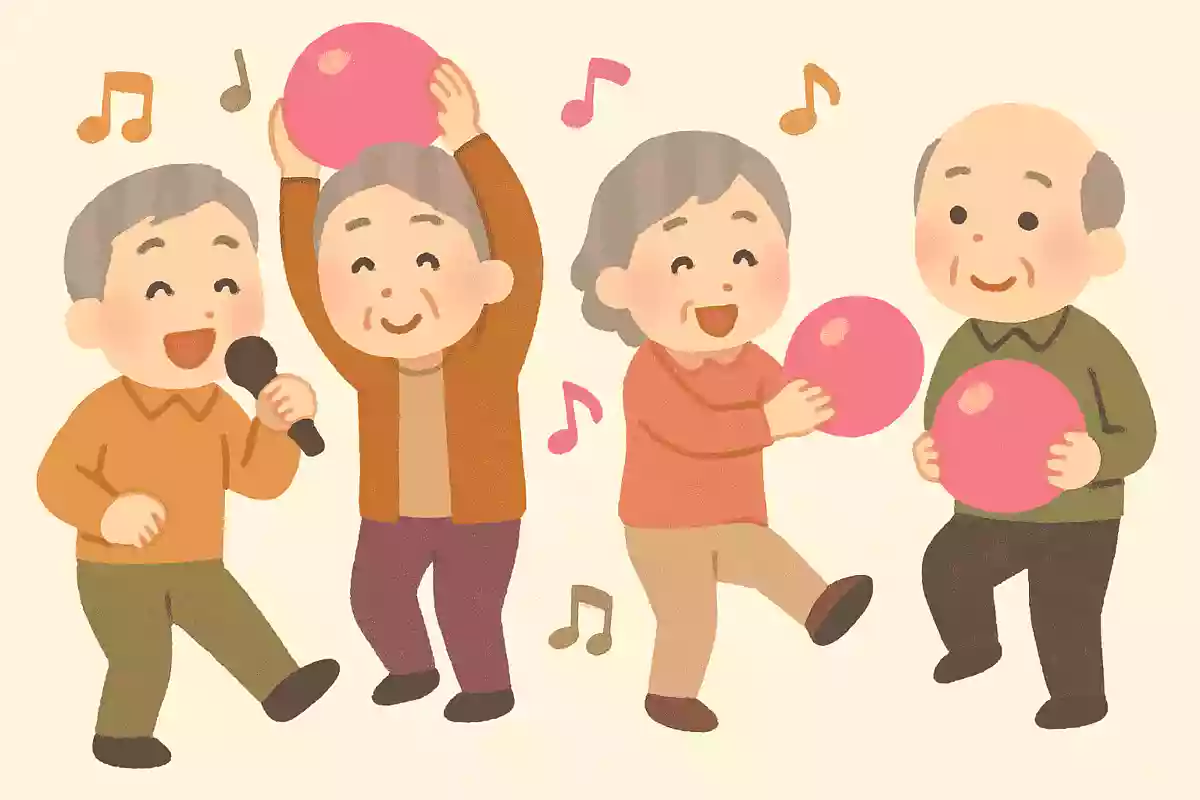
This is an exercise where you move a ball to the music, making it a fun way to train your body.
By feeling the bright, uplifting mood of “Tsubasa wo Kudasai,” you become more conscious of making big, expansive movements.
Since the song has a relaxed tempo, being able to apply steady, sustained force to the ball over time is another key point.
Progressing without rushing and checking each movement leads to smoother body mechanics.
If you add choreography that reflects the imagery of the song, you can feel its world even more and make the exercise even more enjoyable.
A-I-U-Be Exercise Twinkle, Twinkle, Little Star

Many care facilities have residents do oral exercises before meals.
The goals of these exercises include preventing aspiration, reducing food spillage, and improving eating and articulation.
This time, we’d like to introduce an oral exercise set to the melody of the children’s song “Twinkle, Twinkle, Little Star.” Using familiar songs—like children’s songs that many older adults know—makes it easier to participate.
By changing the lyrics to “aiuebe” and vocalizing them, you can expect to strengthen the tongue and the muscles around the mouth.
Since it also trains the facial expression muscles, conversations with richer expressions may become smoother.
It’s an exercise that also supports communication, so please give it a try.

A-I-U-Be Exercises, Yokai Version

Let’s try doing the “Ai-U-Be” mouth exercise to a cheerful anime song themed around bright, upbeat yokai! Some older adults may have watched this anime with their grandchildren back in the day.
If the song feels familiar, it might make it easier to engage in the exercise.
The Ai-U-Be exercise is recommended for preventing mouth breathing, which can affect tooth alignment and lead to cavities.
By doing the exercise, the tongue’s position changes, making nasal breathing easier.
Adding a melody to a routine exercise may also boost motivation for older adults.
Please feel free to make use of this idea!
A-I-U-Be Classic Exercise

Let’s add a touch of classical music to the “AIUEBE” mouth exercise used to help prevent colds and influenza.
You can use a slow, gentle melody like Gymnopédies, or a classical piece that older adults enjoy.
Doing the exercise to one’s favorite classical music makes it more enjoyable for seniors, too.
Move your mouth widely to the melody—“a, i, u, be”—and stick your tongue out and lower it.
This exercise is especially recommended in dry seasons like autumn and winter.
Give it a try!
Aiueo mouth exercises for preventing facial sagging and wrinkles

When you talk with others, the things you’re worried about can get resolved and your stress can be relieved.
Older adults also have concerns and things on their minds.
Through communication with the people around them, we hope they can lead vibrant, lively lives.
The “Ai-U-Be” exercises are recommended because they strengthen the muscles used for vocalization.
Try adding exercises that open the mouth wide, stick out the tongue, and stretch the throat.
Once you get used to them, it’s fine to make adjustments, like matching the movements to a song’s melody.
AIUE breathing/vocalization exercise

Because the tongue’s nerves are connected to the brain, moving the tongue is expected to help activate brain function.
Let’s also do some brain training with the “A-I-U-BE exercises,” which involve moving the tongue.
Open your mouth wide for “a,” stretch it sideways for “i,” round it for “u,” and stick out your tongue while vocalizing “be.” Once you get used to it, level up by tilting your face upward, sticking out your tongue, and doing the exercises in time with song lyrics.
Doing these exercises changes the tongue’s position, making nasal breathing easier.
This also helps prevent cold and influenza pathogens from entering the body.
Feel free to add your own variations and enjoy practicing!