

[For Seniors] Recommended Rhythm Play and Exercises
In this article, we introduce recommended rhythm games and exercises for older adults!
When people hear “exercise,” they might imagine something intense and feel it’s not for them.
Rhythm exercises involve moving your body to music, so you can use your whole body to keep the beat, or simply clap along while seated—both are great options!
Start by getting into the rhythm.
It’s important to do exercises without overexerting yourself, so prioritize what feels “fun” and try them casually at your own pace.
- [For Seniors] Simple Rhythm Exercises: Recommended Songs and Routines
- [For Seniors] Fun Exercises You Can Do While Seated
- For Seniors: Fun and Lively Exercise Recreation
- [For Seniors] Enjoyable Brain Training! Finger Exercises That Help Prevent Dementia
- [For Seniors] Hand and finger play roundup: Finger exercises that lead to brain training
- Hand games that liven things up for seniors—also great brain training
- Energetic and Lively! Sing-and-Exercise Program for Seniors
- [For Seniors] Easy and fun seated activities you can do in your room
- [Today's Recommendation] Gentle Health Exercises for Seniors
- [For Seniors] Simple Recreational Activities You Can Enjoy While Seated
- For seniors: Enjoyable stick exercises. Easy workouts.
- [For Seniors] Let's Enjoy Exercising with a Towel!
- [For Seniors] Let's try customizing the usual Pa-Ta-Ka-Ra exercises!
[For Seniors] Recommended Rhythm Games and Exercises (71–80)
Where are you folks from?
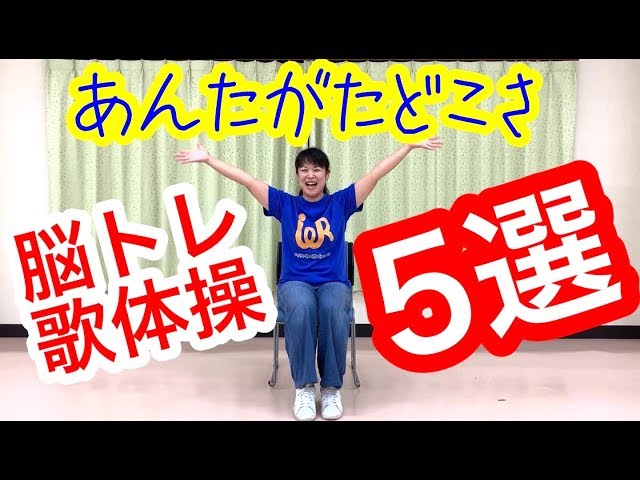
Antagata Dokosa is known as one of the handball songs among traditional children’s songs.
There are two theories about its setting: Kumamoto City in Kumamoto Prefecture and Kawagoe City in Saitama Prefecture.
Many older people may remember playing while bouncing a ball when they were young.
In this recreation activity, participants sit and clap their hands while patting their thighs, and also add foot stamping and arm swinging.
Performing various actions simultaneously seems likely to help invigorate both body and mind.

Goo Choki Paa-ty (Rock-Paper-Scissors Party)

Shall we all try dancing the “Goo-Choki-Paa” exercise together—just watching it might lift your spirits! This routine is done standing, but it can also be done seated, so it can be adapted to the physical and mental condition of older adults.
Various animals and creatures appear throughout, and their movements are expressed with the hands and feet.
For example, a fist (goo) can represent a gorilla, and scissors (choki) can represent a crab—there are so many ways to communicate using just your hands.
Don’t forget to take a deep breath at the end to refresh your body and mind.
Rock-Paper-Scissors Exercise

This “Rock-Paper-Scissors” exercise is done while speaking out loud.
Using your voice provides beneficial stimulation to the brain, so it’s recommended.
Even a small voice is fine—the key is to perform the rock-paper-scissors movements while speaking.
Exercises that change the movement on each side are also effective for activating the brain.
These can be easy to get wrong, so it may be difficult to do them correctly right away.
However, making mistakes is also important and can be a good opportunity to communicate with others.
Staff should actively speak to participants while they are exercising.
[For Seniors] Recommended Rhythm Play & Exercises (81–90)
Donguri Korokoro

“Donguri Korokoro,” the song that makes you want to sing when autumn arrives, is a children’s song composed in the Taisho era.
The lyrics were written by Aoki Zonyo and the music composed by Yanada Tadashi.
It is said to be one of Japan’s three great children’s songs, and in 2007 it was selected for the “100 Best Japanese Songs.” The song is said to have been created based on experiences from early childhood.
Its content tickles a child’s heart and is something many can relate to.
It’s recommended to sing it energetically while dynamically acting out the acorn, the pond, and the loach.
Hinamatsuri Exercise

Here’s an introduction to a seated exercise that’s perfect for March.
Let’s move our legs and arms to the tune of the children’s song “Ureshii Hinamatsuri.” This exercise is expected to improve blood circulation and help reduce swelling.
Many older adults have probably heard or sung “Ureshii Hinamatsuri” at least once, right? Using a familiar song makes it easier to get started.
Some of the moves also match the imagery of the lyrics, which makes them easy to remember and helps the body move more naturally.
It’s fine to wait until you’re comfortable, but try doing the exercises while singing along.

Rock, paper, scissors in a cross

Crossed Rock-Paper-Scissors is a calisthenic exercise done with your hands crossed.
Instead of just doing rock-paper-scissors normally, you cross your hands, so it’s a workout for your brain, too.
It can be hard to do it perfectly on the first try.
By repeating it, your body will learn the movements.
There are also variations like tapping your feet while doing rock-paper-scissors, or adding hand claps, so give them a try.
They all require mental focus, so it feels like your brain gets a full workout.
Rock, paper, scissors with pumpkin

Goo-Choki-Pa Pumpkin is a recommended exercise for Halloween.
Dressing up in Halloween costumes while you dance will lift your spirits and make it even more fun.
Since the Goo-Choki-Pa movements are incorporated into various parts, it should help activate the brain.
You can do it standing or sitting, so please adjust it to your physical and mental condition.
The song used here is an upbeat track that I believe will also benefit the minds and bodies of older adults.
Let’s enjoy the Goo-Choki-Pa exercise along with the up-tempo music.