

Mozart: An Introduction to His Signature and Popular Works

Wolfgang Amadeus Mozart, who had a profound impact on classical music.
He began composing at the age of five, displayed his talents from an early age by performing before European royalty, and left behind more than 800 works during his 35-year life.
He also produced masterpieces in every musical genre of his time and excelled not only as a composer but also as a conductor, pianist, organist, and violinist, earning him the title of a musical genius.
In this article, we introduce some of Mozart’s signature and most popular pieces.
Please enjoy his music—melodies that are catchy and familiar, yet of high quality and imbued with a charm that defies simple description.
- Pick up Beethoven’s famous and representative works!
- [Masterpiece Classics] A special showcase of gem-like masterpieces so beautiful they’ll move you to tears
- Classical masterpieces. Recommended classical music.
- Classical piano masterpieces: legendary performances from around the world you should hear at least once
- Timelessly beautiful classical masterpieces. Recommended classical music.
- Brahms's masterpieces. Popular classical music.
- Cool classical masterpieces. Recommended classical music.
- Today's Classics: Recommended classical music and great performances to listen to today
- [Tchaikovsky] Pick up famous and representative pieces!
- Jacques Ibert Popular Song Ranking [2026]
- Famous pieces recommended for opera beginners. Recommended opera songs.
- J.S. Bach | Introducing Famous and Representative Works
- Masterpieces of Ballet Music: Introducing Classic Favorites
[Mozart] Introducing Representative and Popular Works (161–170)
Ave verum corpus (Mozart)Wolfgang Amadeus Mozart

Since it’s a Mass, many composers have works with the same title, but the one I’d like to introduce is Mozart’s Ave verum corpus.
While the most basic form is a church choir performance, this piece is also used in instrumental renditions rather than vocal ones.
In the featured video, it is performed by a male four-part ensemble.
Twinkle, Twinkle, Little StarWolfgang Amadeus Mozart


Twinkle, Twinkle, Little Star is a melody with a certain nostalgia that naturally soothes the heart—no wonder it’s beloved by many in Japan.
It wouldn’t be surprising if some people mistake it for a Japanese children’s song, but in fact, the original tune was an 18th-century French chanson, and it became globally popular as a nursery rhyme through English lyrics set to the melody.
Because the tune is simple, it’s often the first piece played by young beginners learning piano, and sheet music arranged to be played with the left hand only is also available.
For adults returning to the piano, especially those who struggle with the left hand, starting with this piece could be a great idea!

Allegro in B-flat major, K. 3Wolfgang Amadeus Mozart

The piece “Allegro in B-flat major, K.
3,” often assigned as a competition piece, is a Mozart staple.
Because it must be played with a lively, lighthearted feel, it packs in techniques essential for beginners, such as a light touch and crisp legato.
The very first measure requires a slur on the first beat in the right hand, which makes it nerve-racking right from the start, but since it’s a short piece, keep repeating it in practice until you get the hang of it.
Imagining a string-like approach to phrasing will help you grasp the knack more easily, so keep that in mind as you play.

Minuet in F major, K. 2, from the Nannerl NotebookWolfgang Amadeus Mozart
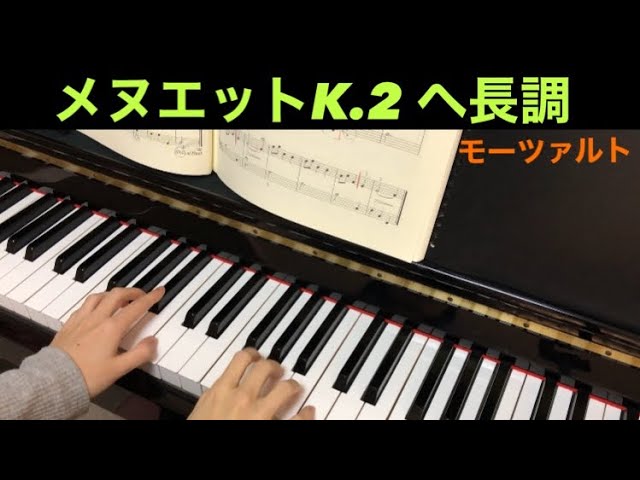
The piece Minuet in F major, K.
2 is said to have been composed by Mozart when he was six years old.
To write something like this at six—what a frighteningly gifted child, right? Jokes aside, this work is popular as a beginner-friendly Mozart piece.
Its characteristic, very Mozart-like structure features a steady rhythm in the right hand while the mood shifts with the left-hand melody.
It’s also great practice for the left hand, so if you’re just starting out, be sure to check it out.
Queen of the Night Aria from the opera The Magic FluteWolfgang Amadeus Mozart

Among Mozart’s operas, The Magic Flute is especially popular.
In it, this aria is sung in the scene where the Queen of the Night, seeking revenge, orders her daughter Pamina to kill her nemesis Sarastro.
It is notoriously difficult because it requires precise control of extremely high notes, and it is said that only a small number of sopranos can sing it well.

Mozart – The Marriage of Figaro Overture (K.492) – Wiener Symphoniker – Fabio Luisi (HD)Wolfgang Amadeus Mozart

Born in 1756, the Australian composer Wolfgang Amadeus Mozart’s work, the opera The Marriage of Figaro, from which this is the Overture.
The Marriage of Figaro is one of the most famous and beloved operas of all time.
The overture is also frequently performed on its own.
Because we dream, life shines.Wolfgang Amadeus Mozart

Mozart, a representative Australian musician alongside Haydn and Beethoven.
Many people may be charging toward their dreams with this famous quote of his in their hearts.
What is it that makes your life shine? The answer surely varies from person to person, but one possibility is “dreams.” The path you walk with the ambition to become this or that.
At times it becomes a wall to overcome, and at times a source of hope.
To have a dream worth devoting your life to may be a great happiness.
This is a quote I would love to give to those who pursue their dreams.
