

[For Seniors] Fun and Informative! Health Trivia Quiz


How about a quiz that lets you enjoyably learn how the body works and fun health trivia? It’s packed with useful knowledge for everyday life—like colors that help soothe eye fatigue, the ideal amount of time to get sunlight, and sleeping positions that can help prevent thrombosis.
There are also plenty of handy tips to support the bodies and minds of older adults, such as beverages that relax the brain and habits said to be effective for hip joint pain.
Enjoy a fun time with your family and friends while boosting your awareness of health.
- [For Seniors] Fun and Informative! Trivia and Quizzes Introduced
- [Brain Training] Lively Word Quiz for Seniors
- [For Seniors] Lively two-choice trivia quiz. Handy to know and tidbits you'll want to share with others
- [For Seniors] Trivia Multiple-Choice Quiz
- [For Seniors] Fun and Informative Trivia Quiz Collection
- [For Seniors] Guaranteed to Liven Things Up! A Collection of Brain Training Activities That Will Spark Laughter
- [For Seniors] Nostalgic quizzes that bring back memories! Showa-era entertainment and sports questions
- [For Seniors] Fun and Educational True-or-False Quiz
- [For Seniors] Fun Riddles That Stimulate the Brain
- [For Seniors] Today’s recommended quiz. Daily brain-training quiz!
- [For Seniors] Boost Your Knowledge! Fun Trivia Quiz
- [For Seniors] Sports Trivia Quiz & Fun Facts. Easy and Entertaining
- [For Seniors] Recommended Trivia Quizzes & Fun Facts for November
Showa Culture and Everyday Life Trivia (11–20)
In the late 1980s, it became popular to wear flashy outfits outdoors and dance “step dance” to disco sounds. What were these people called as a ‘tribe’?

Since the Heisei era, many dance-vocal groups have emerged, but even before that, there was a large dance collective! They were reportedly seen near Yoyogi Park in Tokyo, as well as in Kichijoji, Ikebukuro, and even Nagoya.
What were these people called? Here’s a hint: they share their name with a vegetable.
The answer is the Takenoko-zoku! There were many groups among those known as the Takenoko-zoku, and some members were even scouted and made their entertainment industry debut.

What was the staple food in school lunches during the Showa era?

In the past, bread was often served as the staple food in school lunches.
Reasons included the large quantities of wheat among postwar relief supplies and the strengthening of training for bakers.
Furthermore, for several years after the war, it was difficult to obtain rice that could be allocated for school lunches, so bread was frequently provided as the main staple in school meals.

What were the three items—black-and-white television, washing machine, and refrigerator—that became widespread in the early 1950s collectively called?
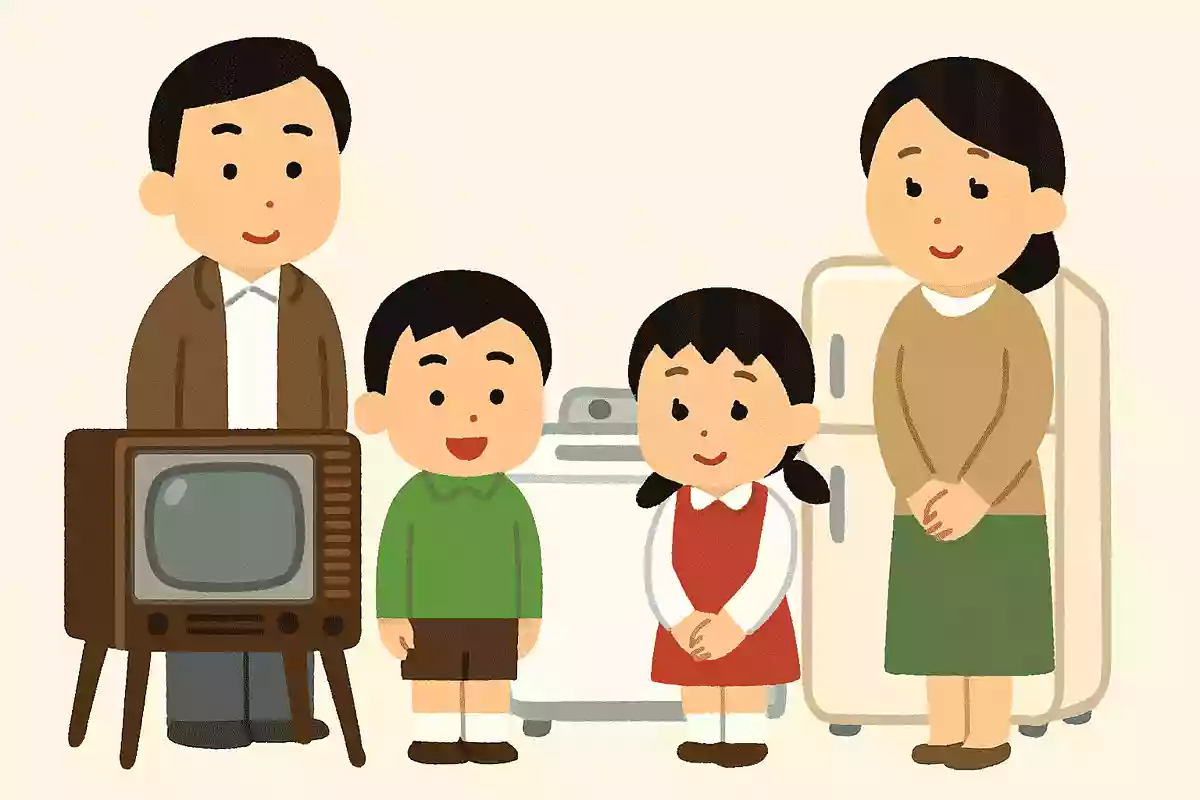
Looking at Japan in the postwar years of the Showa era, it was a time when technology and culture developed rapidly.
The household appliances that became symbols of Japan’s growth and spread in the early Showa 25s (around 1950) were the black-and-white television, the washing machine, and the refrigerator—what were these three collectively called? Since all of these appliances are related to daily life, they came to be valued as indispensable for everyday living.
The answer is the “Three Sacred Treasures.” As time went on, a new set of Three Sacred Treasures with a different lineup also emerged.

In the Showa era, a certain behavior was commonplace on trains. What is that behavior that is now prohibited?

Everyday scenery changes as time goes by, and it’s common for sights we once took for granted to disappear.
Let’s think about how behavior on trains has changed, recalling what things looked like back then.
If you imagine what became more strictly regulated over time—something almost everyone used to do—you might figure out the answer.
The answer is smoking.
There was a time when people could smoke not only on platforms and inside train cars, but practically anywhere.
What meat was considered a staple in school lunches during the Showa era?

Whales were once everyday food.
In Japan, a country surrounded by the sea, whales were used as a source of meat.
For that reason, from the late 1950s through the 1960s (the Showa 30s and 40s), school lunches also featured whale-based dishes.
In particular, whale Tatsuta-age (deep-fried, soy-marinated whale) seems to have been served at many schools.
Whale meat, which is highly nutritious, was an important food that helped make up for nutritional deficiencies.
Trivia of Showa-era culture and life (21–30)
What is the gesture or action people do when they are happy or celebrating to lift their spirits?

When you move your body in sync with feelings of joy and happiness, it can make you feel even brighter and may even contribute to your health.
So what is the indispensable action for celebrations that also helps lift your spirits? It’s a traditional gesture in Japan, so just picturing a celebratory scene with a group might help you guess.
The answer is “banzai,” the motion of raising both hands along with the shout.
It’s a good idea to focus not only on the feeling but also on the vocalization and arm movement.
From the late 1950s to the 1960s in the Showa era, a certain indoor sport became extremely popular. What sport was it?
The sport in question—many older people might say they used to play it often, especially with the recent boom—what could it be? Here are some hints: it’s a sport that uses a heavy ball, and you throw that ball toward a specific target.
The answer is bowling! At the time, there were over 3,500 bowling alleys nationwide, and many people owned their own shoes and balls.
Numerous star players emerged as well, such as Kayoko Suda and Ritsuko Nakayama.