

[For Seniors] Fun Brain Training! Lively Mind Exercises


Activities like games and brain training exercises conducted in senior facilities—often called “mental workouts”—are said to help prevent dementia or slow its progression.
So this time, we’re introducing “mental workouts for seniors”!
Mental workouts not only provide a sense of accomplishment when a problem is solved and activate brain functions, but they also play an important role in creating opportunities for communication with other seniors.
They are also recommended as a way to relieve stress for seniors who may fall into repetitive daily routines.
By adjusting the difficulty level to suit each senior’s condition and adding creative touches to make the activities easier to engage with, you can further increase their sense of satisfaction.
Try incorporating them into your recreation time or daily routine.
- [For Seniors] Fun and Engaging Brain-Training Recreation
- [For Seniors] Guaranteed to Liven Things Up! A Collection of Brain Training Activities That Will Spark Laughter
- [For Seniors] A Brain-Training, Crowd-Pleasing Word Search Game
- [Brain Training for Seniors] Recommended Hand-Play Recreation for Dementia Prevention
- [For Seniors] Brain Training Recommended for Dementia Prevention
- Fun Brain Training! Memory Games for Seniors
- [For Seniors] Brain-Training Recreation Using a Whiteboard
- Simple games for preventing and improving dementia
- [For Seniors] Find daily brain training. Today’s recommended brain workout.
- [For seniors] Fun brain training! Let’s get excited with the “Aru-Nashi” quiz
- Recreation Activities Effective for Long-Term Care Prevention for Seniors
- Hand games that liven things up for seniors—also great brain training
- [For Seniors] Enjoyable Brain Training! Finger Exercises That Help Prevent Dementia
[For Seniors] Fun Brain Training! Lively Mental Exercises (71–80)
Where is the flower’s name?

Let’s try finding flower names hidden among rows of hiragana arranged in a 5-by-5 grid.
It may look simple, but it’s actually quite challenging.
Since some people might not recognize more elaborate names, it’s a good idea to prepare simple answers when creating the puzzle.
On the other hand, if your audience knows a lot about plants, including more technical names can make it more enjoyable.
Creating the puzzles themselves also provides brain-training benefits, so in senior care facilities, consider starting from the puzzle-making process itself.

Word Search: Constellations Edition

Among the letters scattered in a 6-by-6 grid, the names of constellations are hidden.
The names can appear in three directions—vertical, horizontal, and diagonal—and some must be read from right to left or bottom to top, so read carefully to find the correct combinations.
Each puzzle has a time limit, which can make you feel rushed, but it’s important to stay calm and focused.
Since the answers are constellation names, it may be somewhat difficult for those not familiar with them.
Studying constellations in advance could be the key to success.
Learning new knowledge also helps stimulate the brain, so it may be effective in preventing cognitive decline.
Word Search: Fruits Edition

Amid the letters scattered across a 6-by-6 grid, there are hidden names of fruits.
The names can be arranged in three ways—vertically, horizontally, and diagonally—and some words must be read from right to left or bottom to top, so read carefully to find the correct combinations.
Each puzzle has a time limit, which can make you feel rushed, but it’s important to stay calm.
The difficulty is a bit high, but you can try as many times as you need until you find them.
In addition to concentration, this also develops thinking skills and word retrieval, and may help prevent cognitive decline.
[For Seniors] Fun Brain Training! Lively Mind Exercises (81–90)
Where is the food?

Hiragana characters are arranged within a 5-by-5 grid.
From this grid, try to find words that are names of foods.
It’s simple, but actually quite challenging.
Even characters you could find if you stay calm and take your time can suddenly become hard to spot if you set a time limit.
When creating problems, it’s good to prepare multiple answers rather than limiting it to just one.
In senior facilities, having participants create puzzles for each other and swap them not only fosters interaction but also doubles the brain-training effect.
Give it a try!
What is the letter that exists only once?
Among the same words lined up, there is one that differs by just a single character.
Try to find it.
You can check them one by one or take a bird’s-eye view—choose whichever approach you prefer.
By firmly remembering the characters and their meanings, it becomes easier to spot the differences, and doing memorization and discrimination tasks at the same time provides good stimulation for the brain.
Because it’s simple and enjoyable for both individuals and groups, it’s also recommended as a recreational activity in senior care facilities.
I made one sheet of paper into ten without tearing or cutting it. How did I do it?
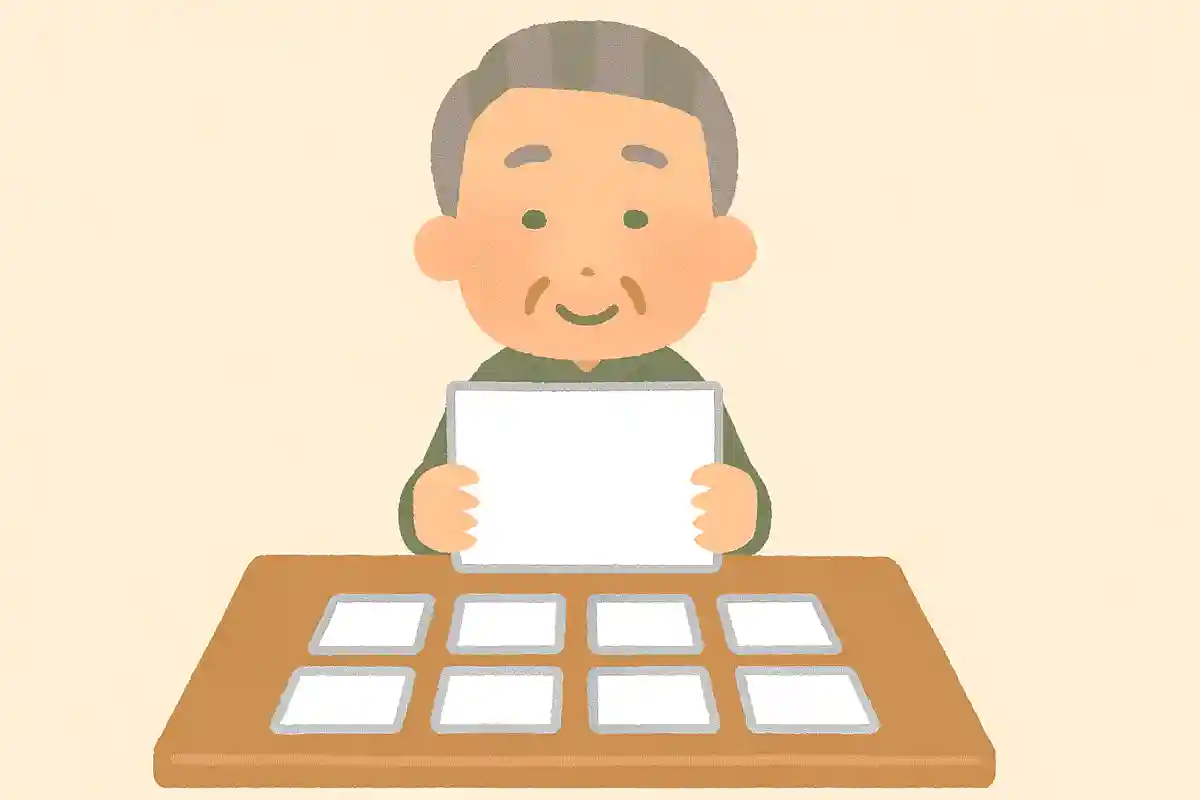
It’s a simple riddle whose answer you can figure out by recalling everyday actions.
I turned one piece of paper into ten without tearing or cutting it.
How did I do it? The hint is something related to money.
Think of a 10,000-yen bill or a 1,000-yen bill.
The answer is “exchange.” For example, you might exchange one 10,000-yen bill for ten 1,000-yen bills in various situations.
The number of pieces increases without tearing or cutting, right? It’s a simple yet humorous riddle.
What is a ____ that starts with ____?

Here’s a brain-training quiz that you can enjoy with a large group as long as you have a whiteboard.
For example, let’s say you make a quiz like, “What are some ___ that start with ___?” First, you put a letter in the first blank.
Then you put a category in the second blank.
For instance, if you put “i” in the first blank and “foods” in the second, the quiz becomes: “What foods start with ‘i’?” Have everyone answer in turn.
If you say, “Let’s try to come up with 10,” everyone will think hard.
That’s what makes it a brain workout.
