

Learn the meanings too! Cool four-character idioms that elementary school students will want to remember

“I want to learn some cool four-character idioms!” Many elementary school students probably feel that way—wanting to use them in school essays or speeches, or even make them their future goals.
Four-character idioms are full of words that express strong will and admirable attitudes.
Because they carry deep meanings, the more you learn about them, the more appealing they become.
Even though they’re just four characters long, many of them really resonate in your heart.
In this article, we’ll introduce four-character idioms that are easy for elementary school students to remember and use.
If you try them in conversations with friends or in your writing, you’re sure to develop wonderful expressive skills.
- Interesting four-character idioms for elementary schoolers! Words you'll want to use once you understand their meanings
- For Elementary School Students: Four-Character Idioms You Can Use for New Year’s Resolutions — How to Set Cool Goals!
- Easy-to-remember, positive four-character idioms for elementary school kids! Words that brighten the heart
- Popular even among elementary school students! Stylish and easy-to-remember four-character idioms
- Easy for elementary school students to remember! A four-character idiom that expresses the feeling of trying your best
- [For Elementary School Students] Four-character idioms you can use in sports! Words that are helpful for cheering and goal setting
- [For Elementary Students] A Collection of Beautiful Four-Character Idioms to Know
- Recommended for elementary school class goals! A collection of impactful ideas using four-character idioms
- Perfect for elementary school slogans! A collection of four-character idiom ideas you'll want to use
- Four-character idioms that help elementary schoolers not give up: words that spark the power to keep trying
- [For Elementary School Students] Inspiring Four-Character Idioms for Shaping the Future at a Glance! Words that Spark Courage
- [Elementary School Students] Perfect for Kakizome! A Collection of Four-Character Idiom Ideas
- Strive toward your goals! Four-character idiom ideas that resonate with elementary school students
Learn the meanings, too! Cool four-character idioms elementary schoolers will want to remember (11–20)
Wind, Forest, Fire, Mountain
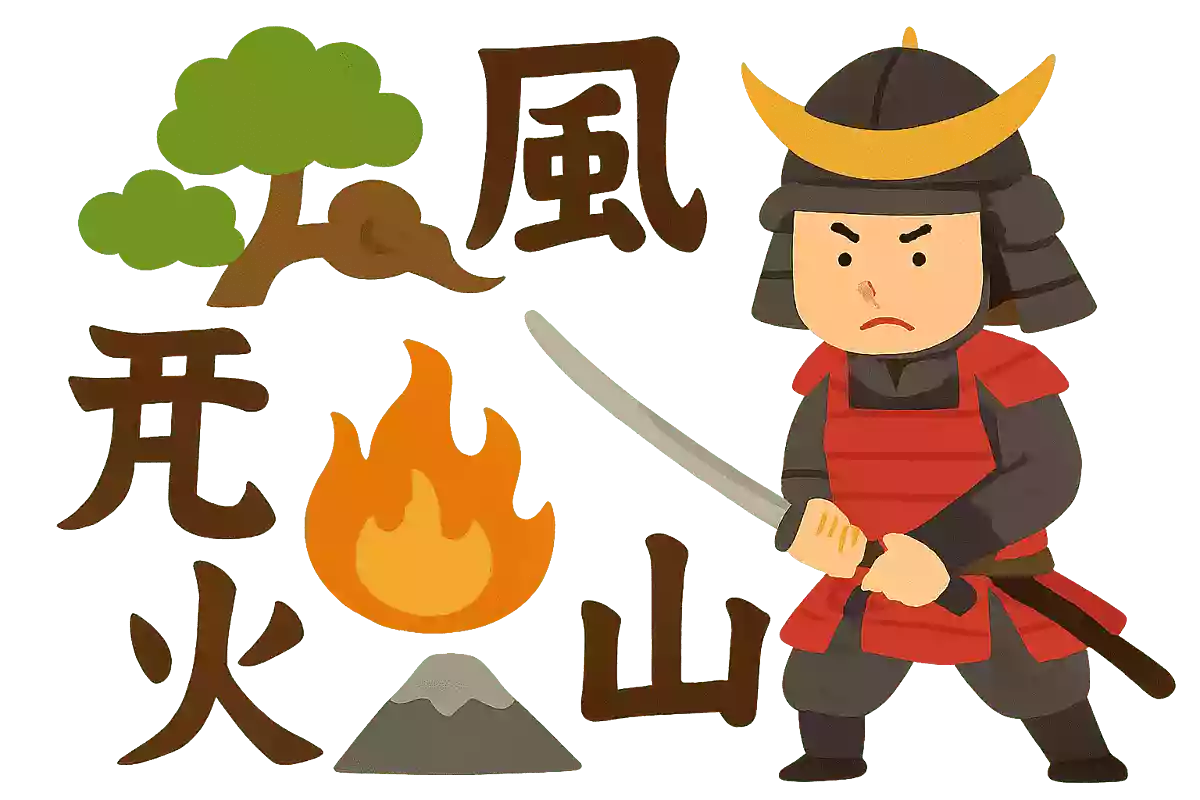
People say, “His life is like Fūrinkazan.” This sentence means that he responds flexibly to various situations and takes bold action as needed.
“Fūrinkazan” is a famous four-character idiom written on the war banner of the warlord Takeda Shingen.
When using the idiom “Fūrinkazan,” it’s clearer to the listener if you explain specifically how each element—wind, forest, fire, and mountain—maps to actions, behaviors, or states.

Limit Break

When you’re working hard at something and hit a wall, you become aware of your limits, don’t you? If you can’t break through with your current ability, the only option is to take a bigger leap and challenge it again.
That’s what it means to surpass your limits.
Put simply, it’s about not setting a finish line for your own strength and aiming to become even stronger and cooler! If you like games, you might think of it as leveling up.
All of you elementary school students are still growing and full of potential.
When you hit a wall, think of it as a chance and bring out your abilities and charm to the fullest!

A land of picturesque mountains and clear waters

It’s read as “sanshi suimei.” The on-yomi (Sino-Japanese reading) of the character for purple includes “shi,” which makes it a bit tough for elementary schoolers.
It means the mountains are purple and the waters are clear, describing scenery of exceptional beauty.
It’s a bit curious that mountains can look purple when the sun shines on them.
This expression was coined by the Edo-period Confucian scholar Rai Sanyō.
It’s said he was deeply moved by the view he could see from his home in Kyoto and created the term.
Use it in sentences like, “On our school trip, we encountered many scenes of sanshi suimei.”
matchmaker (literally: “go-between under the moon,” meaning a person who brings two people together, especially for marriage)

A person who acts as a go-between for a man and a woman is described as a “gekkahyoujin” (matchmaker).
This term combines “Gekka Rōjin” (the Old Man under the Moon) and “Hyōjin” (the Ice Person).
Both come from classical anecdotes.
“Gekka Rōjin” refers to a Tang-dynasty tale in which a man named Wei Gu hears from a mysterious old man about a red cord—what we now know as the red thread of fate.
“Hyōjin” comes from a story in which Linghu Ce of the Jin dynasty had a dream interpreted about speaking with someone beneath the ice, which was taken to mean he would serve as an intermediary for marriage.
Flower in the mirror, moon on the water

This is a four-character idiom that means “beautiful things that you can see but cannot grasp.” For example, a flower reflected in glass, clouds in the sky mirrored in a puddle, or the moon reflected on a bathroom window at night are all very beautiful, yet you can’t touch them.
Likewise, the dazzling lights at an amusement park, or the feeling when you can’t yet buy a toy you really want, can be described as kyōka suigetsu—“things that are fun to look at but can’t be obtained.” It’s a phrase you can use to describe everyday moments that feel dreamy and a little mysterious.

A single smile is worth a thousand gold pieces.
Isshou Senkin is a beautiful four-character idiom meaning “a single smile or laugh is worth a thousand pieces of gold.” It teaches us that a heartfelt smile makes people happier than expensive things or money.
A smile that cheers up a friend, or a small laugh that soothes a family, has the power to brighten the atmosphere around us.
Valuing smiles in everyday life also helps us build good relationships with many people.
It’s easy to remember and conveys the importance of feelings.
It’s one of the four-character idioms I especially recommend for families with elementary school children.

Learn the meanings too! Cool four-character idioms that elementary schoolers will want to remember (21–30)
cherry, plum, peach, and apricot (each flower/thing has its own unique beauty)
@hiroaki946 Oubaitōri Shorts Short video Mini video Set phrase Four-character idioms Proverbs Japanese Meaning of words Wordplay Learning Education Trivia Japanese culture Time-killer Study Knowledge Trivia Everyday life Power of words VOICEVOX: Shikoku Metan A four-character idiom that recognizes differences: “Oubaitōri” Do you know what it means? First, an example sentence: With the arrival of spring, the cherry, plum, peach, and apricot (sour plum) blossoms in the garden were in full bloom, coloring the yard. As the children looked at each flower, they said things like, “I like the pale pink of the cherry blossoms,” “The fragrance of the plum is the best,” “Peach petals are so cute,” and “The white blossoms of the apricot are lovely too.” By noticing the charm each flower possesses and learning the spirit of oubaitōri, the children began to feel that they should also cherish their own individuality. Meaning: Oubaitōri (桜梅桃李) comes from the idea that cherry, plum, peach, and apricot blossoms each have their own unique beauty. It teaches the importance of each person having their own individuality and talents, and expressing their own beauty without comparing themselves to others. It also implies that when people recognize and make use of their strengths and characteristics without comparison, overall harmony can be achieved. That is all.
Original song – hiroaki946 – hiroaki946
This four-character idiom means that just as cherry blossoms, plum blossoms, peach blossoms, and apricot blossoms each bloom with their own unique beauty, it’s okay for every person to be different, too.
It’s easy for elementary school students to understand and carries a message close to “Everyone is different, and that’s okay,” so it’s a good phrase to use in class activities or moral education.
It encourages children to value their own strengths and personalities as they are and to feel positive about themselves.
Beyond memorizing it as study, it can also be a starting point for recognizing differences among friends.
The sound of the phrase is beautiful, and it’s an idiom that lets students enjoy learning while imagining seasonal flowers.
