

[For Seniors] Brain Training Recommended for Dementia Prevention

In this article, we introduce brain-training activities that can help prevent dementia in older adults.
As we age, memory is something everyone worries about.
For those concerned, we recommend simple, easy-to-do brain training designed for seniors.
Doing brain training activates the brain and can contribute to overall mental and physical well-being.
There are quiz formats, riddles, four-character idioms, and even brain-training activities you can do while moving your body.
Find the brain training that suits you, and enjoy doing it.
If you’re a caregiving professional looking for brain-training ideas, be sure to check these out.
- [For Seniors] Brain Training! Recall Quiz Collection!
- [For Seniors] Challenging but Exciting! Kanji Quiz
- [For Seniors] Find daily brain training. Today’s recommended brain workout.
- [For Seniors] Lively Wordplay Game: Fun Recreation for Elderly Care
- [For Seniors] Fun Brain Training! Prefecture Quiz
- Recommended for seniors. Brain training with an odd-one-out quiz.
- [For Seniors] Popular Brain Training and Recreational Quizzes
- [For Seniors] Fun and Lively! Recommended Quiz Questions
- [For Seniors] Fun Riddles That Stimulate the Brain
- [For Seniors] Enjoyable Brain Training! Finger Exercises That Help Prevent Dementia
- [For Seniors] A Brain-Training, Crowd-Pleasing Word Search Game
- [Brain Training] Lively Word Quiz for Seniors
- [For Seniors] Recreational activities and games that let you have fun while strengthening your legs
[For Seniors] Boost Brain Health! Recommended Brain Training (51–60)
Urashima Tarō Game

Watch out for the tamatebako! Let me introduce a Urashima Taro card game.
First, prepare 18 Urashima Taro cards, 9 Princess Otohime cards, 9 Tamatebako (mystery box) cards, and 18 Turtle cards.
Stack them all face down.
Take turns flipping one card at a time.
If you reveal Urashima Taro and a Turtle, you get 1 point.
If you reveal a Tamatebako, you get 0 points and all the cards you’re holding are confiscated.
If you reveal Princess Otohime, you get 1 point, plus you reclaim any confiscated cards and may draw 2 additional cards.
The player with the most points from the cards they’re holding at the end wins.
Since which card appears is entirely up to luck, even people who aren’t confident at card games can enjoy it casually.
Give it a try!
Kanji Puzzle

Here’s a kanji puzzle to boost creativity.
Print out kanji characters and cut them in half.
Try combining the pieces to form the correct characters.
Once you get the hang of it, you can raise the difficulty by cutting the kanji into quarters.
If you laminate the printed and cut pieces, you can use them over and over.
It’s a fun brain workout that builds your ability to visualize kanji shapes and identify where each component belongs.
You can make it even more exciting by setting a time limit or forming teams.

Mackerel and Spanish mackerel: a game where you only take the cards with the same kanji

If you want to train your visual discrimination, try this! Here’s a game where you only grab cards with the same kanji.
First, write two similar-looking kanji—such as 鯖 and 鰆—on cards, making sure each one appears the same number of times.
When the game begins, one person quickly gathers all the mackerel (saba) cards, while the other quickly gathers all the Spanish mackerel (sawara) cards.
The player who gathers all of their cards first wins.
Because you have to instantly tell apart similar shapes, it naturally boosts fine visual recognition, and it also seems to improve concentration and decision-making.
It’s fun to include a variety of kanji, symbols, or pictures, too.
Give it a try for inspiration!
Number Cop

Let me introduce Number Cups, a brain-training game you can do with minimal preparation.
All you need are construction paper and paper cups.
Write the numbers 1 through 9 on both the construction paper and the paper cups, and place the construction paper on the floor or table.
At the start signal, place each paper cup on the paper with the matching number.
Because it requires comprehension and decision-making—identifying which number and where to place it—along with quick reactions, it sends plenty of stimulation to the brain.
You can expect it to help prevent cognitive decline while having fun as a game.

[For Seniors] Prevent Dementia! Recommended Brain Training (61–70)
Reminiscence Session: Nostalgic Tools from Early Showa Era

Reminiscence therapy is a type of psychotherapy in which you choose a theme, recall past memories, and reflect on the scenery, environment, and your own self from that time.
To help you remember, it’s good to prepare photos or videos of tools you used in the past—or the actual items if possible.
By recalling details such as how the tool was used (“I used it like this”), when and under what circumstances (“I used it at night after finishing farm work”), or specific experiences (“I was scolded because I couldn’t use it well”), you can evoke a wide range of memories.
You may learn related episodes and even remember things the person themselves had forgotten.
When continued, this approach is considered to have beneficial effects on improving cognitive function.
This kid had a hard time writing katakana, didn’t they? I wonder if they didn’t cry?
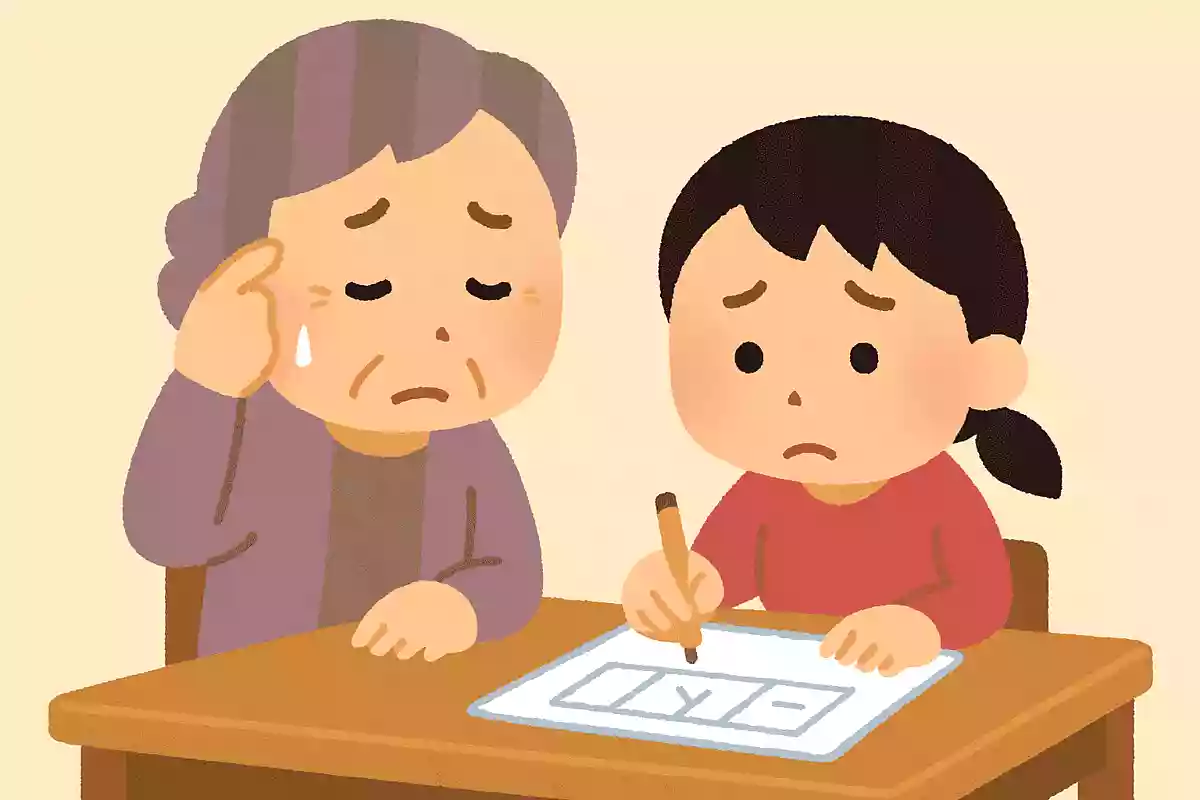
“Kono ko nakanaka katakana kakenakatta na, nakakanakatta kana?” is quite a long tongue twister.
Are they worried that the child who couldn’t write katakana didn’t end up crying? Words with similar sounds like nakanaka and katakana run together almost like a reverse reading.
Plus, the repeated ka sounds create a string of identical syllables, which adds to the difficulty of reading.
Tongue twisters can make you rush, but the key is to stay calm and read through without hurrying.

Both the Japanese plum and the peach are kinds of peaches; the peach and the Japanese plum are both kinds of peaches.
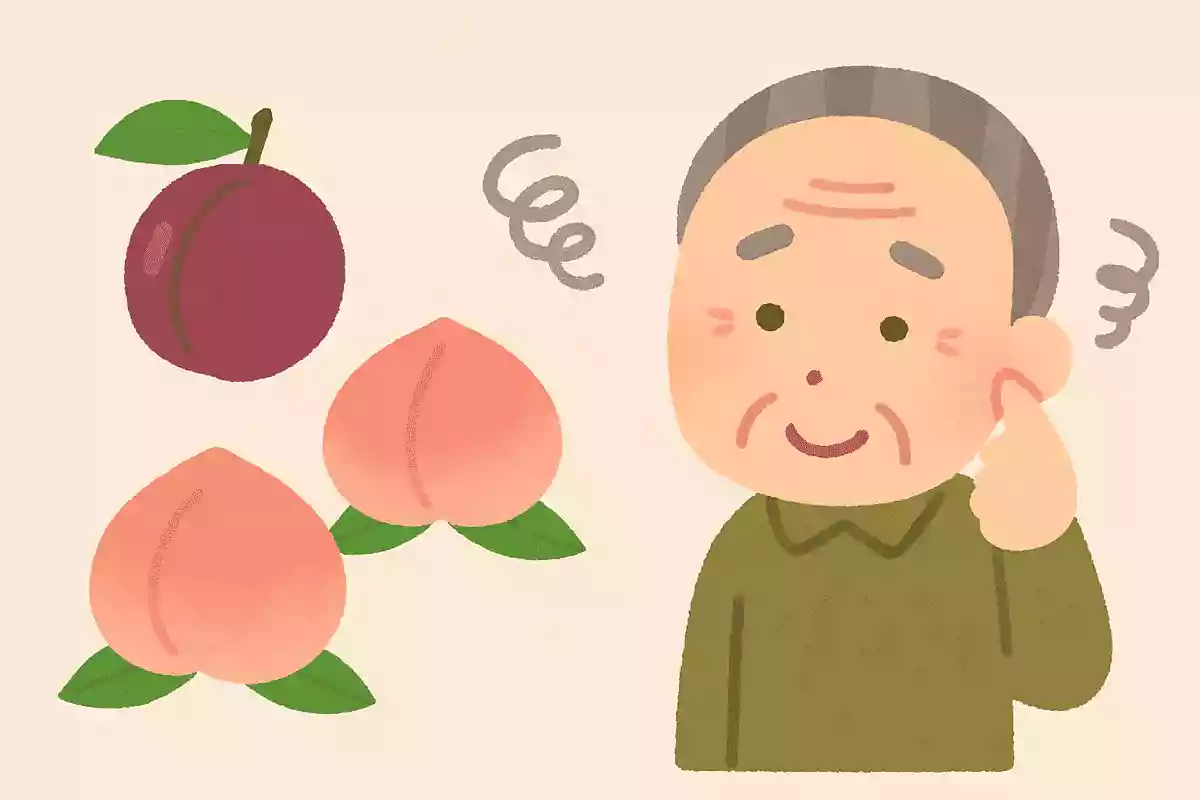
Plums come into season around mid-June.
Plums are a size smaller than peaches and are known for their sweet-and-tart flavor.
Although they’re said to be smaller than peaches, their shapes are similar, which is why there’s a tongue twister: “Sumomo mo momo mo momo no uchi; momo mo sumomo mo momo no uchi,” roughly meaning “Both plums and peaches are kinds of ‘momo.’” Because of this tongue twister, some older adults may have the impression that plums and peaches are the same variety.
However, plums belong to the genus Prunus in the rose family, while peaches belong to the genus Amygdalus (also within the rose family), so they are different.
Indeed, while their shapes are similar, plums have smooth skin, whereas peaches have a fine fuzz.
In fact, plums are said to be more closely related to apricots than to peaches.