

[For Seniors] Hand and finger play roundup: Finger exercises that lead to brain training


For older adults, moving their hands and fingers is very important because it helps stimulate brain activity.
That’s why many senior care facilities incorporate hand and finger play as a way to help prevent dementia.
Among these activities, brain-training style hand and finger games may seem difficult at first, but they allow participants to talk and think together—saying things like “I did it!” or “How do you do this part?”—so they can enjoy the activity while engaging in communication.
There are exercises that involve different movements with the left and right hands, or moving the fingers while singing.
Please choose and adapt activities according to each older adult’s physical and mental condition.
- [For Seniors] Enjoyable Brain Training! Finger Exercises That Help Prevent Dementia
- [For Seniors] Popular Hand-Play Songs: Fun Brain-Training Ideas
- [Brain Training for Seniors] Recommended Hand-Play Recreation for Dementia Prevention
- Hand games that liven things up for seniors—also great brain training
- For Seniors: Fun and Lively Exercise Recreation
- [For Seniors] Extremely Effective Brain Training! A Fun Collection of Hand Games
- [For Seniors] Enjoy Easily! Hand Play 'Shimoshika Meyo' (If If, Tortoise)
- [For Seniors] Recommended Rhythm Play and Exercises
- [For Seniors] Fun and Engaging Brain-Training Recreation
- [For Seniors] DIY Hand Rehabilitation Tools to Strengthen Fingertips: A Collection of Handmade Ideas
- [For Seniors] Liven Things Up With Different Left-Right Movements! Game and Exercise Ideas
- [For Seniors] Recommended Easy Strength Training
- [For Seniors] Recommended Handmade Activities! Simple Ideas
For seniors: A collection of hand and finger games. Hand and finger exercises that lead to brain training (41–50)
Thumb and pinky finger exercise

This is a finger exercise where you raise and move the thumb and pinky in turn.
With both hands made into fists and your arms extended forward, raise only both thumbs.
Next, repeat the motion of tucking the thumbs in while raising the pinkies.
Once you get used to the simple movement, it’s also recommended to alternate the thumb and pinky back and forth.
As you practice, make sure the raised finger isn’t staying up by mistake and that the other fingers are properly lowered.
You can also move your fingers along with lively, rhythmic music or clapping.
Try incorporating this during recreation or exercise sessions at senior care facilities.

The Itomaki (Spool Winding) Song Using Rubber Bands

This exercise aims to make finger movements smoother by stretching a rubber band with both hands and moving it from finger to finger.
Maintaining strength is important to keep the band well stretched, so sustaining effort while moving adds complexity that also helps stimulate the brain.
If you coordinate the movement of shifting the rubber band with a song—such as the children’s song “Ito Maki”—and proceed rhythmically, it will further improve smoothness.
We also recommend starting with patterns that move the band to the same finger on both hands, then gradually shifting the positions to make the patterns more complex over time.

Balance game with clothespins
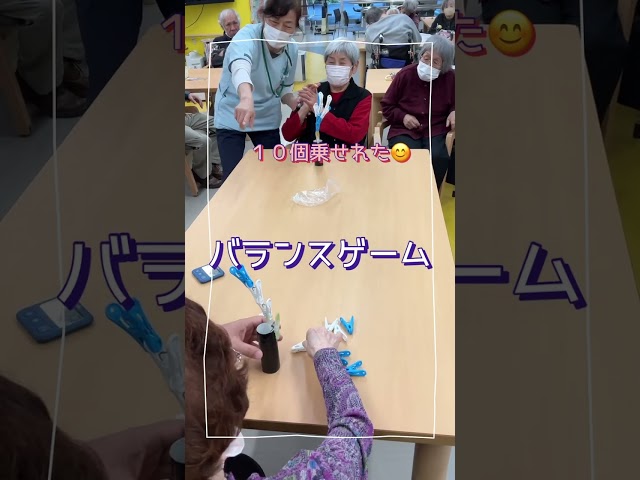
We’d like to introduce a senior-friendly game you can enjoy with everyday materials: the Clothespin Balance Game.
First, stand an empty toilet paper roll upright on a table, then clip clothespins onto it one by one.
The rules are simple: compete to see how many clothespins you can attach without making anything fall.
You can build upward to make it taller, or spread outward like branches.
With a bit of creativity, you can even make interesting, sculpture-like shapes—that’s part of the appeal.
Because it requires careful finger control and concentration, it’s a fun way to train fine motor skills.
It’s a recommended activity that gets everyone excited, whether played individually or in a group.

Rhythmic gymnastics on a journey of the heart

Let me introduce a rhythm exercise you can do on a gentle, melody-filled journey of the heart.
While seated, clap along with the song and alternately touch the insides of your knees.
Cross your arms in front of your chest as if placing your hands on your shoulders.
Moving your feet in step as well may also serve as a good workout for the brain.
The key is to move your whole body with large motions, but only within a comfortable, enjoyable range.
When you move, try to include your facial expressions and feelings too—you may find it even more fun to sing your heart’s journey.

Brain training exercises of see-not, speak-not, hear-not

Let me introduce a brain-training exercise that moves your body and stimulates your mind: the “see no evil, speak no evil, hear no evil” workout.
For “see no evil,” cover your eyes with both hands.
For “hear no evil,” cover your ears with both hands.
For “speak no evil,” cover your mouth with both hands.
When you hear the staff member’s cue, decide which pose it is and move your hands to make that pose.
It can train your reaction speed and thinking skills, and it might even encourage more communication.
Even if you make mistakes, keep it lighthearted—relax and enjoy the exercise!
OK finger exercise

Consciously moving your fingers helps activate the brain, improve circulation, and support smoother daily life.
This simple exercise strengthens and improves finger movement by intentionally engaging your fingers.
You’ll alternately perform a clenching-and-opening motion and a wrist-twisting motion, while also checking that you’re moving properly.
It’s also recommended to do the same with your toes, not just your hands, to help promote circulation throughout your entire body.
Hometown: A song-and-exercise routine that livens things up with three movements

Move your hands to the melody of the children’s song “Furusato,” and stimulate your brain not only through the hand movements but also by visualizing your hometown.
The flow is two claps followed by forming a number with your hands, thinking ahead to the next number while keeping the rhythm of the song in mind.
After making a 5 with both hands, the count returns to 1, so this is where you should focus carefully and aim for smoother movements.
Once you get used to it, we also recommend increasing the speed to further improve concentration.