Tongue twisters used for play and articulation practice.
Whether you’re just having fun or trying to improve your diction, you might as well enjoy it! In this article, we’ll introduce tongue twisters that make wordplay fun and interesting.
We’ve gathered tongue twisters that let you feel the charm of language—some with delightful word sequences that make you want to say them out loud, and others that are amusing even if you don’t quite understand the meaning.
They can also be used for children’s play or oral exercises for older adults, so please use them as a reference!
Japanese tongue twisters that are hard to read and difficult to understand (1–10)
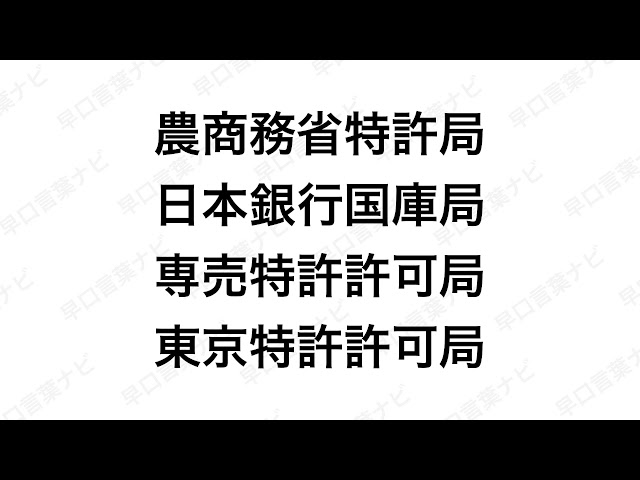
Ministry of Agriculture and Commerce Patent Bureau, Bank of Japan Treasury Bureau, Monopoly Patent Authorization Bureau, Tokyo Patent Authorization Bureau
[Tongue Twister Guide] Ministry of Agriculture and Commerce Patent Bureau, Bank of Japan Treasury Bureau, Monopoly Patent Authorization Bureau, Tokyo Patent Authorization Bureau | Japanese Tongue Twisters | Hayakuchi Kotoba
The government offices that appear in the tongue twister sound like they could be real, but they don’t actually exist.
That sense of plausibility may be what gives it a feeling of reality and makes the tongue twister amusing.
When saying this tongue twister, it might help to picture each office in your own way as you speak.
Because consonants in the “k” row repeat, as in Kyokakyoku or Kokkokyoku, it’s said to be effective for improving articulation.
Of course it’s fun as a tongue twister, but it’s also one that professional announcers and voice actors incorporate into their practice.
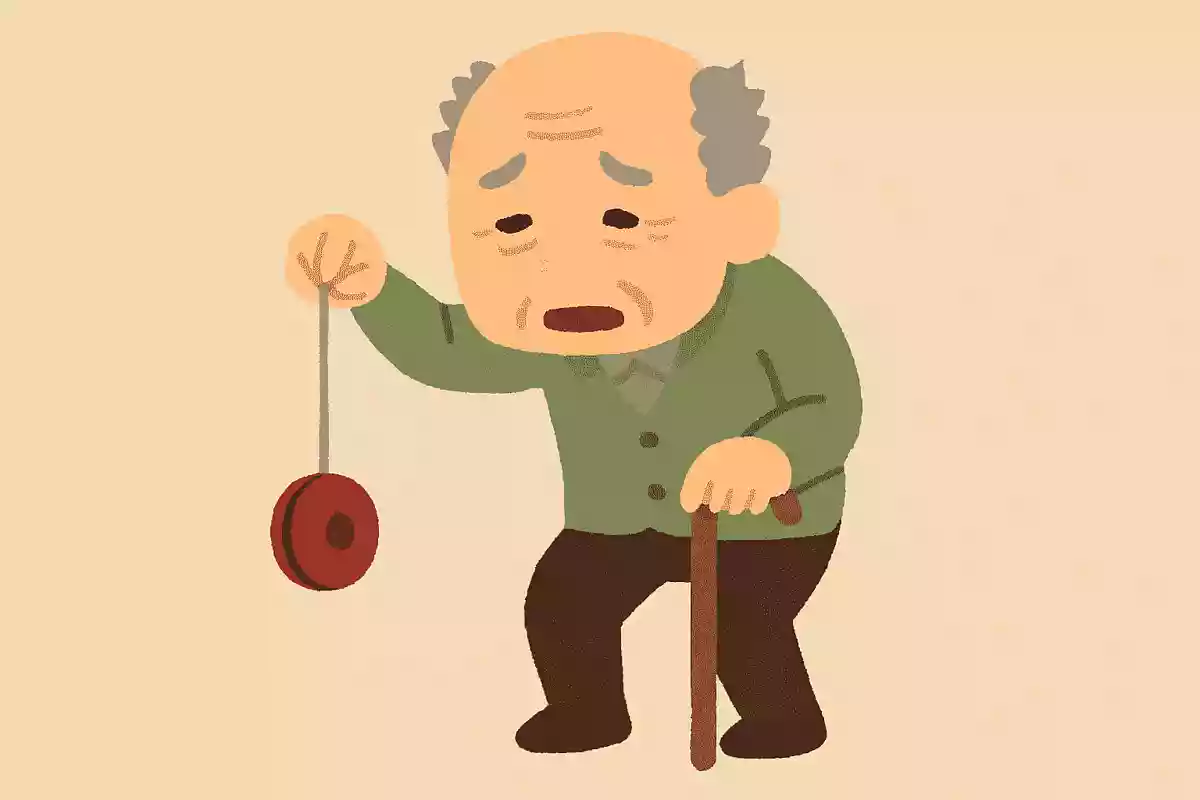
You request a yo-yo as a method to prevent becoming frail.
For those who struggle with the pronunciation of “yo,” this tongue twister might be a real hurdle: “A request for a yo-yo as a way to prevent becoming feeble.” Is someone asking for a yo-yo to prevent aging? Looking at the whole tongue twister, “yo” appears six times, and “yobo” appears four times.
Fortunately, there are no small characters (ゃゅょ), so just focus on the voiced sounds and give it a try.
Try saying it with an emphasis on the “bo.” By the way, some say yo-yos are effective for brain training.
Laugh and liven things up with a tongue-twister activity—we’ll have fun sharing it with participants while improving oral function!
The word “export,” which also comes up in social studies class, is hard to say even on its own, isn’t it? The repeated “yushutsu” is what raises the difficulty of this tongue twister.
Many people find they stumble or have trouble pronouncing it partway through.
While many tongue twisters are on the longer side, this one is relatively short.
Still, despite its length, it’s quite challenging.
It might be easier to read if you break it into words like “export car,” “export hot water,” and “export vinegar.”
There’s a famous Hakata dialect tongue twister: “Kittokatto kattotte tte i’ttotta to ni nande kattotte kuren katta to, tte iwareta kenga Kit Kat kattokan to ikankan’tta to ni katteku’to wasuretotta ken, mata kaigiya ikan to ikanken ga mendokusaka.” It’s quite long, so even just reading it is tough.
In short, it says: “They wanted me to have bought a Kit Kat, but since I forgot to buy it, I have to go buy one now—what a hassle.”
Japanese Difficult and Hard-to-Read Tongue Twisters (11–20)
General Secretary Gorbachev’s child, child General Secretary Gorbachev
[Tongue Twister Navi] General Secretary Gorbachev’s child — Child General Secretary Gorbachev | Japanese Tongue Twisters | Hayakuchi Kotoba |
This is a tongue twister that mainly uses General Secretary Gorbachev’s name.
Some people might not know him.
General Secretary Gorbachev was a Russian politician active from the 1970s to the early 2010s.
His full name is Mikhail Gorbachev.
A funny point in the tongue twister is that his child is referred to as “Little General Secretary Gorbachev.” Try it while paying attention to the pronunciation of “cho” and “sho.” By the way, he had a daughter named Irina.