Tongue twisters used for play and articulation practice.
Whether you’re just having fun or trying to improve your diction, you might as well enjoy it! In this article, we’ll introduce tongue twisters that make wordplay fun and interesting.
We’ve gathered tongue twisters that let you feel the charm of language—some with delightful word sequences that make you want to say them out loud, and others that are amusing even if you don’t quite understand the meaning.
They can also be used for children’s play or oral exercises for older adults, so please use them as a reference!
Japanese Difficult and Hard-to-Read Tongue Twisters (11–20)
Aya, apologize to the greengrocer.
[Tongue Twister Navi] O-Aya Apologizes to the Greengrocer | Japanese Tongue Twisters | Hayakuchi Kotoba
This is a tongue twister that makes you wonder what happened, as someone is advising Aya to apologize to the greengrocer.
It focuses mainly on the “a” and “o” sounds, with occasional Ya- and Ma-row sounds added in, which is what makes it feel complex.
If you find it really hard to say, try practicing with just the vowels first, then switch back to the original sentence—you might find it easier.
If you let too much breath escape while pronouncing, the sounds can get crushed, so keeping your articulation crisp should help it come across more clearly.
I heard Kayō Yamamoto used to go to this high school.
[Hakata Dialect Tongue Twister] People from Fukuoka can say it easily, right!! ✨
There’s a relatively short and easy tongue twister: “Koko no kōkō ni Yamamoto Kayo ga kayottottarashii ken ne.” Yamamoto Kayo is a local TV personality active mainly in Fukuoka and beloved by locals.
In the tongue twister, it means “It seems Kayo Yamamoto used to attend this high school.” It’s a tongue twister that really reflects Fukuoka, especially the Hakata dialect.
If it feels hard, try taking a quick breath at the ‘ga’ part.
On a gas-spraying bus, 100 passengers who often eat persimmons from 100 passenger planes in Massachusetts caused the gas bus to explode.
In Massachusetts, on a gas-spraying bus, 100 frequent-persimmon-eating passengers from 100 passenger planes caused a bus gas explosion. (Read in a news anchor-like voice) [Yoban Niu clip]
A tongue-twister so insanely hard that nailing it deserves a standing ovation! This one-liner—“In Massachusetts, 100 passenger planes each carrying 100 persimmon-loving passengers cause a gas-bus explosion”—is a chaotic masterpiece that tests your diction, focus, and sense of humor all at once.
It kicks off with the foreign place name “Massachusetts,” piles on numbers and tricky phrases, and caps it with the classic “gas-bus explosion.” You have to fire through it in one breath, and even if you mess up, it’s guaranteed laughs.
Whether you nail it or fail it, it kills either way—truly top-tier tongue-twister material.
Try it with friends or coworkers and watch the room explode with energy.
Our well bucket won’t break; the neighbor’s well bucket will.
[Tongue Twister] #20 'The well bucket at home is an uncrushable bucket; the neighbor’s well bucket is a crushable bucket' #Shorts
This is a tongue twister that repeatedly uses the same word, making it easy to misspeak with slight differences.
A key feature of the phrase is that the word “tsurube” appears many times.
Because of the difference between “tsuburenu” (doesn’t get crushed) and “tsubureru” (gets crushed) and the consecutive “ts” sounds, your tongue tends to get tangled as your speaking speed increases.
The trick to mastering this phrase is to keep a steady rhythm for “tsurube” while pronouncing each word carefully.
Practice by focusing on accuracy first, then gradually increasing your speed as you confirm correct pronunciation.
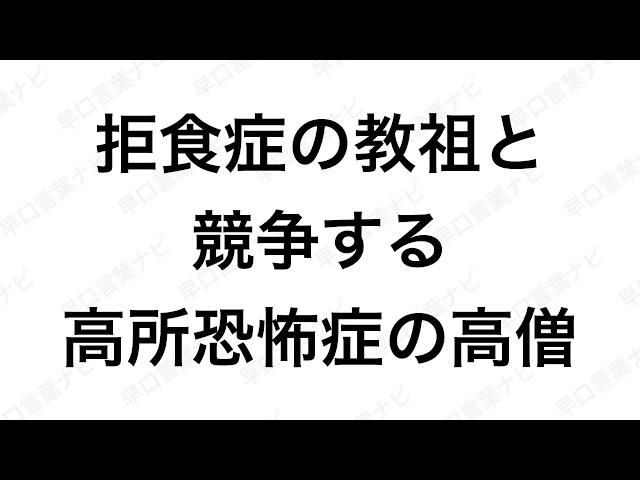
A high priest with acrophobia competing with the guru of anorexia
[Tongue Twister Navigator] A guru with anorexia competes with a high-ranking monk with acrophobia | Japanese Tongue Twisters | Hayakuchi Kotoba |
First of all, the sentences themselves are funny.
Yet you have to repeat them quickly—that alone makes for a hilarious tongue twister.
These tongue-twister lines paint scenarios that make you laugh and wonder, “What’s going on?” Why not compete with family and friends to see who can rattle off these fun tongue twisters the best? Let’s play with tongue twisters that train the “kya” and “sha” sounds.
If you get flustered or too intense, you’ll stumble and get tangled up.
They’re tongue twisters you can brag about if you nail them.
It’s also fun to improve and leave your friends speechless.
Ultimate luxury aircraft at a deserted Kyushu airport
[Tongue Twister Navi] Ultimate Luxury Aircraft at the Empty Kyushu Airport | Japanese Tongue Twisters | Hayakuchi Kotoba |
Let me introduce a rising star among fiendishly tricky tongue twisters that you just can’t help but stumble over: “The ultimate luxury aircraft of the vacant Kyushu airport.” With the repeated bursts of ‘kyu,’ ‘ku,’ and ‘kou’ sounds, the faster you go, the more your tongue gets lost.
The ending, especially “ultimate luxury aircraft,” is a notorious pitfall that makes you giggle as your mouth can’t keep up.
It’s addicting because, despite being completely meaningless, it’s the sound alone that makes it so hard to say.
Great for practicing solo or getting a group laughing as you challenge each other.
Perfect for articulation drills and party games alike.
How many times can you say it in a row without tripping up?
[Question for Otoha] Looking for a circus at Akasaka Sacas [Tongue Twister #71] #Shorts
A tongue twister modeled after Akasaka Sacas, a multi-purpose complex in Minato City, Tokyo.
The hallmark of this phrase is the repeated combination of the “sa” and “ka” sounds.
Because the two parts—Akasaka Sacas and “saakasu sagasu” (search for a circus)—sound similar, saying it quickly can easily tangle your tongue and cause confusion.
Add emphasis by clearly separating each word and focusing on each sound.
Like rhyming in rap, paying attention to the vowels and speaking rhythmically out loud is also a recommended way to master it.