



Tongue twisters used for play and articulation practice.
Whether you’re just having fun or trying to improve your diction, you might as well enjoy it! In this article, we’ll introduce tongue twisters that make wordplay fun and interesting.
We’ve gathered tongue twisters that let you feel the charm of language—some with delightful word sequences that make you want to say them out loud, and others that are amusing even if you don’t quite understand the meaning.
They can also be used for children’s play or oral exercises for older adults, so please use them as a reference!
- Challenging tongue twisters: Introducing high-difficulty phrases and sentences!
- [Recreation] Challenge! A roundup of tongue twisters recommended for elementary school students
- [Diction Training] A Collection of Tongue Twisters to Improve Articulation
- Nagoya dialect tongue twisters are exquisite! A fun collection where your tongue gets tied in knots with regional dialects
- Witty quotes that make you chuckle without thinking
- “Chau chau, anta” — a Kansai-dialect tongue twister. A phrase only Kansai folks can say.
- Bursting into laughter! A roundup of Hakata dialect tongue twisters
- [For Seniors] Boost Oral Function with Tongue Twisters! Recommended Picks to Try
- The magical power of words that make people laugh! A collection of quotes that lighten the heart
- Challenge together! A roundup of word games for adults
- [Trick Quiz] Quiz Questions That Excite Everyone from Kids to Adults
- [Rec] Interesting! A roundup of wordplay games
- A collection of long tongue twisters. Also recommended for practicing announcements and narration.
A Collection of Tongue Twisters with Fun Wordplay (1–10)
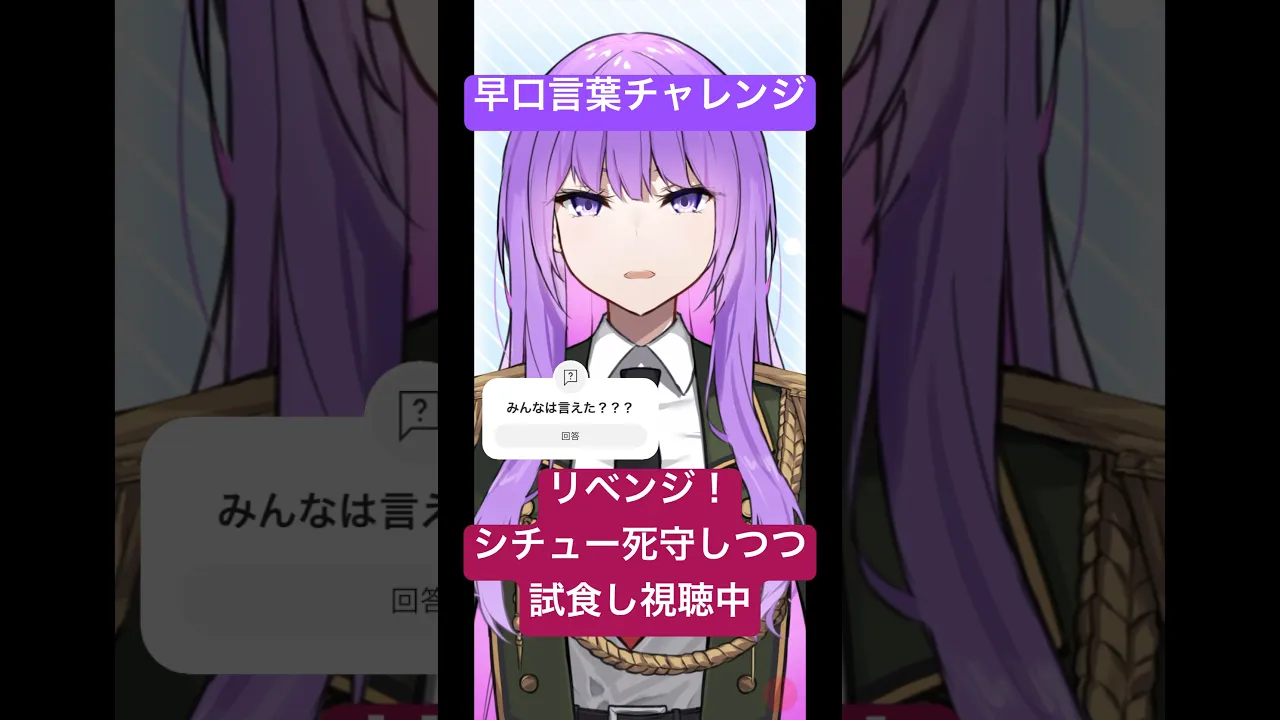
While guarding the stew, I’m taste-testing and watching (something)

It’s a tongue twister that’s fun precisely because the situation is hard to read—someone is desperately guarding their stew while watching something.
The slightly different yet similar sounds of the words “shichū” (stew), “shishu” (to defend to the death), “shishoku” (tasting), and “shichō” (listening/viewing) create a sense of awkwardness in pronunciation.
First, the strangeness of a situation where someone is dead set on protecting their stew is striking—it makes you wonder if it’s their absolute favorite food.
Even though it’s normal to watch something while eating, adding an obsession with the food itself makes the sentence feel curious and odd.

The tapir who throws up after seeing the bus gas explosion.

It’s like taking the classic tongue twister “bus gas explosion” and adding the reaction of someone who witnessed it.
A bus having a gas explosion is a shocking situation, so it makes sense that a tapir who sees it would end up vomiting.
It’s also key that it doesn’t get caught in the blast: one side is the explosion, while the other quietly throws up—this contrast adds to the humor.
The words “bus,” “gas,” “explosion,” “vomit,” and “tapir” all sound similar in Japanese, which is what makes it hard to say.
The mystery of the banana is still a mystery.

This tongue twister focuses on the N-sound, which becomes tricky and changes when pronounced consecutively.
It’s a simple combination of words, yet the phrase “banana’s mystery” has a curious charm, doesn’t it? Even if you make a point of separating the words clearly because it’s hard to say when read in sequence, there’s a mischievous twist at the end: the phrase “nanoda zo,” which is one word yet difficult to pronounce.
There’s also a more complex version that adds “Banana no nazo no nazo-nazo nado nazo na no dakeredo” at the beginning.
By repeating it, this tongue twister seems perfect for really training your N-sounds.
Well, well—are you the parent of a greengrocer or the parent of a potato seller?

It’s a tongue twister with a rather unclear situation—being unsure whether it’s the parent of a greengrocer or the parent of a potato seller.
The tricky point of this tongue twister lies in the mouth shapes for “o” and “ya.” Be mindful of switching between the small mouth opening for “o” and the wide opening for “ya.” In the part where “ya” repeats, you keep the same mouth shape and move only your tongue to produce the same sound, so tongue movement is just as important as mouth shape.
Among mostly “a” and “o” sounds, the single “i” sound in “imoya” (potato seller) adds to the overall difficulty.
I gotta buy some KitKats.

There’s a tongue twister that plays on the KitKat product name: “Kit Kat kattokan to ikankatta noni, anta ga kattokan katta node, ikankatta kanda wa.” It’s pretty confusing, isn’t it? In simple terms, it means something like, “We were supposed to buy a Kit Kat, but you didn’t buy it in advance, so that was no good.” The phrases “katto” and “katta” keep appearing, so pay attention to those and give it a try.

Red seared short ribs, Blue seared short ribs, Yellow seared short ribs
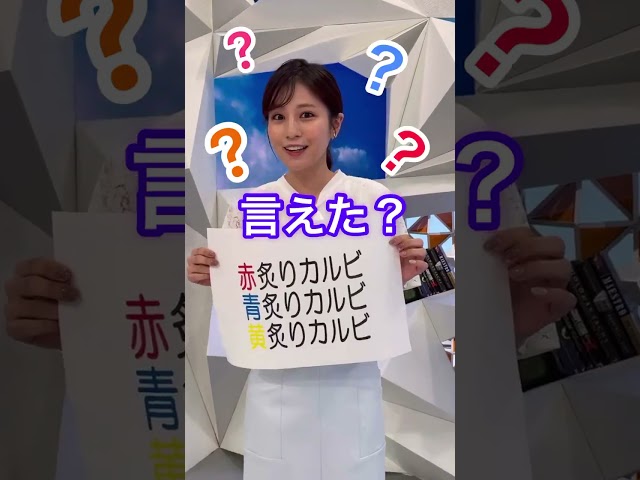
When it comes to classic tongue twisters, aren’t the ones themed around red, blue, and yellow the go-to? There are many variations, like “aka makigami, ao makigami, ki makigami” (red wrapping paper, blue wrapping paper, yellow wrapping paper) and “aka pajama, ao pajama, ki pajama” (red pajamas, blue pajamas, yellow pajamas).
Among them, this tongue twister is especially difficult.
Even just saying “aburi karubi” is hard, and this one is even more challenging.
Try saying only “aburi karubi” first, and you’ll get a feel for how tough it is.
By the way, the trick is to put a stronger intonation on the “bu” sound.
super-duper drippy catcher

It’s a tongue twister that makes you wonder why on earth the baseball catcher is all soaked and sopping wet.
The word “mecha-mecha” (super/very) also adds to the humor of the situation, conjuring up an image of someone so drenched it’s obvious at a glance.
You can tell he’s a catcher at the moment he’s holding up his mitt, so imagining him still getting into position while dripping wet brings a mix of concern and laughter.
Focusing on the mouth shapes for “mecha,” “bicha,” and “catcher” should make it easier to say.