

Challenging tongue twisters: Introducing high-difficulty phrases and sentences!

Tongue twisters exist in every country.
I think everyone in Japan has been familiar with them since childhood.
This time, I’ve picked out only the especially difficult tongue twisters.
You’ll find not only long, complicated ones, but also very short tongue twisters that are surprisingly hard to say.
Although tongue twisters might seem like they’re just for kids, adults can enjoy them too at parties or drinking gatherings.
If you practice in advance, you might even become the center of attention in those situations.
Now then, please sit back and enjoy!
- Tongue twisters that will make you laugh out loud! Super funny
- [Diction Training] A Collection of Tongue Twisters to Improve Articulation
- A collection of long tongue twisters. Also recommended for practicing announcements and narration.
- Nagoya dialect tongue twisters are exquisite! A fun collection where your tongue gets tied in knots with regional dialects
- Challenge together! A roundup of word games for adults
- “Chau chau, anta” — a Kansai-dialect tongue twister. A phrase only Kansai folks can say.
- Bursting into laughter! A roundup of Hakata dialect tongue twisters
- [Recreation] Challenge! A roundup of tongue twisters recommended for elementary school students
- [Challenging and Fun!] Quizzes & Riddles for Adults
- Chinese tongue twisters: A collection of rao kou ling helpful for learning Chinese
- Perfect for pronunciation practice! A collection of English tongue twisters.
- [Trick Quiz] Quiz Questions That Excite Everyone from Kids to Adults
- Get Caught? Or Not!? Simple Ways to Kill Time During Class
Difficult tongue twisters. Introducing high-difficulty phrases and sentences! (51–60)
100 passenger aircraft, 100 passengers each

A tongue twister that’s hard even when spoken slowly: “100 passenger planes, 100 passengers each.” Let’s first go over the reading step by step.
"旅客機" is read as "ryokakuki," and the part "客各100人" is read as "kaku-kyaku hyaku-nin." In other words, each of the 100 airplanes has 100 passengers on board.
If you insert a slight pause after “kaku,” you’ll be more likely to succeed.
Incidentally, there’s an even harder version: “In Massachusetts, 100 passenger planes, with 100 persimmon-eating passengers each, are riding a gas-spraying bus and the bus gas explodes.” If you want to raise the difficulty, give that one a try too.

Monkeys stabbing bamboo leaves, monkeys getting stabbed by bamboo leaves, monkeys getting stabbed by bamboo leaves, monkeys rubbing.Kenta Otani
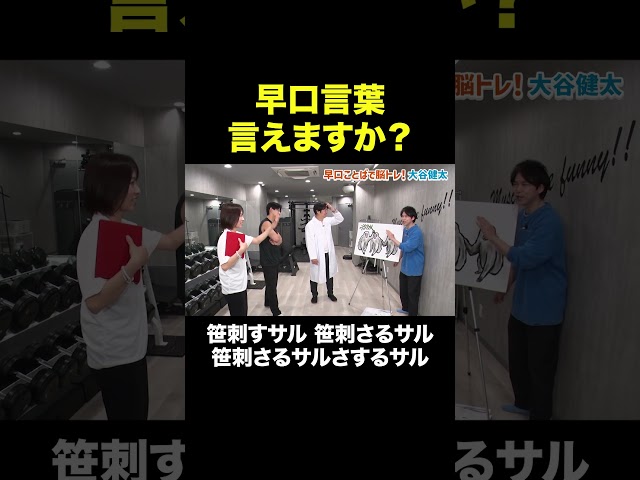
It’s a tongue twister depicting three monkeys: one monkey stabbing bamboo leaves, one monkey being stabbed with bamboo leaves, and one monkey rubbing them.
Part of the fun is that you can’t really tell why anyone would be stabbing bamboo leaves in the first place—the background is a mystery.
In any case, it’s a tongue twister packed with consecutive sa sounds, so proceed while figuring out where other characters slip in.
Be careful not to stumble on the intervening r sounds when you’re too focused on sa.
It’s important to check your mouth shape and airflow as you pronounce it.

Snowplow in operation

A tongue twister based on a scene often seen in snowy regions: “Snowplow snow removal in progress.” The tricky part of this tongue twister is that the word for “snow removal” appears twice, which makes it easy to lose track of where you are as you repeat it.
It also features several pronunciation challenges: the “jo” sound occurs twice, and the “sha” and “gyo” sounds each occur once.
Try practicing with those four points in mind.
If you master this tongue twister, you might just get better at pronouncing the small kana sounds (ゃ, ゅ, ょ).
Author intraoperative
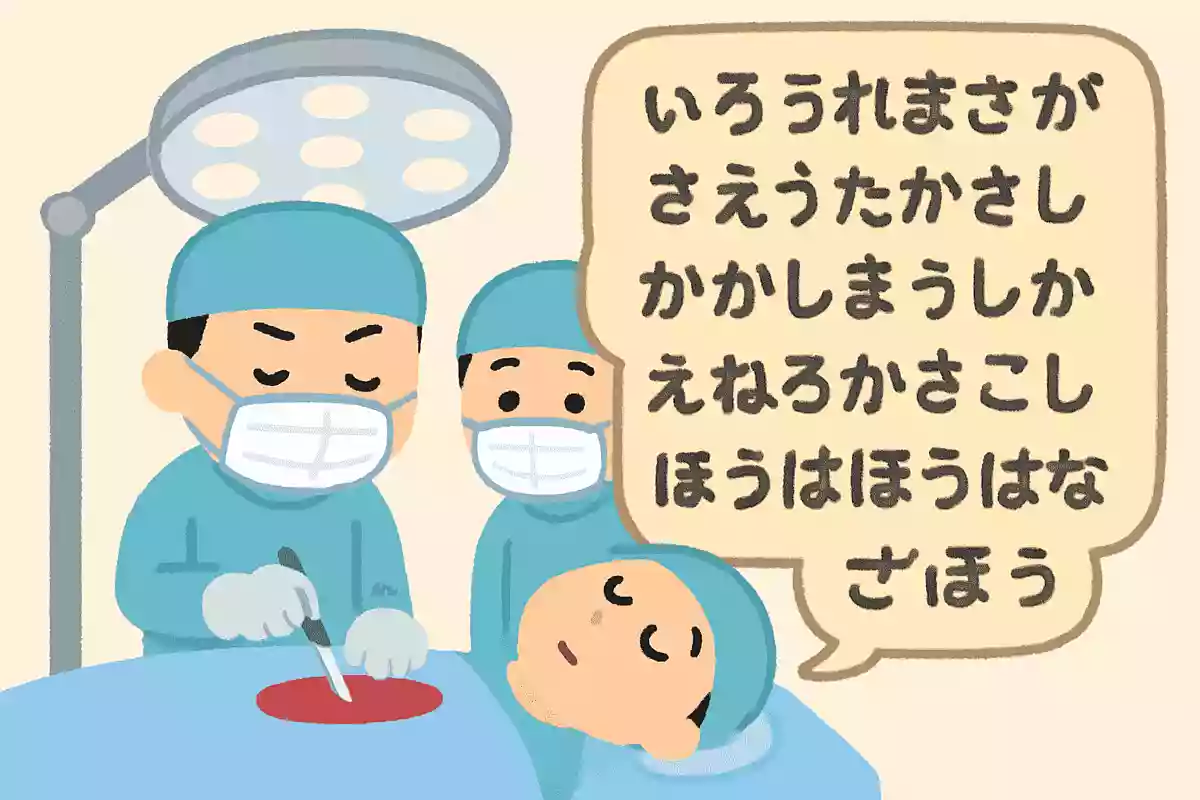
The tongue twister “chosakusha shujutsu-chu” (author undergoing surgery) gives off a somewhat serious vibe.
It makes you wonder what happened to the author, doesn’t it? This tongue twister is simply composed of hard-to-say words lined up in a row.
However, it’s trickier than it looks, so be careful.
In particular, the “shujutsu” part is where many people stumble.
Also, because it’s short, you keep running into the tricky spots as you repeat it, which is one reason it’s so difficult.
Difficult Tongue Twisters. Introducing high-difficulty phrases and sentences! (61–70)
Tongue Twister Challenge

Prepare a tongue-twister script and challenge yourselves to see how many seconds it takes to read it! Announcers and voice actors use this as enunciation training, right? If you search for “tongue twisters,” you’ll find plenty, and you can also create your own.
Add furigana to the kanji so that even first-time readers can read it.
The person who reads it the fastest without stumbling wins! Tripping up, getting stuck, and struggling to say it will get everyone excited, and if you can say it smoothly, you’re sure to draw attention!

Consumption expenditures; Non-consumption expenditures

Let me introduce a somewhat tricky tongue twister: “consumption expenditure fee, non-consumption expenditure fee.” The words are quite similar, aren’t they? The term “consumption expenditure fee” refers to money paid in exchange for obtaining something—like food costs, rent, or entertainment expenses.
In contrast, “non-consumption expenditure fee” refers to money paid without directly getting something in return—such as social insurance premiums, health insurance, or consumption tax.
Keeping those meanings in mind, give it a try.
Once you master “consumption expenditure fee,” all you have to do is add “non-” to complete the second phrase.
You request a yo-yo as a method to prevent becoming frail.
For those who struggle with the pronunciation of “yo,” this tongue twister might be a real hurdle: “A request for a yo-yo as a way to prevent becoming feeble.” Is someone asking for a yo-yo to prevent aging? Looking at the whole tongue twister, “yo” appears six times, and “yobo” appears four times.
Fortunately, there are no small characters (ゃゅょ), so just focus on the voiced sounds and give it a try.
Try saying it with an emphasis on the “bo.” By the way, some say yo-yos are effective for brain training.