

[For Seniors] Extremely Effective Brain Training! A Fun Collection of Hand Games


As a form of recreation for older adults, many facilities incorporate hand games that involve moving the fingers and arms.
It’s said that making fine movements with the fingertips or performing different motions with the right and left arms helps activate the brain.
In this article, we’ll introduce a variety of hand games that also serve as brain training.
These hand games range widely—from activities that only move the fingertips to ones that use the arms, and even the upper body and legs.
Please choose activities that match participants’ physical condition.
- [For Seniors] Hand and finger play roundup: Finger exercises that lead to brain training
- [For Seniors] Simple Recreational Activities You Can Enjoy While Seated
- [For Seniors] Enjoyable Brain Training! Finger Exercises That Help Prevent Dementia
- Hand games that liven things up for seniors—also great brain training
- [For Seniors] Fun and Engaging Brain-Training Recreation
- [Brain Training for Seniors] Recommended Hand-Play Recreation for Dementia Prevention
- [For Seniors] Fun Recreational Activities Without Equipment
- [For Seniors] Today’s Recommended Activity: Fun and Engaging
- [For Seniors] Popular Hand-Play Songs: Fun Brain-Training Ideas
- [For Seniors] Recommended Easy Strength Training
- [For Seniors] Easy and fun seated activities you can do in your room
- [For Seniors] Fun! Games and Ideas to Boost Memory
- Recreation Activities Effective for Long-Term Care Prevention for Seniors
[For Seniors] Highly Effective for Brain Training! A Fun Collection of Hand Games (31–40)
Balance game with clothespins
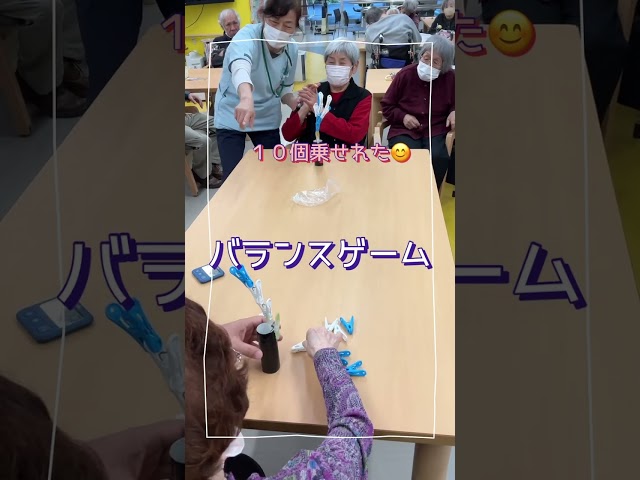
We’d like to introduce a senior-friendly game you can enjoy with everyday materials: the Clothespin Balance Game.
First, stand an empty toilet paper roll upright on a table, then clip clothespins onto it one by one.
The rules are simple: compete to see how many clothespins you can attach without making anything fall.
You can build upward to make it taller, or spread outward like branches.
With a bit of creativity, you can even make interesting, sculpture-like shapes—that’s part of the appeal.
Because it requires careful finger control and concentration, it’s a fun way to train fine motor skills.
It’s a recommended activity that gets everyone excited, whether played individually or in a group.

Balance game with paper cups and a ball
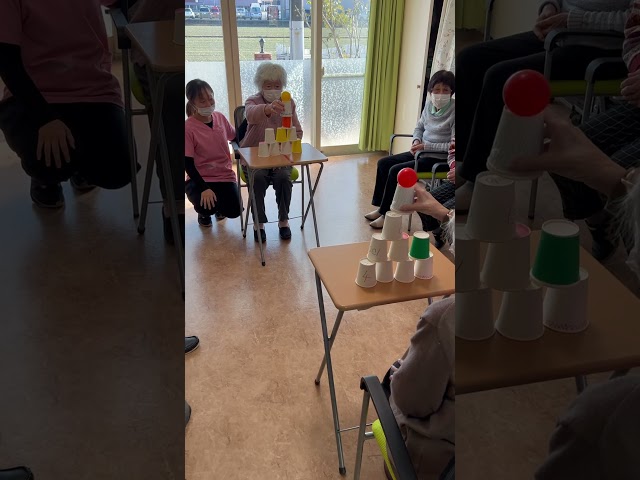
Introducing a unique balance game for seniors that uses paper cups and a ball: “Balance Game with Paper Cups and a Ball.” Stack paper cups into a pyramid and place a ping-pong ball or similar ball on the topmost cup to begin.
Carefully move the cups one by one, stacking each onto the cup below while making sure the ball doesn’t fall.
With movements similar to sport stacking, you clear the game once you’ve finished nesting all the paper cups into one stack! It’s a fun way to train concentration, finger dexterity, and sense of balance.
Since it can be played while seated, even those who aren’t confident in their physical stamina can participate with peace of mind.
It’s a recreational activity full of thrilling, heart-pounding moments.
Finger exercises with plastic bottle caps

Here’s a recreational activity you can make using the many plastic bottle caps that tend to pile up.
Place the caps on a base sheet, matching each cap with the same kanji written on the sheet, making sure not to make mistakes.
Kanji sets that are hard to distinguish—like the fish or tree radicals series—are recommended.
Because players identify the characters while pinching the caps with their fingers, it trains both the brain and fine motor skills.
Give it a try—make it and play with it! You could also turn it into a game by pairing addition problems with their answers.

Bamboo Shoot Digging Game

Here’s a sit-down bamboo shoot digging game you can enjoy.
Tear up newspaper and hide bamboo shoots made from milk cartons in it.
Use a hanger to push aside the newspaper and find the bamboo shoots.
When you peel the milk carton off the bamboo shoots you’ve found, you’ll discover a daikon radish and a bamboo shoot made by wrapping items around plastic bottles.
Each item has points: daikon is 10 points and bamboo shoot is 100 points.
Compete to see how many points you can score—the highest score wins! Setting a time limit will make it even more exciting.

Table hockey

Let us introduce a game that gets everyone excited with simple preparation: table hockey.
Once you have a table ready, build walls at both ends so the ball won’t fall off.
Make mallets out of cardboard, and when you have a ping-pong ball, the game begins.
Push the ball to make it fall onto the opponent’s side, and race to five points.
It’s a simple yet incredibly thrilling game.
It can also help with rehabilitation from the hands to the shoulders, so even those who don’t like rehab can enjoy getting exercise benefits.
Give it a try!
[For Seniors] Highly Effective Brain Training! A Fun Collection of Hand Games (41–50)
Seated Rhythm Exercises to Classic Showa-Era Hits

This time, we’d like to introduce “singing exercises” that get your body moving to nostalgic Showa-era hits.
Since you’ll be moving your body, it’s best to start with a slower tempo.
When you move to music, your brain is continuously handling multiple activities—keeping the beat, moving your body, and planning what to do next.
Because of this, a wealth of stimuli activates the brain, and it’s said to offer benefits similar to brain training.
Once you get used to it, adding singing while you move will stimulate your brain even more.
Do it within a comfortable range, and most of all, enjoy yourself.
Chestnut Picking Game

Let me introduce the Chestnut-Picking Game, a fun way to help with arm rehabilitation.
Make ring shapes out of construction paper in the shape of chestnuts and write point values on them.
You can also make maple and ginkgo leaves to set the mood.
Once you place everything in a cardboard box, you’re ready to go.
Use a cane to pick up the chestnuts and compete based on the points of the ones you collect.
Once everyone gets used to it, add a time limit, such as finishing within 30 seconds, or rules like making the last chestnut worth double points to keep it feeling fresh and exciting.
It can be enjoyed while sitting in a chair or using just one hand, so it’s recommended as a recreational activity at senior care facilities.