

[For Seniors] Challenging but Exciting! Kanji Quiz


In this article, we introduce kanji quizzes designed for older adults!
These quizzes are often used as activities at day service centers, and this time we’ve gathered ones that focus on kanji.
With people using mobile phones more often and being able to convert text so easily, many can read kanji but find writing them difficult, don’t you think?
It’s great to let each person think carefully on their own, and it’s also fun to solve the questions everyone’s unsure about by chatting and consulting together.
Kanji quizzes are a win-win—they train the brain and help with studying—so be sure to give them a try!
- [For Seniors] Fun and Exciting! Difficult Kanji Quiz
- [For Seniors] Lively Wordplay Game: Fun Recreation for Elderly Care
- [For Seniors] Perfect for Dementia Prevention! Jumbled Kanji Quiz
- [For Seniors] How many can you read? A comprehensive showcase of difficult food kanji
- [For Seniors] Fun! Let’s Get Excited with Japan’s Number One Quiz
- [For Seniors] Quiz on Kanji with Many Strokes
- [For Seniors] Fun and Lively! Recommended Quiz Questions
- [For Seniors] Have Fun with Wordplay Characters! A Collection of Funny Puzzles
- [Interesting] Summary of Kanji Reading Quiz Questions
- [For Seniors] Today’s recommended quiz. Daily brain-training quiz!
- [Brain Training] Lively Word Quiz for Seniors
- [For Seniors] Kanji Decomposition Quiz: Assemble the scattered characters
- [For Seniors] Fun Riddles That Stimulate the Brain
[For Seniors] Challenging but Lively! Kanji Quiz (11–20)
Name of the sweets

There are plenty of snack names we casually read every day that, when written in kanji, we’re not actually sure how to read.
You might imagine older people would know them better, but when they’re presented as a quiz, many of us still draw a blank.
The process of recalling words you’ve momentarily forgotten is good brain training, and getting the right answer feels satisfying, so it makes for a lively activity in day-service recreation.
However, if participants are struggling too much to find the answer, prepare hints that capture key characteristics, and facilitate the session in a way that doesn’t build up stress for the respondents.

Confusing kanji

One of the tricky things about Japanese is that the same word can use different kanji depending on its meaning, and the kanji can change with the nuance.
This set focuses on commonly confused kanji that people often memorize incorrectly or end up writing by mistake.
それは難しく聞こえるかもしれませんが、実際には「Atsui: 暑い or 熱い — どっち?」のような二者択一の問題が出る、シンプルで楽しいクイズです。遊び方も理解も簡単です。
If you also learn how the incorrect kanji is used in other contexts, it leaves a stronger impression and should make it less likely you’ll make the same mistake next time.

Puzzle Kanji Quiz

A puzzle kanji quiz where you combine jigsaw-like pieces to form a complete character and answer which kanji it makes.
Putting together kanji split into parts also works as brain training for older adults.
When choosing kanji, it’s best to pick ones with easy-to-recognize radicals or fewer strokes.
Even simple characters can take time to solve, so set a generous time limit.
You can present just one character, or adjust the difficulty with two-character compounds to make it more exciting.
Give this quiz a try and enjoy the satisfying feeling when you figure out the answer!

Find the odd one out

Let’s liven things up with a kanji quiz that helps you learn kanji knowledge while having fun.
A grid is filled with the same kanji, but there’s just one that’s different.
The game is to find it.
If you set a time limit and do a countdown, it gets even more thrilling and exciting.
It also works as brain training to boost memory and concentration.
Although it uses kanji, it’s like a game that requires eyesight and attention, so it’s great fun to take on the challenge with a big group of friends.
Let’s prepare an easy-to-enjoy kanji quiz for seniors as well and have everyone play together.

Four-character idiom fill-in-the-blank quiz

This is a recreation activity where you hide one character from a common four-character idiom—phrases frequently used in everyday conversation by Japanese people—and turn it into a quiz.
Even idioms whose meanings we understand and use in conversation can be tricky when we try to write them down.
Many people have probably also experienced having a clear image in mind but forgetting which kanji to use.
When giving this quiz to older adults, prepare questions suited to the group’s level and offer hints such as the idiom’s meaning.
Running it in a way that stimulates the brain can make it a form of training, so give it a try.
Kanji addition

The “kanji addition” game, where you combine radicals to figure out what character they form, has been popping up a lot on quiz shows in recent years.
Even kanji everyone should know become unrecognizable once they’re broken apart, so just thinking through them helps stimulate the brain.
Once you get used to it, it could be even more fun to take all the kanji from two- or three-character compounds, break them down into their radicals, and turn them into quizzes.
In today’s world, where the spread of computers and smartphones has reduced opportunities to handwrite kanji, this is a quiz that’s surprisingly tough not only for seniors but also for younger generations—so give it a try!
[For Seniors] Difficult but Exciting! Kanji Quiz (21–30)
“立” + “木” + “見” + “子” =
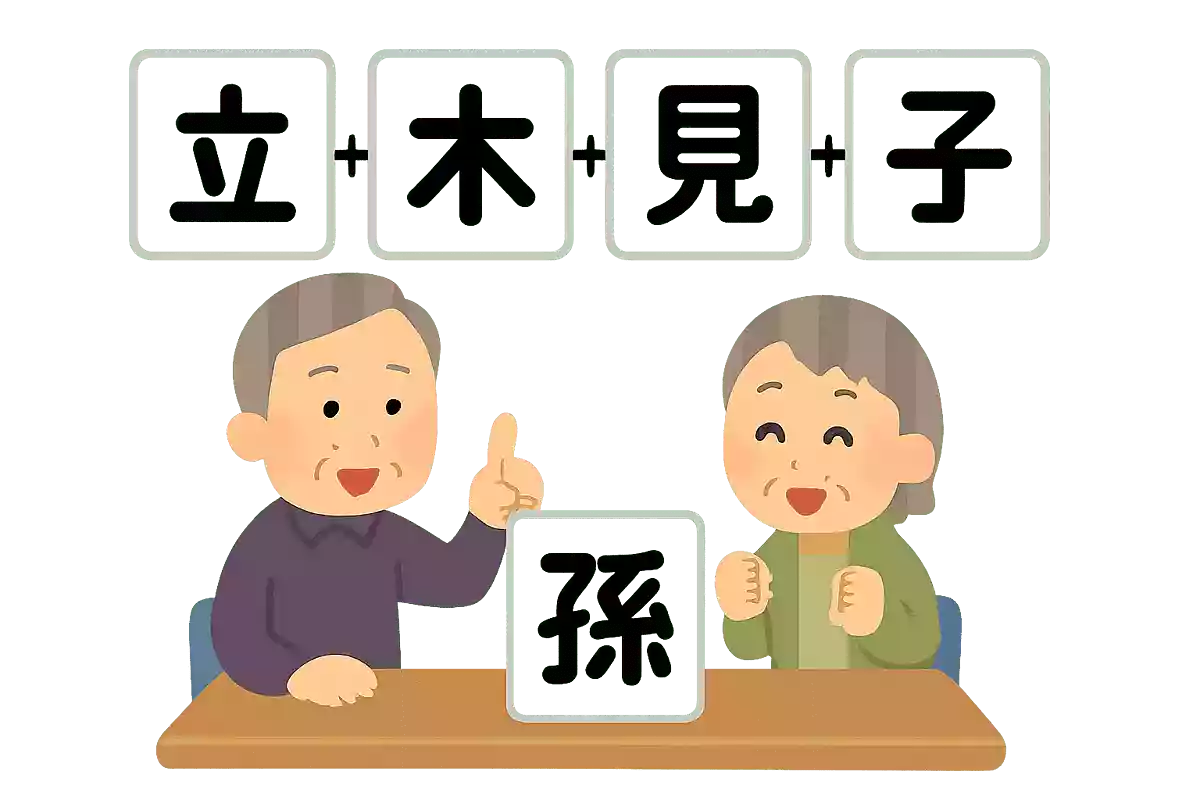
これは、漢字の『立』(stand)、『木』(tree)、『見』(see)、『子』(child)を組み合わせて、ひとつの単語を完成させるパズルです。
The challenge lies in how many parts you use to form one kanji and in the process of figuring out the combinations, which can stimulate the brain.
The answer is “parent and child.”
It’s a tricky problem because you need to arrive at the kanji “親” (parent), which is formed by combining three of the components.
A clear strategy is to use the more complex part, '見', as the center and then consider how to place the others around it.