

[For Seniors] Challenging but Exciting! Kanji Quiz


In this article, we introduce kanji quizzes designed for older adults!
These quizzes are often used as activities at day service centers, and this time we’ve gathered ones that focus on kanji.
With people using mobile phones more often and being able to convert text so easily, many can read kanji but find writing them difficult, don’t you think?
It’s great to let each person think carefully on their own, and it’s also fun to solve the questions everyone’s unsure about by chatting and consulting together.
Kanji quizzes are a win-win—they train the brain and help with studying—so be sure to give them a try!
- [For Seniors] Fun and Exciting! Difficult Kanji Quiz
- [For Seniors] Lively Wordplay Game: Fun Recreation for Elderly Care
- [For Seniors] Perfect for Dementia Prevention! Jumbled Kanji Quiz
- [For Seniors] How many can you read? A comprehensive showcase of difficult food kanji
- [For Seniors] Fun! Let’s Get Excited with Japan’s Number One Quiz
- [For Seniors] Quiz on Kanji with Many Strokes
- [For Seniors] Fun and Lively! Recommended Quiz Questions
- [For Seniors] Have Fun with Wordplay Characters! A Collection of Funny Puzzles
- [Interesting] Summary of Kanji Reading Quiz Questions
- [For Seniors] Today’s recommended quiz. Daily brain-training quiz!
- [Brain Training] Lively Word Quiz for Seniors
- [For Seniors] Kanji Decomposition Quiz: Assemble the scattered characters
- [For Seniors] Fun Riddles That Stimulate the Brain
[For Seniors] Difficult but Exciting! Kanji Quiz (41–50)
garlic
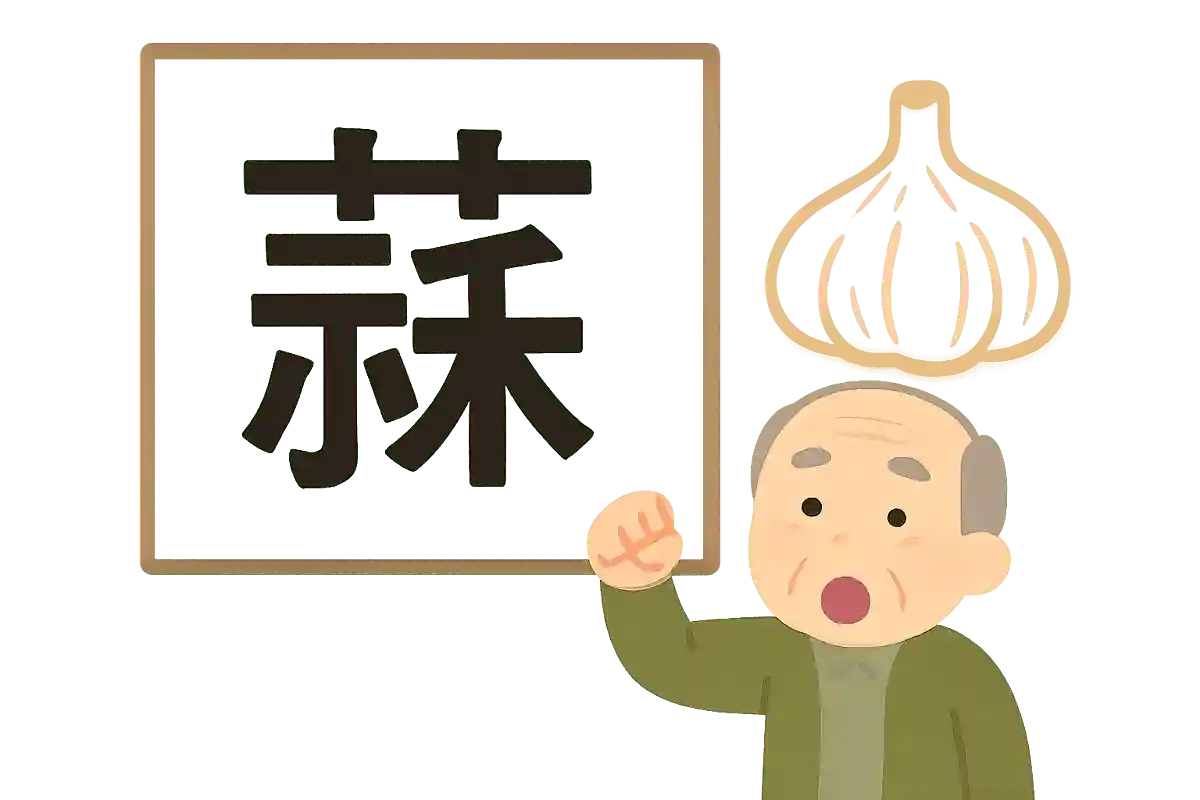
A plant mainly used for food, with the bulb as the primary part and the sprouting stem, known as shoots, also eaten.
Records indicate it was cultivated in ancient Egypt around 3200 BCE, giving it a very long history.
Most notable is its strong odor, and it is widely cherished around the world as a spice with invigorating, restorative effects.
The answer is garlic; it is said to have been introduced to Japan in the Heian period, and before the customs of eating meat and using oils became established, it appears to have been used as a tonic for promoting vitality.

[For Seniors] Challenging but Exciting! Kanji Quiz (51–60)
Difficult-to-read kanji of spring

This is a quiz that presents items commonly seen in spring—such as foods and animals—written in kanji, and asks you to think of their readings.
Even if you know the words, you might not often see them in kanji, and some may be more strongly associated with being written in katakana or hiragana.
The fact that they’re related to spring is a major hint, so you might find the answer by picturing springtime scenes.
It may help to consider the meanings of each kanji used and think of things associated with spring that fit those meanings.
cherry (specifically, sweet cherry)
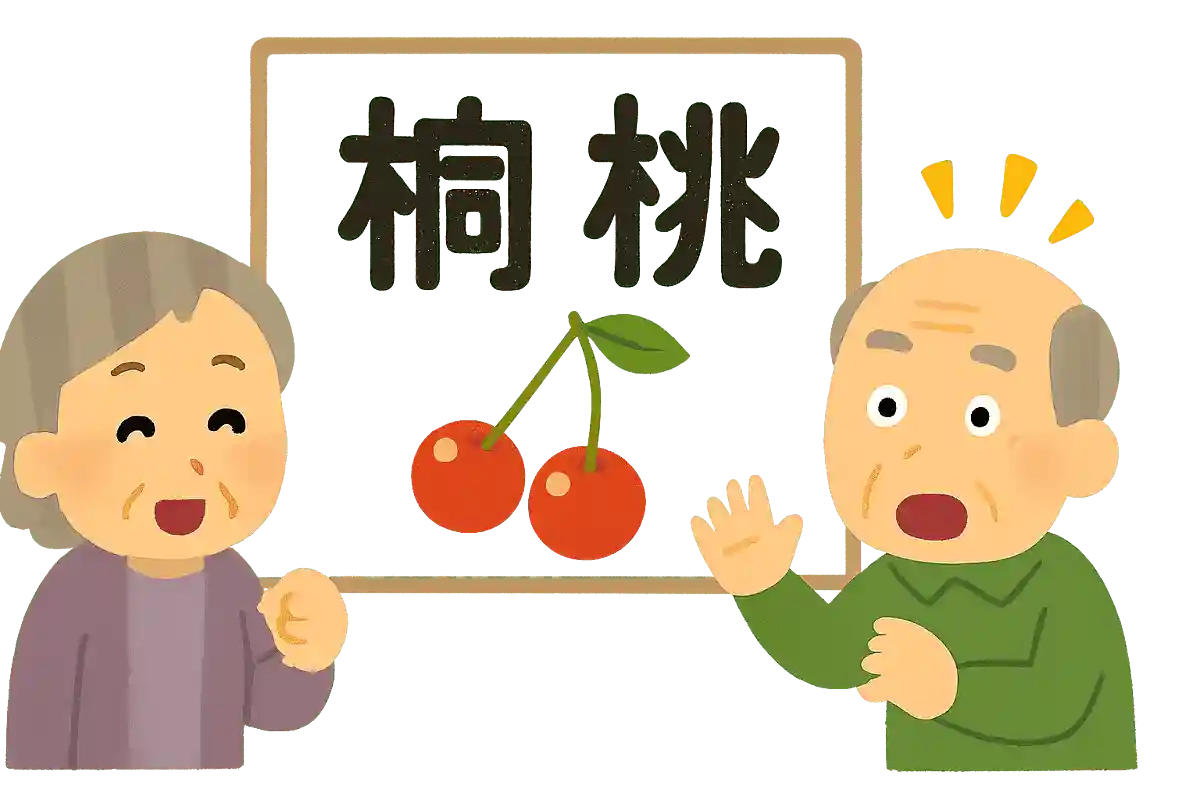
As you can infer from the kanji for sakura, it’s a plant related to cherry blossoms, and many varieties are cultivated in Japan.
It’s a fruit characterized by its red, round appearance—some people might guess it from that description alone.
Rather than imagining the meaning of the kanji, simply reading the characters as “sakura momo” already gets you quite close to the answer.
The answer is cherries (sakuranbo).
Because it’s associated with cherry blossoms, you might assume it has a long history in Japan, but it’s actually a fruit with a surprisingly short history, said to have been introduced from China in the early Meiji period.
sponge gourd
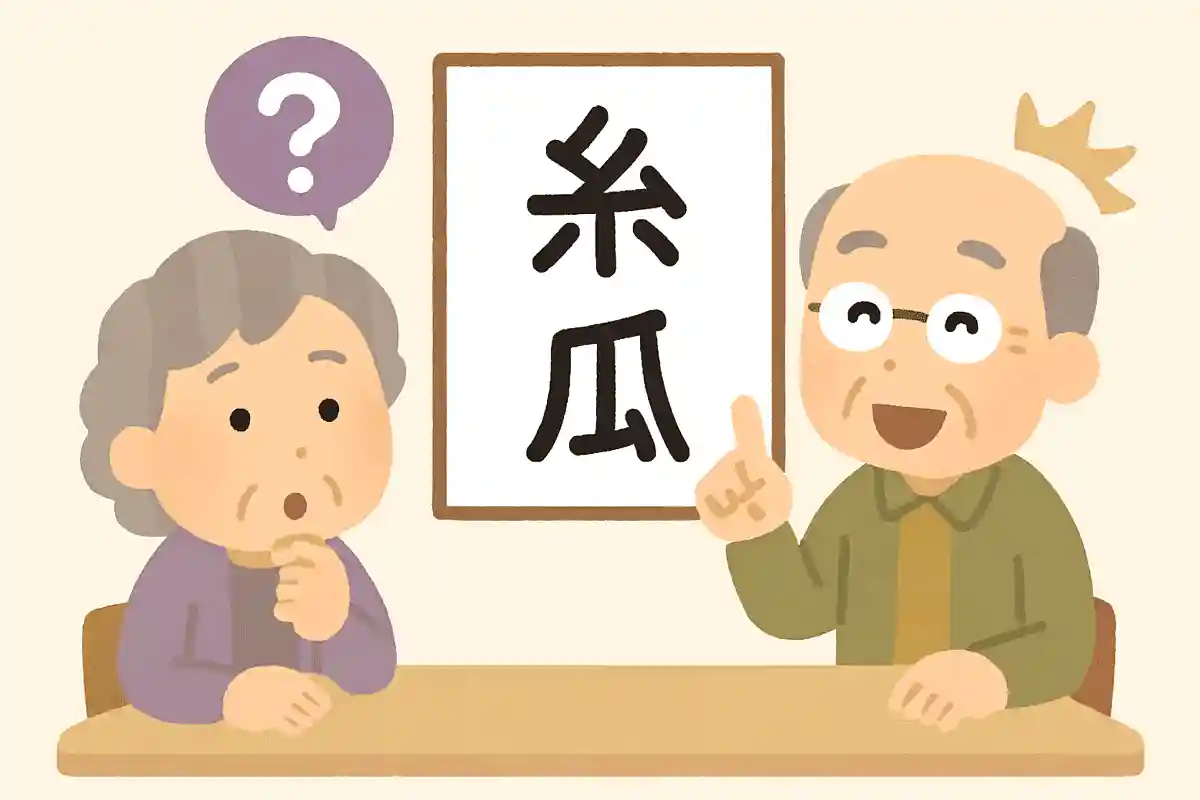
It’s a plant native to India that is said to have been brought to Japan from China during the Muromachi period.
After blooming in summer, it produces large fruits, and the name commonly refers to these fruits.
While it’s enjoyed as food, it’s also used as a skin lotion, and the fibers of the fruit are often utilized as well.
The answer is loofah; some may recognize it from the fact that it’s a member of the gourd family with thread-like fibers.
There’s also a theory about the name’s origin: “itouri” (thread gourd) was shortened to “tōri,” and since the syllable “to” falls between “he” and “chi” in the Iroha poem ordering, it came to be called “hechima,” meaning “between he and chi.”
pineapple
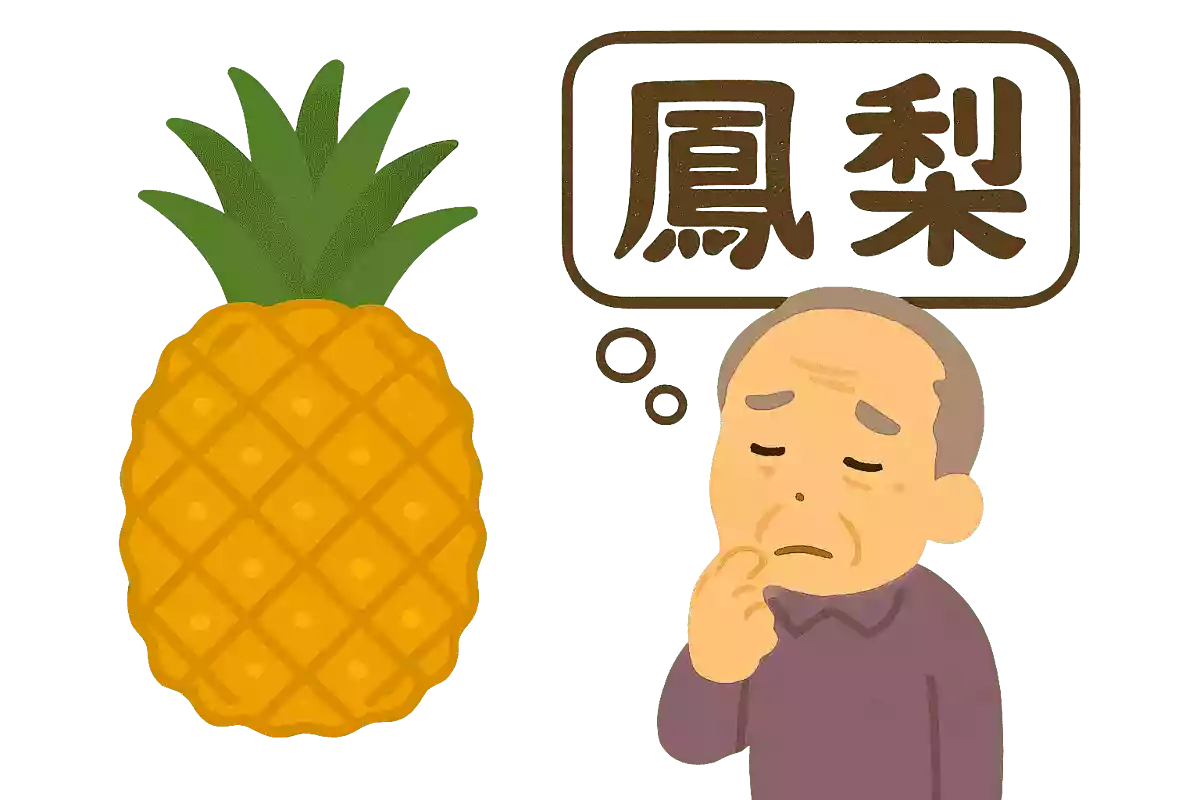
It’s a fruit strongly associated with being grown in tropical countries, and because it’s commonly written in katakana, the kanji can seem hard to read.
Some people may have seen the whole large fruit, while for many, the cut pieces or canned version might be more familiar.
The leaves and the fruit’s skin give a spiky impression, and beyond the tough rind, the sweet, refreshing aroma is another defining feature.
The answer is pineapple—a quintessential tropical fruit that you also often see in Chinese cuisine and the like.
Single-Overlaid Kanji Association Quiz

Let me introduce the “Overlapping Kanji Single-Character Association Quiz,” which features a two-step challenge: writing multiple kanji stacked in one spot, then guessing what the combined kanji makes you think of.
First, you have to decipher the kanji gathered in one place—but it won’t be straightforward.
Don’t rush; tackle them one by one.
Once you figure out the overlapping kanji, derive an answer such as something associated with that character—an object, a person’s name, or a place name.
Since it’s quite difficult, it’s a good idea to start with problems that overlap just two kanji.
Be sure to savor the sense of accomplishment when you get it right!

“Sun” + “Speech” + “Ten” + “Temple” =
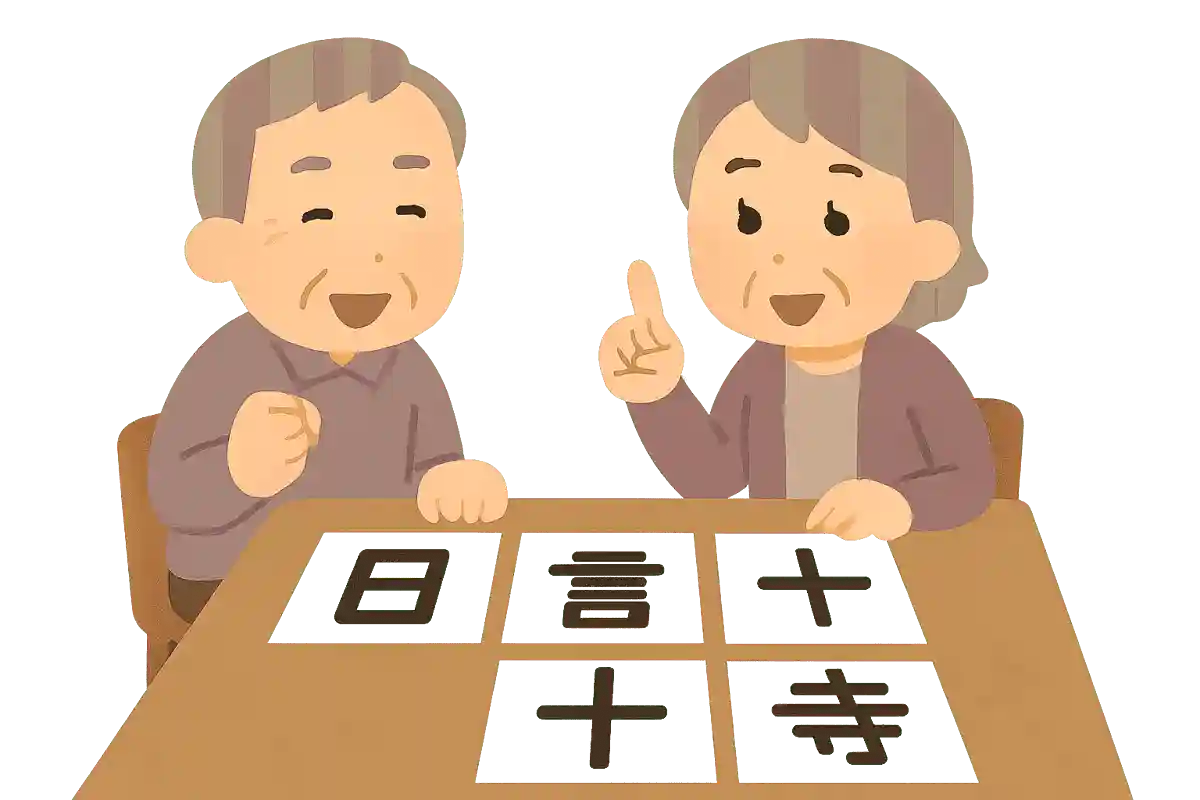
Let’s think of words that can be formed by combining the parts “日” (sun/day), “言” (speech), “十” (ten), and “寺” (temple).
If we focus on the more complex parts, “言” and “寺,” and think about where to place the other parts around them, it becomes easier to arrive at the answer.
The answer is “時計” (clock/watch).
It’s a simple pattern where the parts are placed side by side horizontally, so if someone can’t come up with the answer, offer that arrangement as a hint.
A tricky point is that when '計' is on the right, the '十' takes on an elongated form, which changes its appearance and makes the puzzle harder to spot.