

![[For Seniors] Challenging but Exciting! Kanji Quiz](https://i.ytimg.com/vi_webp/5iRyQl2CWA8/maxresdefault.webp)


In this article, we introduce kanji quizzes designed for older adults!
These quizzes are often used as activities at day service centers, and this time we’ve gathered ones that focus on kanji.
With people using mobile phones more often and being able to convert text so easily, many can read kanji but find writing them difficult, don’t you think?
It’s great to let each person think carefully on their own, and it’s also fun to solve the questions everyone’s unsure about by chatting and consulting together.
Kanji quizzes are a win-win—they train the brain and help with studying—so be sure to give them a try!
- [For Seniors] Fun and Exciting! Difficult Kanji Quiz
- [For Seniors] Lively Wordplay Game: Fun Recreation for Elderly Care
- [For Seniors] Perfect for Dementia Prevention! Jumbled Kanji Quiz
- [For Seniors] How many can you read? A comprehensive showcase of difficult food kanji
- [For Seniors] Fun! Let’s Get Excited with Japan’s Number One Quiz
- [For Seniors] Quiz on Kanji with Many Strokes
- [For Seniors] Fun and Lively! Recommended Quiz Questions
- [For Seniors] Have Fun with Wordplay Characters! A Collection of Funny Puzzles
- [Interesting] Summary of Kanji Reading Quiz Questions
- [For Seniors] Today’s recommended quiz. Daily brain-training quiz!
- [Brain Training] Lively Word Quiz for Seniors
- [For Seniors] Kanji Decomposition Quiz: Assemble the scattered characters
- [For Seniors] Fun Riddles That Stimulate the Brain
[For Seniors] Difficult but Exciting! Kanji Quiz (1–10)
Food Kanji Quiz

How about playing a slightly challenging quiz where you guess the readings of food-related kanji? Let’s prepare a wide range of questions, from easy-to-read food kanji to ultra-difficult ones.
If you join the game with friends, you’ll be buzzing with excitement—How do you read that again? What’s this one called? As you work through the quiz, you’ll also pick up knowledge about kanji, which adds a nice little bonus feeling.

Fill-in-the-blank quiz

A fill-in-the-blank quiz where you answer the kanji that fits in the blank at the center, surrounded by four kanji.
By identifying the single kanji common to all four, it can also spark deeper learning.
If the answer doesn’t come easily, offer hints that make use of the blank space.
Think from various angles—such as on’yomi and kun’yomi readings—to arrive at the answer.
You can also give hints based on the radical of the answer kanji or its first stroke.
It’s fine to play individually, but it’s also recommended to try it in teams with your day-service companions.

Proverb fill-in-the-blank quiz

How many proverbs do you know? Since we don’t really use them in everyday life, many people might not actually know that many.
That’s why I recommend a proverb fill-in-the-blank quiz.
In this quiz, part of a proverb is left blank, and you fill in the missing kanji.
This lets you learn kanji and proverbs at the same time.
Look up the meanings of the proverbs as you go and give it a try.
You can also enjoy cooperative play: one person supplies the kanji, and the other explains the meaning.

Kanji Association Quiz

This is a quiz where you guess the target kanji from various hints.
You pose questions like “Who is at the temple?” and provide clues that gradually lead players to the correct answer.
At first, you only give auditory information, but by writing the kanji for “temple” and the hints on paper or a board, you can also convey visual information.
In the end, if you give a hint like “ninben” (the person radical), players can arrive at the answer “samurai.” It’s also recommended to add systems like fastest buzzer or raising hands to make it more game-like.
Radical Guessing Quiz

This is a quiz where you answer the radical common to multiple kanji.
Let’s prepare quizzes with a wide range of difficulty, from ones anyone can answer easily to real brainteasers.
To start, try a format that’s easier for older participants, such as choosing a radical that fits two kanji.
Setting a time limit and offering gradual hints can help lead to the correct answer.
It’s also a good idea to explain the meanings and stroke orders of the radicals afterward—things that are easy to forget in daily life.
While you’re thinking of the answers, give this brain-training quiz a try!
Commonly misread kanji

Are there any kanji you see all the time but actually remember incorrectly? It’s scary how powerful assumptions can be, isn’t it? Let’s make it fun by turning commonly misread kanji into a quiz! I think many older adults also use smartphones to type, so if you’ve gotten used to relying on that, take this chance to study again.
Even if you get something wrong, there’s nothing to be embarrassed about! What matters is noticing it, so give it a try at home or during activities at your facility.

Kanji Etymology Quiz
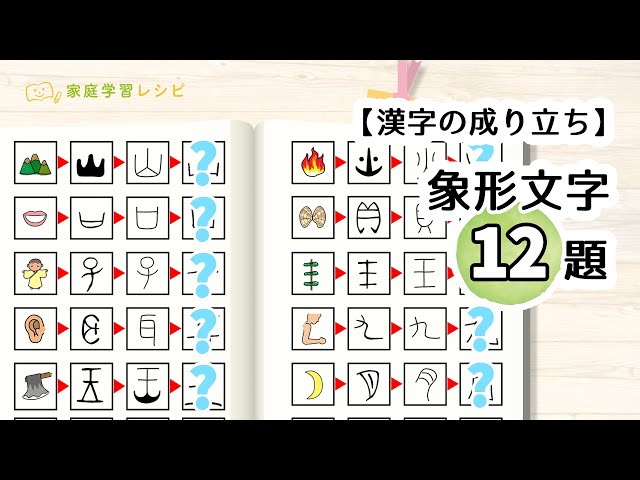
For situations where you want to recommend learning basic kanji, a Kanji Origins Quiz is ideal.
Prepare illustrations of pictographs that represent the shapes of things using dots and lines, and have students work with them.
By drawing the stages of how the illustration transforms into the kanji in sequence, learners won’t just memorize—they’ll retain it as knowledge.
Another tip is to write words that express the illustration, such as “a chain of mountains” for 山 or “a large battle axe” for 王.
Try creating a basic kanji quiz themed around the characters taught in elementary school.