

[For Seniors] Oral Exercises to Keep Eating Deliciously and Enjoyably

Daily meals are important for staying healthy for years to come.
To help older adults enjoy their meals, try actively incorporating oral exercises into your daily routine.
As we age, it becomes harder to swallow food, and the risk of choking and aspiration increases.
To help prevent aspiration, simple oral exercises before eating are recommended.
In this article, we introduce easy pre-meal oral exercises recommended for older adults.
To improve swallowing, it’s important not only to exercise the mouth but also to loosen the muscles around the mouth, as well as the shoulders and neck.
Incorporate these oral exercises and enjoy your meals.
- [For Seniors] Let's try customizing the usual Pa-Ta-Ka-Ra exercises!
- [For Seniors] Spice Up Your Usual Oral Exercises! Patakara Exercises and Tongue Twisters
- [For Seniors] Boost Oral Function with Tongue Twisters! Recommended Picks to Try
- [For Seniors] Stay Healthy Through Your Mouth with the A-I-U-BE Exercises!
- For seniors: Enjoyable exercises done while seated, accessible for wheelchair users.
- Energetic and Lively! Sing-and-Exercise Program for Seniors
- [For Older Adults] Games to Enhance Oral Function: Enjoyable and Easy to Do
- Summary of exercises for seniors: introducing preventative care movements by body part.
- [October Health Topic] Introducing Recreational Activities for Seniors!
- [For Seniors] Today’s Recommended Activity: Fun and Engaging
- [Today's Recommendation] Gentle Health Exercises for Seniors
- [For Seniors] Recommended Muscle Training Gear. Simple and Easy
- [For Seniors] Hand and finger play roundup: Finger exercises that lead to brain training
[For Older Adults] Oral Exercises (11–20) for Enjoying Delicious Eating for Years to Come
salivary gland massage
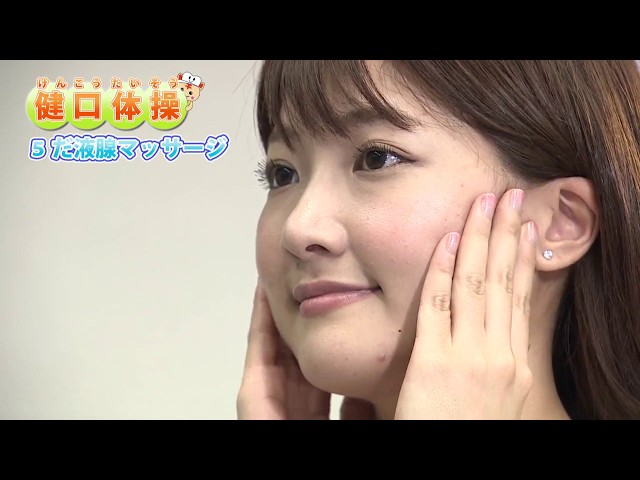
When you swallow food, you may produce less saliva and it may not pass smoothly through your throat.
This exercise aims to stimulate the secretion of saliva—essential for eating—from the outside.
It’s a simple routine in which you massage the three salivary glands with your fingers: in front of the earlobe, inside the bone below the ear, and under the tongue.
While the massage promotes saliva production, it also seems to help strengthen the facial muscles at the same time.
It might be good to stay aware of where the saliva is coming from and think about the mouth’s movements when eating.

Cheek exercises

These are exercises that strengthen the muscles around the face and cheeks—essential for chewing and swallowing.
By thoroughly training not only the inside of the mouth but the entire facial musculature, you can also develop richer facial expressions and clearer pronunciation.
The routine involves alternately inflating the cheeks with air to stretch the muscles, maintaining that state, and then releasing it.
Key points are to focus on the sensation of the muscles stretching and on the feeling of relaxation when the air is released.
By moving the air around inside your mouth, you can train areas beyond the cheeks and become more aware of your mouth movements.
Patakara exercises

This is an exercise that involves clearly pronouncing words to train the muscles of the face, starting with those inside the mouth.
By consciously focusing on mouth movements, you can strengthen your chewing and swallowing abilities while also promoting saliva production.
The exercise consists of repeatedly pronouncing each of the sounds in “pa-ta-ka-ra,” with key points being the movements of the mouth and throat muscles, as well as the tongue.
While the main goal is to improve swallowing function, the large mouth movements and clear articulation also help make speech more intelligible and enrich facial expressions.
Where are you guys from?

This is an exercise where you sing the children’s song “Antagata Dokosa” while paying attention to your mouth movements.
Instead of singing it as-is, you replace the syllable “sa” in the lyrics with “pa.” Doing so is expected to improve oral function more than singing normally.
The popping “pa” sound stimulates the inside of the mouth and helps promote saliva secretion, and because it engages the muscles well, it also brightens your facial expression.
If you sing along with hand claps and open your hands on each “pa,” it should make the exercise easier to understand and more enjoyable.
Throat-lifting exercises

This exercise focuses your attention on the normally unconscious action of swallowing food, helping you understand which parts of your throat engage and how to strengthen them.
As you swallow water, touch your throat with your hand to check how it moves, learn how the effort is applied, and aim to move your throat up and down.
The key is to gradually step up the practice—such as by reducing the amount of water—to develop a better feel for the movement.
Once you can move your throat freely, your swallowing will become more precise and smooth.
By actively moving the inside of your mouth, this exercise also helps promote saliva production.
tongue twister

Tongue twisters, where you quickly pronounce set phrases, are often seen as a way to improve enunciation.
By consciously moving the tongue and articulating words clearly, you can also train the muscles used for swallowing.
To become more aware of the tongue and throat muscles and their movements, it may be more important to move your mouth fully and focus on clear pronunciation—along with using facial expressions—rather than simply aiming for speed.
Actively moving the tongue also helps stimulate saliva production, so it’s recommended.
[For Seniors] Oral exercises (21–30) for enjoying delicious meals for years to come
Tongue exercise

To move food smoothly down the throat, it’s important to be mindful of the tongue’s muscles and movements.
If you train with awareness not only of the tip of the tongue but all the way to the base, it also helps you become more aware of how your throat moves.
A simple exercise of slowly moving the tongue from side to side is effective—the key is to move it slowly.
By taking your time, the tongue engages more strength, so while focusing on the tongue’s movement, you’re also strengthening the muscles.
This exercise not only builds the muscles used for eating, but also helps with clearer pronunciation.