

Masterpieces by Franz Schubert: Sparkling classical works left by the King of Song. Recommended classical music.


Franz Schubert, the Austrian composer hailed as the “King of Song” for leaving behind more than 600 lieder, including masterpieces such as Erlkönig and Ave Maria.
Schubert is known not only for his many celebrated songs, but also for his wide-ranging output in solo piano works, symphonies, and chamber music.
In this article, we’ve handpicked Schubert’s most popular pieces as well as hidden gems beloved by devoted classical-music aficionados.
We present a selection of sparkling works infused with the spirit of a musician who composed throughout his life.
- Robert Schumann | Introduction to his famous and representative works
- [Masterpiece Classics] A special showcase of gem-like masterpieces so beautiful they’ll move you to tears
- A poignant classic masterpiece. Recommended classical music.
- Cool classical masterpieces. Recommended classical music.
- Pick up Beethoven’s famous and representative works!
- Mendelssohn’s Masterpieces | Popular Classical Music
- Johann Strauss II | Introducing Famous and Classic Pieces
- Masterpieces by Gustav Mahler. Popular classical music.
- Mozart: An Introduction to His Signature and Popular Works
- A masterpiece by Franz Liszt. Popular classical music.
- Masterpieces of the Romantic Era: A sweeping introduction to soul-stirring, celebrated gems!
- Classical Masterpieces: Recommended Works You Should Hear at Least Once
- Carl Maria von Weber Popular Song Rankings [2026]
Franz Schubert’s Masterpieces: Exquisite Classical Works Left by the King of Song. Recommended Classical Music (91–100)
Allegretto in C minor, D 915Franz Schubert
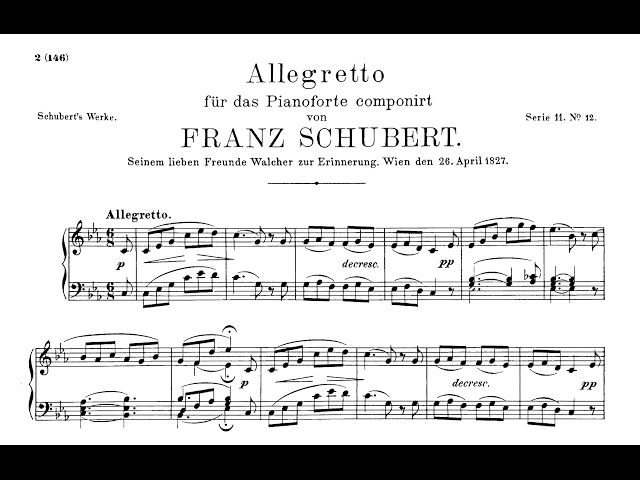
Let me introduce a short piece by Franz Schubert, known as a standard-bearer of the Romantic era.
Written on the occasion of a friend’s departure, this work is filled with the emotions of farewell and profound poignancy.
It is cast in ternary form, and the delicate balance between the main section in C minor and the middle section in A-flat major is striking.
The melody bears traces of Beethoven’s influence, while its sonorities foreshadow Schumann and Brahms—another part of its appeal.
Composed in April 1827, the piece may also reflect an elegiac tribute to Beethoven.
Even beginners at the piano can approach it: the hands often move in parallel, and the passages that shift out of sync can be mastered with slow practice.
A highly recommended piece for anyone wishing to step into Schubert’s world.
Andante in C major, D 29Franz Schubert

Andante in C major, D 29 was composed in 1812, when Schubert was still around fifteen years old.
It is said that he even wrote “September 9, 1812” on the score, making it a rare early work by Schubert in which the date of composition is clearly indicated in the composer’s own hand.
If you have basic piano technique, you should be able to play it without much difficulty, though the relatively frequent accidentals may be a bit confusing for beginners.
Because the main theme’s melody is repeated, once you’ve learned it you can play it smoothly—so keep practicing it over and over.

Franz Schubert’s Masterpieces: Sparkling Classical Works Left by the King of Songs. Recommended Classical Music (101–110)
Ellen’s Songs No. 3Franz Schubert

Ellen’s Song No.
3 is one of Franz Schubert’s most celebrated masterpieces, composed in 1825 and commonly known as “Schubert’s Ave Maria.” Its beautiful melody has long been beloved as a classic that captures the hearts of many.
In addition to being featured in Disney’s masterpiece film Fantasia, it’s a piece you’ll hear in all sorts of settings.
It’s also very popular as a choral work, so do try singing it with all your heart.
Schubert’s LullabyFranz Schubert

Schubert’s “Lullaby” is a world-famous work said to have been composed with thoughts of his mother, who died when he was 15.
It overflows with love and gratitude for her—a bidirectional song of love, from mother to child and from child to mother in thankful return.
Schubert’s LullabyFranz Schubert

Franz Schubert’s “Schubert’s Lullaby” is arguably the most famous lullaby in the world.
With its gentle, soothing melody that lulls one to sleep, it’s a very simple and beautiful piece.
The tender, unadorned lyrics—perfectly matched to the words that say, “Sleep in your mother’s arms”—leave a strong impression.
When performing a lullaby, the beauty of the sound is paramount.
Even when playing it on the piano, focus on producing a rounded, gentle tone, calm your mind, and play with tenderness.

Scherzo in B-flat major, D.593Franz Schubert

Schubert composed Two Scherzos, whose light waltz rhythm feels pleasantly buoyant, in 1817.
In terms of his creative output, that year is not generally considered particularly noteworthy, and this work, too, was not published until much later—1871, long after Schubert’s death.
The piece introduced here is No.
1.
While it features a distinctive, dance-like right-hand arpeggio, it does not demand advanced technique; it is a piece that even beginners who have become reasonably comfortable with the piano should be able to play.
SerenadeFranz Schubert

Called Schubert’s Serenade, it’s the fourth song in the song cycle “Swan Song.” Since a serenade means appealing to one’s beloved from beneath their window, this piece too faithfully pleads love to a sweetheart.
But Japanese men can’t really do something that cheesy, can they? The mood of the piece is still a love scene, isn’t it?