

[For Seniors] Enjoyable Brain Training! Proverb Quiz Collection
A traditional Japanese proverb.
It doesn’t come up often in everyday conversation, but many people remember it as general knowledge.
So this time, we’ve prepared a quiz using proverbs, designed for older adults.
By enjoying the quiz format and recalling the phrases, it can serve as brain training, and the back-and-forth of “maybe this, maybe that” will likely help communication with those around you.
Many seniors know a lot of proverbs, so they may also shine in the role of instructor.
We hope you enjoy a fun time with the proverb quiz.
- [Brain Training] Lively Word Quiz for Seniors
- [For Seniors] Proverb Quiz with Animal Names
- [For Seniors] Weather Proverb Quiz
- [For Seniors] Recommended and Exciting! Brain-Teaser Quiz Collection
- [For Seniors] Brain Training! Recall Quiz Collection!
- [For Seniors] Fun! Let’s Get Excited with Japan’s Number One Quiz
- [For Seniors] Lively two-choice trivia quiz. Handy to know and tidbits you'll want to share with others
- [For Seniors] Laugh-Out-Loud, Crowd-Pleasing! Fun Quiz
- [For Seniors] Lively Wordplay Game: Fun Recreation for Elderly Care
- [For Seniors] Have Fun with Wordplay Characters! A Collection of Funny Puzzles
- [For Seniors] Fun and Informative! Trivia and Quizzes Introduced
- [For Seniors] Today’s recommended quiz. Daily brain-training quiz!
- [For Seniors] Nostalgic quizzes that bring back memories! Showa-era entertainment and sports questions
[For Seniors] Fun Brain Training! Proverb Quiz Collection (1–10)
Don’t forget to dance until the sparrows [ ]
![Don't forget to dance until the sparrows [ ]](https://media.ragnet.co.jp/img/1200__png__/files/2025/04/217d4965036a3613b7c2e9a113595dbc.webp)
This proverb expresses the idea that habits formed in childhood do not change even as one grows older, based on the observation that the way sparrows hop remains the same throughout their lives.
Using this proverb as a starting point, it could be fun to reflect on the quirks and habits each of us has had since we were young.
From the meaning of “not changing even with age” and the word “without forgetting,” if you match words that express the passage of time, you might arrive at the answer.
The riddle’s answer is “Sparrows don’t forget their dance even at a hundred,” which is a phrase often used when calling attention to bad habits that never seem to go away no matter how much time passes.

When you have money, you even use 【 】.
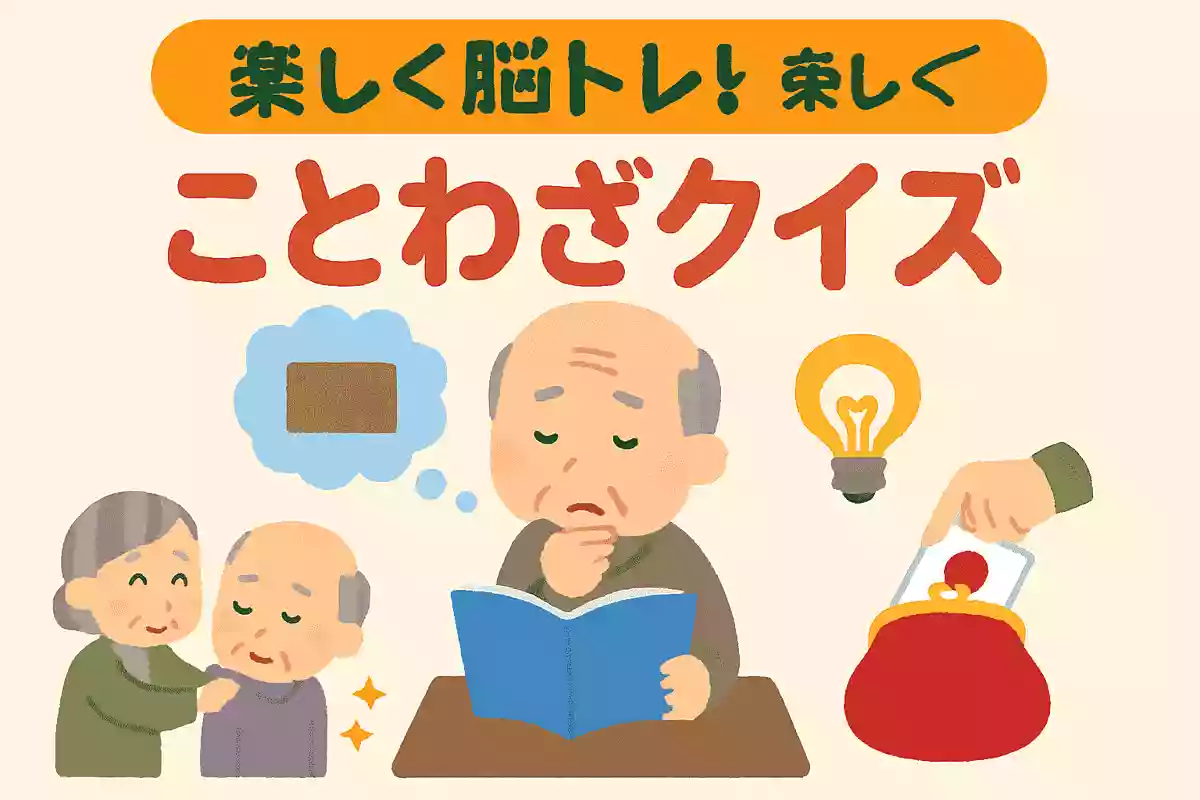
It’s a proverb that expresses the fearsome power of money—the idea that with money, you can make anything move as you wish.
Since money is closely tied to everyday life, it might be interesting to reflect on it while mixing in experiences and anecdotes related to money.
Focusing on the notion that it can move anything, if you apply words that denote things you’d normally avoid or find terrifying, you may get closer to the answer.
The intended answer is the saying “When you have money, you can even employ demons” (銭あるときは鬼をも使う), a phrase that conveys both the importance and the scariness of money.
Tighten your helmet even after a victory.

This is a proverb that teaches us not to let our guard down even after winning a battle or achieving success.
It carries the lesson that precisely when you succeed, you should tighten your focus and avoid complacency.
Considering that it’s an old proverb and thinking about what was worn during battles might help you find the answer.
The riddle points to the proverb “After victory, tighten the chin strap of your helmet” (勝って兜の緒を締めよ), which depicts preparing and securing one’s gear even after winning, without relaxing one’s vigilance.
[For Seniors] Fun Brain Training! Proverb Quiz Collection (11–20)
Like comparing a paper lantern to [ ].
![Like comparing a paper lantern to [ ].](https://media.ragnet.co.jp/img/1200__png__/files/2025/04/12abe5e9f52b976a99409d86defe6727.webp)
When it comes to proverbs that use chōchin, or paper lanterns whose soft, hazy glow soothes the heart, there’s “chōchin ni tsurigane” (a lantern and a temple bell).
It describes things that are out of balance or not even comparable.
Both a lantern and a bell hang suspended, but a lantern made of paper, cloth, and bamboo cannot compare in weight to a temple bell made of bronze—hence the saying.
In the past, it could refer to an ill-matched arranged marriage due to differences in social status, or serve as a pun implying one-sided love, since one side is “heavier.” Nowadays, you might hear the similar expression “like the moon and a soft-shelled turtle” more often.

Ema in [ ]
![Ema in [ ]](https://media.ragnet.co.jp/img/1200__png__/files/2025/04/2ed0289ebc7bcaa5bc8f1ba7fc81a5ad.webp)
The phrase “a monkey with an ema (votive tablet)” means a well-matched pair.
Because monkeys were believed to be guardians of stables, farmers in the past would paste papers bearing the character for “monkey” (申) on their stables.
It’s also said that at New Year and festivals, ema and talismans depicted monkeys leading horses.
Since this combination was considered auspicious, the proverb came into being.
It’s a celebratory saying often used as praise, similar to expressions like “plum blossoms with the nightingale” or “a lion with peonies.”
to hoist one’s [banner] on one’s strong point
![to hoist one’s [banner] on one’s strong point](https://media.ragnet.co.jp/img/1200__png__/files/2025/04/00857c9b086514013be468c26942b451.webp)
Hoisting your sails when the wind is in your favor in your area of expertise—“Ete ni ho o ageru”—means seizing a golden opportunity and throwing yourself into it with enthusiasm.
Like raising sails to catch a tailwind so you won’t miss the chance, it describes making full use of an opening to make a leap forward.
It appears in the Edo Iroha Karuta, a set of proverb cards from the late Edo period, and seems to have been commonly recited at the time.
There are several synonymous expressions that include “sail,” such as “junpū manpan” (smooth sailing) and “oite ni ho o ageru” (to hoist one’s sails with a following wind).
Reflecting on your life through proverbs might even spark lively stories about your youthful zeal for taking on challenges.
under the willow
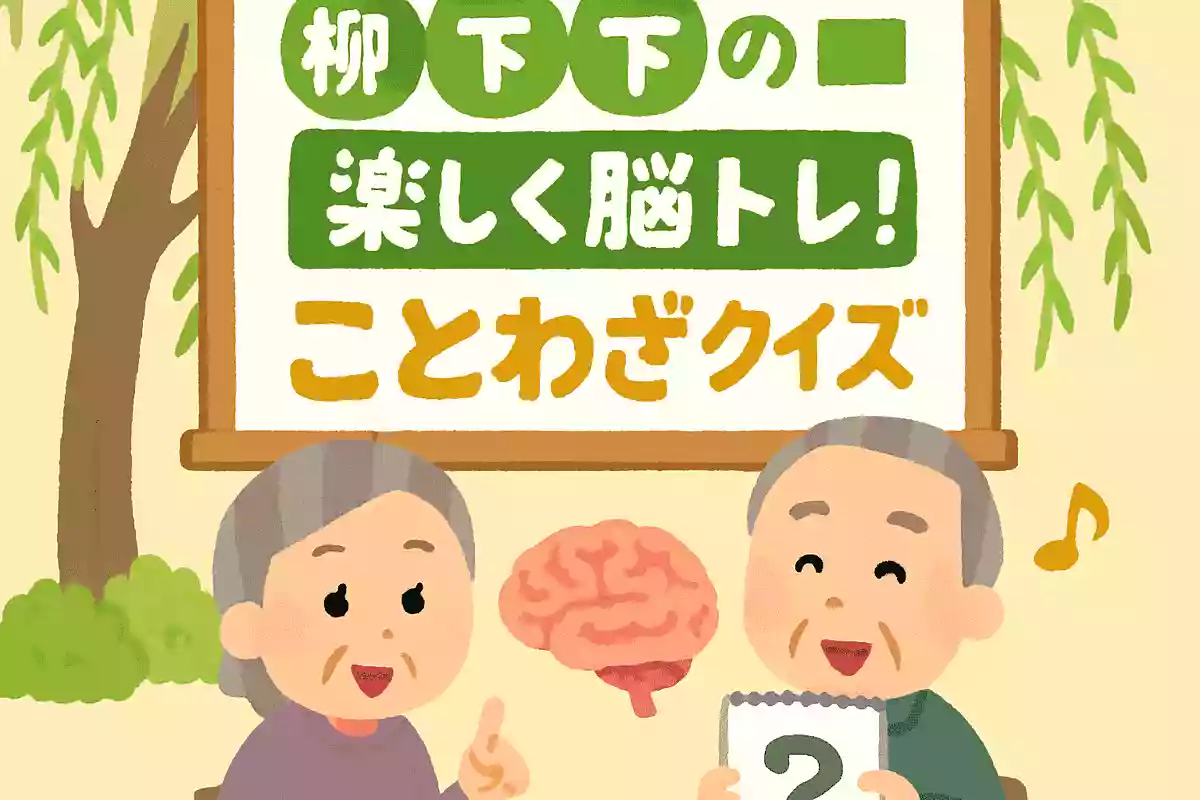
It’s a proverb that means even if you succeed by chance, repeating the same method won’t necessarily lead to success again.
If you think about what you might find under a willow tree that would make you feel successful, the discussion can get lively as everyone shares their own ideals.
Since the range of answers seems broad, it’s recommended to focus on the word “willow” and expand your ideas to things like dish names that use the kanji for willow.
The answer to the riddle is likely “dojo under the willow” (yanagi no shita no dojo), and it’s a proverb that might bring to mind Yanagawa-nabe.