

Challenging tongue twisters: Introducing high-difficulty phrases and sentences!

Tongue twisters exist in every country.
I think everyone in Japan has been familiar with them since childhood.
This time, I’ve picked out only the especially difficult tongue twisters.
You’ll find not only long, complicated ones, but also very short tongue twisters that are surprisingly hard to say.
Although tongue twisters might seem like they’re just for kids, adults can enjoy them too at parties or drinking gatherings.
If you practice in advance, you might even become the center of attention in those situations.
Now then, please sit back and enjoy!
- Tongue twisters that will make you laugh out loud! Super funny
- [Diction Training] A Collection of Tongue Twisters to Improve Articulation
- A collection of long tongue twisters. Also recommended for practicing announcements and narration.
- Nagoya dialect tongue twisters are exquisite! A fun collection where your tongue gets tied in knots with regional dialects
- Can you say them? A collection of Hakata-dialect tongue twisters
- Challenge together! A roundup of word games for adults
- “Chau chau, anta” — a Kansai-dialect tongue twister. A phrase only Kansai folks can say.
- [Recreation] Challenge! A roundup of tongue twisters recommended for elementary school students
- [Challenging and Fun!] Quizzes & Riddles for Adults
- Chinese tongue twisters: A collection of rao kou ling helpful for learning Chinese
- Perfect for pronunciation practice! A collection of English tongue twisters.
- [Trick Quiz] Quiz Questions That Excite Everyone from Kids to Adults
- Get Caught? Or Not!? Simple Ways to Kill Time During Class
Difficult tongue twisters. Introducing high-difficulty phrases and sentences! (51–60)
Please buy me a KitKat.

There’s a famous Hakata-dialect tongue twister: “Kittokatto kattotte tte ittotato ni nande kattotte kurenkattato, tte iwareta kengā Kitto Katto kattokanto ikankattato ni kattekutto wasuretottaken, mata kaigiya ikanto ikanken ga mendokusaka.” It’s quite long, so even just reading it is tough.
In short, it means: “They wanted me to have bought a KitKat in advance, but since I forgot to buy it, now I have to go buy one—what a hassle.”

I heard Kayō Yamamoto used to go to this high school.

There’s a relatively short and easy tongue twister: “Koko no kōkō ni Yamamoto Kayo ga kayottottarashii ken ne.” Yamamoto Kayo is a local TV personality active mainly in Fukuoka and beloved by locals.
In the tongue twister, it means “It seems Kayo Yamamoto used to attend this high school.” It’s a tongue twister that really reflects Fukuoka, especially the Hakata dialect.
If it feels hard, try taking a quick breath at the ‘ga’ part.
In the wide corridor of a Roman prison, a sixty-six-year-old man wanders nervously, holding a candle.

The tongue twister that goes, “In the wide corridor of a Roman jail, sixty-six old men wander nervously with candles,” is an unusual and rather long one that’s pretty hard to memorize! I mean, even the first half—“the wide corridor of a Roman jail”—is hard to picture, right? (lol) And then it says “sixty-six old men wander nervously with candles,” but what on earth are those elderly men doing walking around with candles inside a jail…? It really makes you wonder.
As a tongue twister, the repeated ‘ro’ sounds make it quite a challenge!

Monkeys stabbing bamboo leaves, monkeys getting stabbed by bamboo leaves, monkeys getting stabbed by bamboo leaves, monkeys rubbing.Kenta Otani
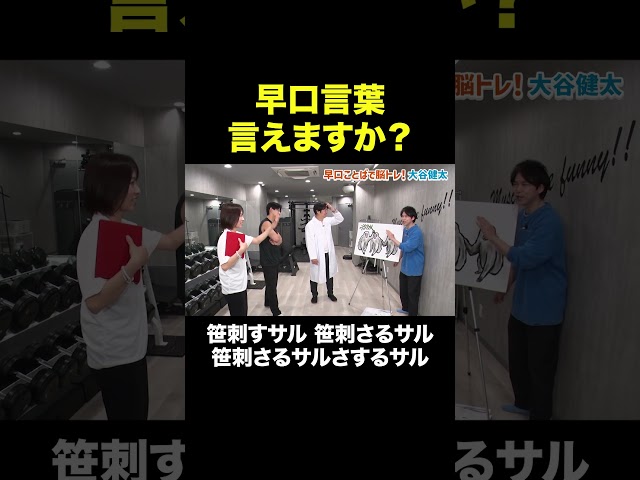
It’s a tongue twister depicting three monkeys: one monkey stabbing bamboo leaves, one monkey being stabbed with bamboo leaves, and one monkey rubbing them.
Part of the fun is that you can’t really tell why anyone would be stabbing bamboo leaves in the first place—the background is a mystery.
In any case, it’s a tongue twister packed with consecutive sa sounds, so proceed while figuring out where other characters slip in.
Be careful not to stumble on the intervening r sounds when you’re too focused on sa.
It’s important to check your mouth shape and airflow as you pronounce it.

Tokyo Patent Approval Bureau

One famous tongue twister is “Tokyo Patent Approval Bureau.” The tricky part is that similar-sounding words—tōkyō, tokkyo (patent), and kyoka kyoku (approval bureau)—come one after another.
People especially tend to get mixed up between “Tokyo” and “patent.” And even if you get through “Tokyo patent,” the “approval bureau” that follows is hard to say! By the way, the Tokyo Patent Approval Bureau is a fictional government agency; in reality, patents are filed with the Japan Patent Office.
Keep practicing, and try to master it!