

Tongue twisters that will make you laugh out loud! Super funny


Tongue twisters used for play and articulation practice.
Whether you’re just having fun or trying to improve your diction, you might as well enjoy it! In this article, we’ll introduce tongue twisters that make wordplay fun and interesting.
We’ve gathered tongue twisters that let you feel the charm of language—some with delightful word sequences that make you want to say them out loud, and others that are amusing even if you don’t quite understand the meaning.
They can also be used for children’s play or oral exercises for older adults, so please use them as a reference!
- Challenging tongue twisters: Introducing high-difficulty phrases and sentences!
- [Recreation] Challenge! A roundup of tongue twisters recommended for elementary school students
- [Diction Training] A Collection of Tongue Twisters to Improve Articulation
- Nagoya dialect tongue twisters are exquisite! A fun collection where your tongue gets tied in knots with regional dialects
- Witty quotes that make you chuckle without thinking
- “Chau chau, anta” — a Kansai-dialect tongue twister. A phrase only Kansai folks can say.
- Can you say them? A collection of Hakata-dialect tongue twisters
- [For Seniors] Boost Oral Function with Tongue Twisters! Recommended Picks to Try
- The magical power of words that make people laugh! A collection of quotes that lighten the heart
- Challenge together! A roundup of word games for adults
- [Trick Quiz] Quiz Questions That Excite Everyone from Kids to Adults
- [Rec] Interesting! A roundup of wordplay games
- A collection of long tongue twisters. Also recommended for practicing announcements and narration.
Long Text & Continuous Challenge Tongue Twisters (1–10)
I’m Bob, I’m Bob, I’m Bob

It’s a simple line where a person named Bob just states his name, and the brisk pace up to the final word is what makes it funny.
Although the phrase is made up of the shared vowel sounds “o” and “u,” the presence or absence of the voiced consonants in “ku” and “bu” creates a tongue-twister effect.
For voiced sounds, how you move your lips is crucial, and it’s important to pay close attention to how you place them against your teeth as well.
First, clearly pronounce each sound—including the shape of your mouth—and then gradually increase your speed while staying mindful of the transitions.
That’s the recommended approach.

I leaned bamboo against this bamboo fence because I wanted to lean bamboo against it.

Among the many types of tongue twisters, one that is known to be especially difficult is: “Kono takegaki ni take tatekaketa no wa, take tatekaketakatta kara take tatekaketa.” Put simply, it evokes the image of bamboo being propped against a bamboo fence.
Once you understand what kind of situation it’s describing, you’ll be less likely to get confused.
That said, it’s quite a long tongue twister, so memorizing it is no easy task.
Start by reading it repeatedly to commit it to memory.

Long Text & Consecutive Challenge Tongue Twisters (11–20)
A singer came and told me to sing, but I would sing if I could sing like a singer; since I cannot sing like a singer, I will not sing.
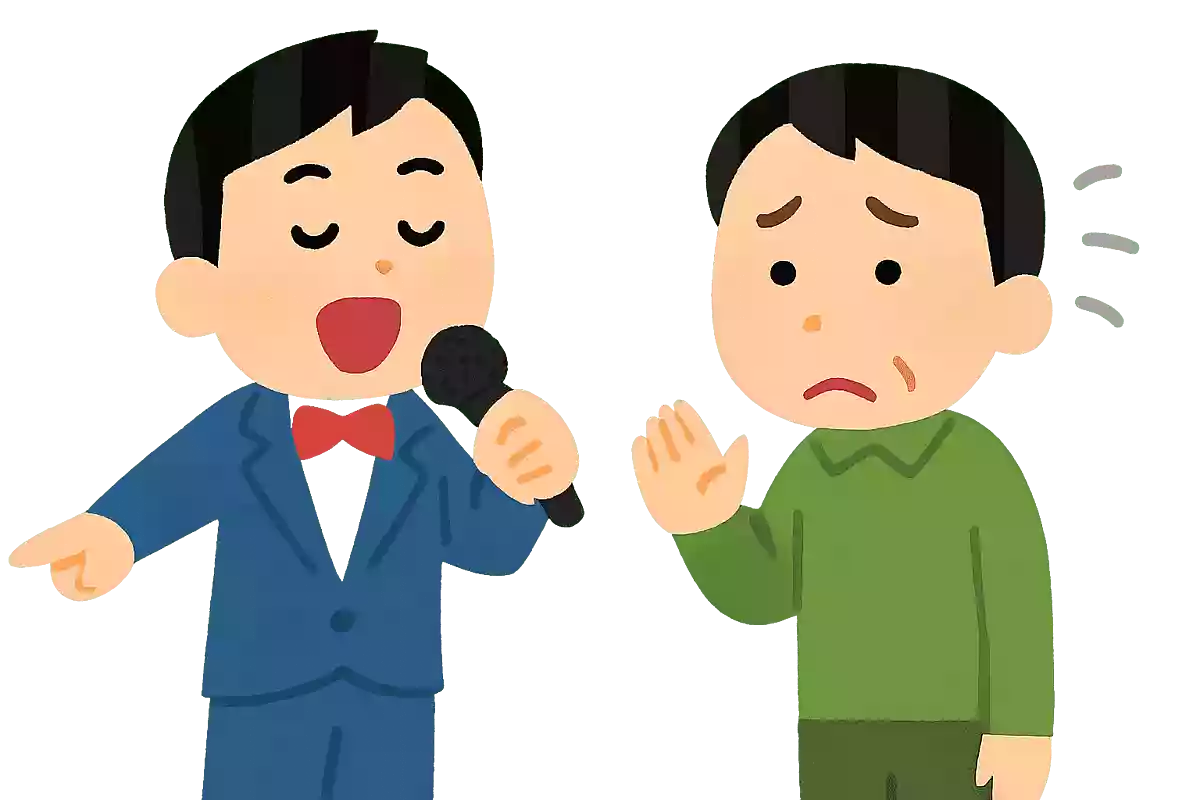
Here’s a tongue twister where every word starts with “utauta.” It seems difficult, but if you tackle “utauta” as a single unit, like a rhythm practice, it might actually become relatively easy.
Also, if you keep repeating that part, your mouth is likely to get tired.
By the way, this tongue twister was used as the title of GReeeeN’s fourth album, and there’s a song with that title as well, so if you’re interested, give it a listen.

If you are going to dance, learn the principles of dancing and dance in accordance with those principles.

This tongue twister, which starts with a phrase reminiscent of the Tokyo Ondo lyrics, is actually easier to say smoothly than you might expect if you think about the structure of the sentence and where the accents fall.
If you place the accent on dōri (reason) and tōri (street/way) and draw them out a bit, it becomes easier to balance the sentence and it gets simpler—so give it a try.
Still, there are so many tongue twisters in the world; it makes you curious about who comes up with them and how, doesn’t it?
Pencils and sharpened points

There’s a tongue twister that uses expressions unique to the Nagoya dialect.
It goes: “Kondon toki wa tokin-tokin no enpitsu motte kan to kan.
Teka chanto kezutto kan to kan tte itto kan to kan.” The first thing that catches your attention is “tokin-tokin,” right? This word describes a pencil tip that’s sharpened to a fine point.
In the tongue twister, it’s basically saying, “Next time, I have to bring a pencil.
Or rather, I really need to make sure it’s properly sharpened, and I should say so too.” Because it includes unfamiliar dialect words, you could say the difficulty level is on the higher side.