

[For Seniors] Laugh-Out-Loud, Crowd-Pleasing! Fun Quiz


Quick wits matter! We bring you laugh-out-loud brain teasers and riddles that make you blurt out “Ahh!” or “I see!” the moment you get the answer or someone tells you the correct one.
There are plenty of riddles that are friendly and familiar for seniors, too.
If the answer doesn’t come easily, try thinking it through with the people around you, or offer small hints to guide everyone toward the solution.
Those “almost got it, but not quite” questions give your brain a great workout.
Enjoy a delightful time that brings a little chuckle and a smile the moment the answer clicks.
- [For Seniors] Fun and Lively! Recommended Quiz Questions
- [For Seniors] Guaranteed to Liven Things Up! A Collection of Brain Training Activities That Will Spark Laughter
- [For Seniors] Nostalgic quizzes that bring back memories! Showa-era entertainment and sports questions
- [For Seniors] Fun and Educational True-or-False Quiz
- [For Seniors] Have Fun with Wordplay Characters! A Collection of Funny Puzzles
- [Brain Training] Lively Word Quiz for Seniors
- [For Seniors] Lively two-choice trivia quiz. Handy to know and tidbits you'll want to share with others
- [For Seniors] Fun! Let’s Get Excited with Japan’s Number One Quiz
- [For Seniors] Trivia Multiple-Choice Quiz
- [For Seniors] Fun Riddles That Stimulate the Brain
- [For Seniors] Fun and Informative! Health Trivia Quiz
- [For Seniors] Sports Trivia Quiz & Fun Facts. Easy and Entertaining
- [For Seniors] Recommended for Brain Training! Nostalgic Showa-Era Quiz
Trivia, Fun Facts, and Tidbits (21–30)
What is the fish whose kanji is composed of the “fish” radical and the character for “spring,” and which is in season in some regions in spring?

Sawara is even used as a spring season word in haiku.
It’s written with the kanji 鰆, and in the Kansai region it is mainly in season in spring.
They say sawara has two peak seasons: spring and winter.
Sawara is a migratory fish in the mackerel family, and it changes its habitat according to the season and its growth.
Because of that, the best season varies by the region where it’s caught.
By the way, sawara is a “shusse-uo,” a fish whose name changes as it grows.
The names differ slightly between Kansai and Kanto as well.
At around 50 centimeters, it’s called names like sagochi, sakochi, sagochi, or yanagi.
In Kansai it’s called sawara once it exceeds 70 centimeters, and in Kanto once it exceeds 50 centimeters.

In the fable of the hare and the tortoise, who will win the race?
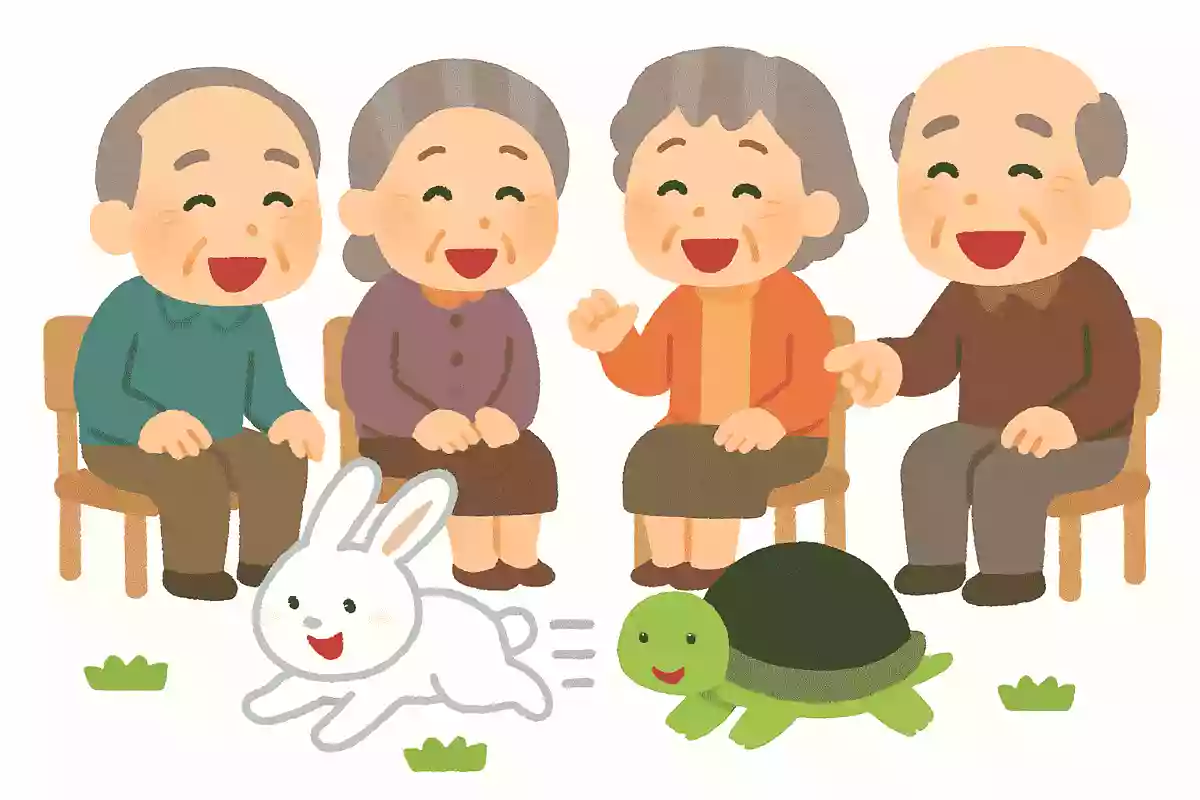
Here’s a question inspired by the famous Aesop fable, The Tortoise and the Hare.
The hare and the tortoise had a race, and the tortoise won, right? You’d expect the hare to beat the tortoise in a race.
The hare himself felt so confident that, while he was letting his guard down, the tortoise reached the finish line first.
The lesson is that even if someone else has superior abilities, steady, earnest effort can lead to great results.
If you also connect it to the children’s song “Usagi to Kame” (The Hare and the Tortoise), it could make conversations with older adults even livelier.
What is the origin of the crescent shape of gyoza?

Dumplings are made by wrapping filling in a round piece of dough and shaping it into a crescent.
Where does that shape come from? The answer is: from the shape of Chinese currency.
In China, people eat dumplings around the time of Spring Festival, the Lunar New Year, and at celebratory occasions.
One reason is that their shape resembles the yuanbao—also known as sycee or “horse-hoof silver,” a type of currency used up through the Qing dynasty—so they carry the wish, “May we be blessed with wealth.” If eating lots of delicious dumplings also boosts your good fortune, that’s the best of both worlds!

In conclusion
For riddles and brain teasers where a straightforward approach doesn’t easily yield an answer, flashes of inspiration are key! Try not to overthink—relax a bit. The answer might just pop into your head. If you enjoy these laugh-inducing riddles and witty puzzles together with older adults, the conversation will naturally liven up and new forms of communication will emerge. Be sure to incorporate them into daily life and enjoy a fun recreation time!