

[For Seniors] Laugh-Out-Loud, Crowd-Pleasing! Fun Quiz


Quick wits matter! We bring you laugh-out-loud brain teasers and riddles that make you blurt out “Ahh!” or “I see!” the moment you get the answer or someone tells you the correct one.
There are plenty of riddles that are friendly and familiar for seniors, too.
If the answer doesn’t come easily, try thinking it through with the people around you, or offer small hints to guide everyone toward the solution.
Those “almost got it, but not quite” questions give your brain a great workout.
Enjoy a delightful time that brings a little chuckle and a smile the moment the answer clicks.
- [For Seniors] Fun and Lively! Recommended Quiz Questions
- [For Seniors] Guaranteed to Liven Things Up! A Collection of Brain Training Activities That Will Spark Laughter
- [For Seniors] Nostalgic quizzes that bring back memories! Showa-era entertainment and sports questions
- [For Seniors] Fun and Educational True-or-False Quiz
- [For Seniors] Have Fun with Wordplay Characters! A Collection of Funny Puzzles
- [Brain Training] Lively Word Quiz for Seniors
- [For Seniors] Lively two-choice trivia quiz. Handy to know and tidbits you'll want to share with others
- [For Seniors] Fun! Let’s Get Excited with Japan’s Number One Quiz
- [For Seniors] Trivia Multiple-Choice Quiz
- [For Seniors] Fun Riddles That Stimulate the Brain
- [For Seniors] Fun and Informative! Health Trivia Quiz
- [For Seniors] Sports Trivia Quiz & Fun Facts. Easy and Entertaining
- [For Seniors] Recommended for Brain Training! Nostalgic Showa-Era Quiz
Trivia, Fun Facts, and Tidbits (21–30)
What is the purpose of the groove on the end of a toothpick where you hold it?

Toothpicks are commonly used in everyday life.
What’s the purpose of the grooves on the end you hold? Are they for grip, or is there some other use? The answer is: they don’t really have any special meaning.
According to toothpick manufacturers, when they sharpen the tip, the toothpicks are set in a machine and shaved at high speed.
The wood on the opposite end would get scorched and turn black, making it look bad, so they started adding grooves there as a workaround.
In the near future, if machines advance to the point where the wood no longer gets scorched, those grooves might disappear.

What is the relationship between Orihime and Hikoboshi in the Tanabata story?

The relationship between Orihime and Hikoboshi, who appear in the Tanabata legend, might be less well known than you’d expect.
In this romantic tale, Orihime and Hikoboshi long for each other from stars far apart, but what exactly is their relationship? The answer is: they are husband and wife.
They are a loving couple, but because they enjoyed being together so much that their work suffered, the Emperor of Heaven separated them.
It’s a bittersweet story in which they can reunite only once a year, on the night of July 7, by the Milky Way.

What is the most harvested fruit in Japan?

In Japan, you can enjoy a variety of fruits depending on the season.
So here’s a question: What fruit is harvested the most in Japan? Try considering factors like the season and region.
The correct answer is mikan.
More precisely, it’s the satsuma mandarin, with a total weight exceeding 740,000 tons.
By the way, the second most harvested is apples at over 660,000 tons, and third is watermelon at over 330,000 tons.
Comparing them like this really shows just how many mikans are harvested.

What is the fish whose kanji is composed of the “fish” radical and the character for “spring,” and which is in season in some regions in spring?

Sawara is even used as a spring season word in haiku.
It’s written with the kanji 鰆, and in the Kansai region it is mainly in season in spring.
They say sawara has two peak seasons: spring and winter.
Sawara is a migratory fish in the mackerel family, and it changes its habitat according to the season and its growth.
Because of that, the best season varies by the region where it’s caught.
By the way, sawara is a “shusse-uo,” a fish whose name changes as it grows.
The names differ slightly between Kansai and Kanto as well.
At around 50 centimeters, it’s called names like sagochi, sakochi, sagochi, or yanagi.
In Kansai it’s called sawara once it exceeds 70 centimeters, and in Kanto once it exceeds 50 centimeters.

In the fable of the hare and the tortoise, who will win the race?
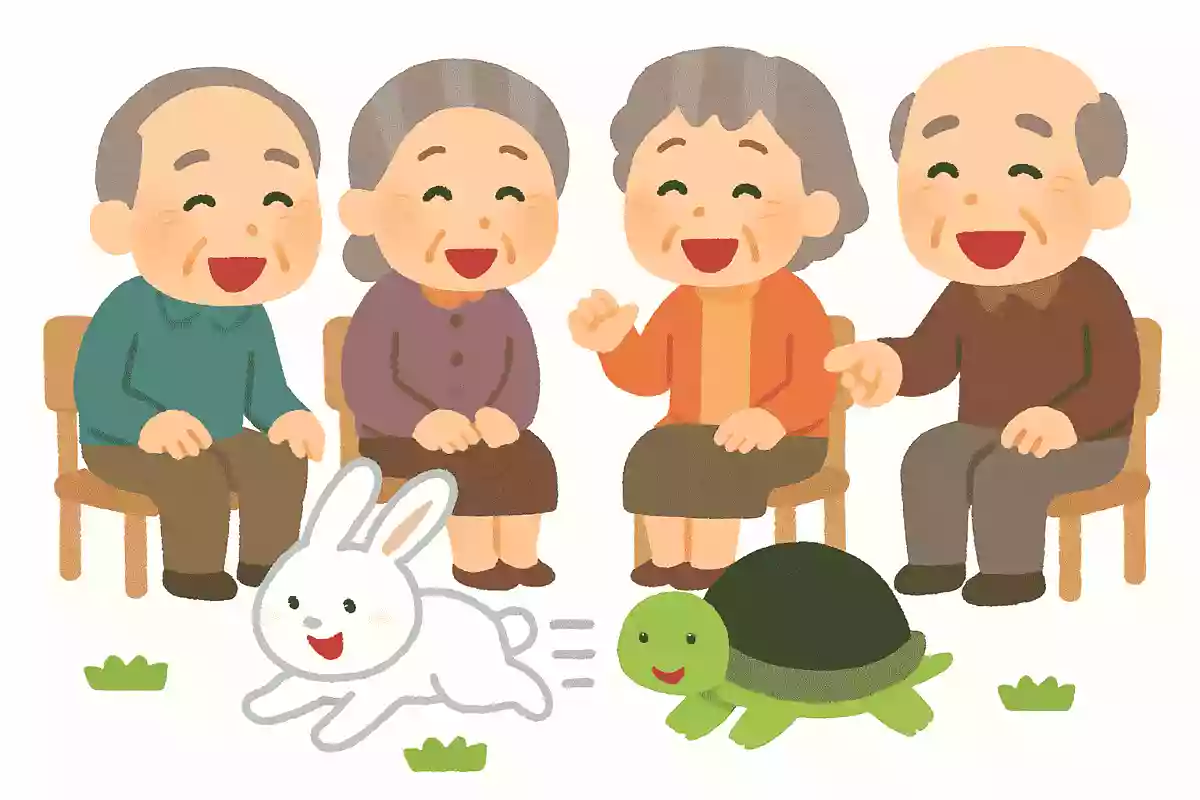
Here’s a question inspired by the famous Aesop fable, The Tortoise and the Hare.
The hare and the tortoise had a race, and the tortoise won, right? You’d expect the hare to beat the tortoise in a race.
The hare himself felt so confident that, while he was letting his guard down, the tortoise reached the finish line first.
The lesson is that even if someone else has superior abilities, steady, earnest effort can lead to great results.
If you also connect it to the children’s song “Usagi to Kame” (The Hare and the Tortoise), it could make conversations with older adults even livelier.